San Francisco: City Lights Books. 2025. 168 pages.
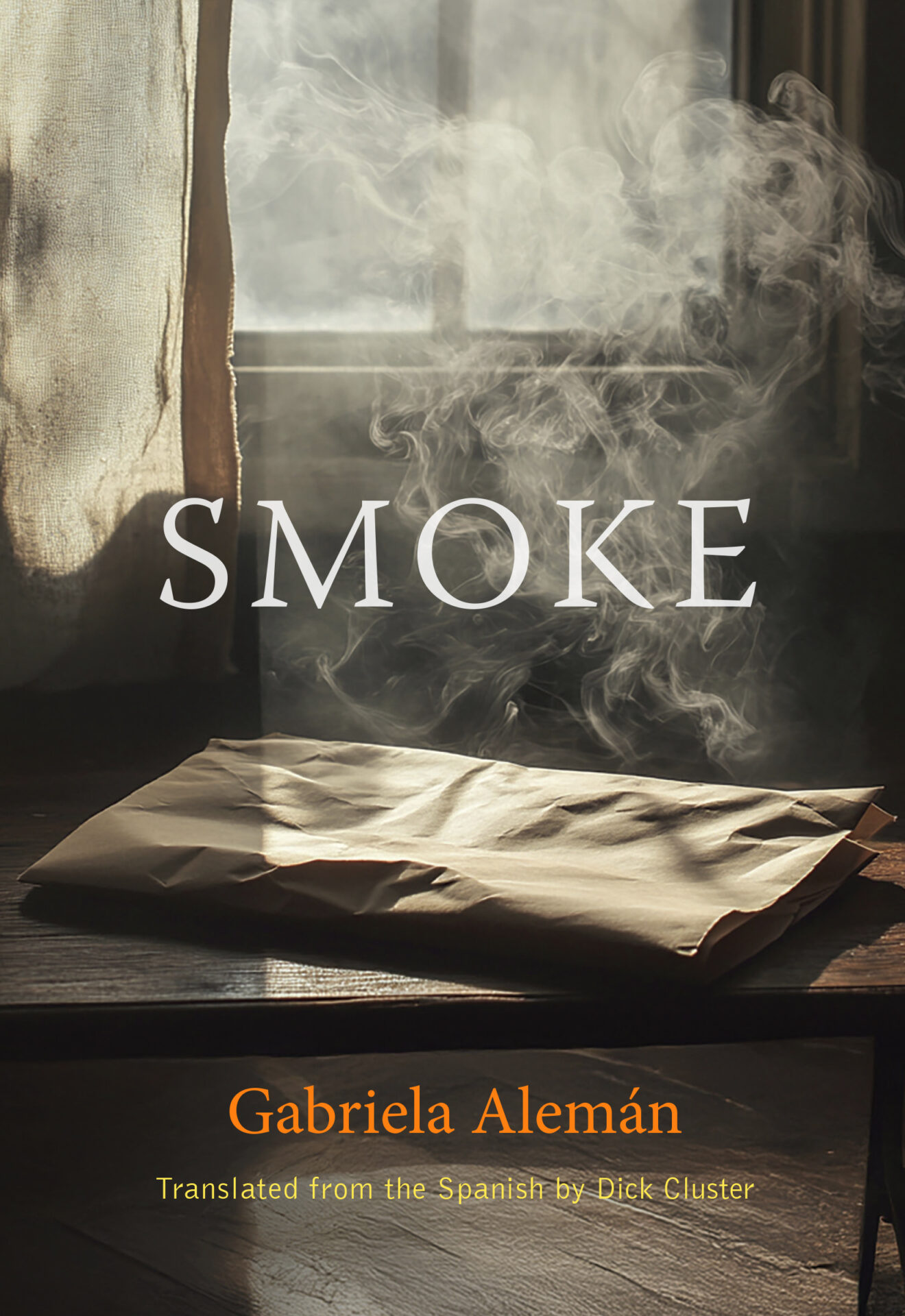 Smoke, Gabriela Alemán’s most recent novel translated into English by Dick Cluster, is primarily about Paraguay and its complicated history, but it simultaneously attracts and repels the label of “historical fiction.” The book’s title and cover art evoke a sort of mysterious literary alchemy, and Alemán, the practitioner of this alchemy, is not a Paraguayan, but an Ecuadorian born in Brazil who lived in Paraguay for a time as a student and professional basketball player. This is her third novel, and she has also published a number of short story collections, a play, and a book of essays. In an interview with Nicolás Licata for the Mexican newspaper El Universal, Alemán describes a longstanding desire to write about Paraguay: “When I lived there, toward the end of the dictatorship, the history they taught me at university and that I heard on the street was a heroic story, about winning the Chaco war, about twelve year-old boy heroes who fought against the Brazilians in the War of the Triple Alliance.” Smoke, originally published in Spanish as Humo in 2017, is the result of twelve years of Alemán’s research and questioning (the Spanish verbs indagar and interpelar come to mind) of this heroic story paraded as history.
While alternating between a present confined to a house in Asunción and a past that travels across land and sea and deep into the Chaco (this semiarid forest, equivalent in surface area to Egypt and lying across Argentina, Bolivia, Paraguay, and parts of Brazil, is an important setting in the novel), the author juxtaposes fictional characters, including a tocaya protagonist also named Gabriela, and fictionalized versions of historical figures, including the infamous military dictator Alfredo Stroessner, whose regime committed acts of terror against Paraguayan citizens and harbored former Nazis. Alemán embroiders the narrative with reproduced fragments of text drawn from political, historical, fictional, and poetic writings by other authors, as noted in the Acknowledgements (some readers may be frustrated that these reproduced passages are not noted directly in the text). Rather than a work of “historical fiction,” per se, Smoke is a literary work that indagates and interpellates the concepts of history, historicity, and historiography, while asserting the collective nature of knowledge and memory.
The novel opens in the present, where the reader witnesses the return of the character named Gabriela to a house in Asunción inhabited by the descendants of a family she knows intimately; both the house and the family seem to represent for her a combination of refuge and menace. After she arrives, Gabriela is given a parcel specifically left to her and containing a journal that belonged to the late Andrei, a Hungarian immigrant and the family patriarch. This journal is the portal through which the reader enters the past, where Andrei is revealed to have lived the life of a sort of South American Odysseus: he traverses unnavigable sections of the Chaco, attempting and failing to form a herd of domesticated ñandúes; he gets caught up in a bloody war rife with foreign meddling and exploitation; he even surpasses the Christ-like lore of Che Guevara by not just visiting a leper colony but medically treating people with leprosy, a vocation that leads him to a close encounter with Stroessner himself.
As the journal exhumes Andrei’s (and Paraguay’s) buried history, Gabriela reckons with the ways Andrei’s family has spent their familial, national, and political inheritance. The house in Asunción is not a place where she can completely relax, as an eerie sound of the scraping of claws repeatedly disturbs her. She even intervenes on behalf of a girl she discovers is being held in a room in the house against her will and whose misfortune echoes a violent episode from Gabriela’s own past. The oppressive mood of the house in Asunción mirrors the bleak pall conjured by the contents of the journal, as they underscore the familiar pattern of violence and exploitation that the Americas have faced for over five centuries. At the same time, the reader is not left with the sense that Alemán is appealing to our more morbid sensibilities or claiming Pan-American victimhood. It is as if the author is simply refusing to look away, which is perhaps the ultimate antidote to “the official story.”
“When we choose not to look away from the most brutal chapters of the past, we may find ourselves inspired, like Andrei, by how people and their stories overcome the odds to reach us in the present.”
Alemán’s writing throughout the novel, whether she is describing wild landscapes or archaic medical treatments, is like a multisensory curio cabinet. No moment, no sensation, no image is too minor for the author to portray it in detail with her masterful hand. Cluster, who also translated Alemán’s Family Album and Poso Wells into English, has rendered a superb translation, delicately handling a complex narrative laden with specific geographical, cultural, and historical references, multilingual dialogue, and texts within texts (Cluster was also awarded a grant from the National Endowment of the Arts to complete the translation). The result is a richly dense yet lucid, poetic, and moving novel that cannot help but lead the reader into a deeper curiosity about Paraguay and how its history is intertwined with the world’s:
In 1938 German troops occupy Austria; a toothbrush with nylon bristles goes on sale for the first time; petroleum is discovered in Saudi Arabia; the Soviet Union officially announces the execution of Nikolai Bukharin; Mexico and Brazil nationalize their petroleum reserves; the Vatican recognizes the government of Francisco Franco; a meteorite weighting 450 metric tons falls on an empty field in Chicora, Pennsylvania; Action Comics publishes the first issue of Superman; the Treaty of Peace, Friendship, and Borders between Bolivia and Paraguay is drafted—three years after the end of the war—with the presidents of Argentina, Brazil, Chile, the United States of America, Peru, and Uruguay acting as judges of equity, ex aequo et bono, not of law; a concentration camp is built in Mauthausen; the radio broadcast of Orson Welles’ The War of the Worlds provokes massive panic among the inhabitants of the eastern United States; Alfonsina Storni commits suicide; Alfredo Pareja Diezcanseco publishes Baldomera in Chile; Billie Holiday sings Strange Fruit at Café Society in New York: “Southern trees bear a strange fruit / Blood on the leaves and blood at the root”; Fela Kuti is born; Georges Méliès dies; MGM announces that Judy Garland will play Dorothy in the upcoming super-production of The Wizard of Oz; Paraguay, convulsed by internal struggles that sap its negotiating strength, must retreat by a hundred kilometers in the Northern Chaco; of the 31,500 sq. km. submitted to arbitration, it is proposed that Paraguay retain less than half, 14,678 sq. km.; President Paiva accedes and the treaty is signed in Buenos Aires on July 21.
In the final chapter of Smoke, as Gabriela is readying herself for her departure from the house in Asunción, pages of the journal that belonged to Andrei escape the confinement of the house through an open window and travel like leaves on the wind to different parts of the city, perhaps signifying that both Gabriela’s and Andrei’s individual memories have been assimilated into the collective memory. Early on in the novel, Andrei writes to his friend Palamazczuk: “There are ways of the past that survive. […] [T]hese people, whom I don’t know at all, they inspire me. They give me the air to breathe. Do you see the difference? […] The difference between this way—which speaks to me of life, of consolation, of a shared spirit—and the other.” When we choose not to look away from the most brutal chapters of the past, we may find ourselves inspired, like Andrei, by how people and their stories overcome the odds to reach us in the present, thanks in no small part to the efforts of brave writers like Alemán and valiant translators like Cluster.