
Basilio Baltasar (Palma de Mallorca, 1955) is a writer, editor, and journalist. He currently serves as jury chair for the Prix Formentor and directs the Fundación Formentor. As editorial director of Seix Barral, he was responsible for reviving the Premio Biblioteca Breve. He is the author of Todos los días del mundo (Bitzoc, 1994), the novel Pastoral iraquí (Alfaguara, 2013), and the essay collection El intelectual rampante (KRK, 2023). He is a corresponding member of the Reial Acadèmia de Bones Lletres de Barcelona.
Eduardo Suárez Fernández-Miranda: The first Premio Biblioteca Breve was awarded on June 14, 1958. Its aim was to “encourage young writers to join the movement for the renewal of contemporary European literature.” The prize remained active until 1972. Years later, while serving as editorial director of Seix Barral, you helped revive it. How did the idea of relaunching the prize come about?
Basilio Baltasar: The Premio Biblioteca Breve was a notable chapter in Barcelona’s publishing history. Its legendary resonance, the magnetism of Seix Barral, and the joie de vivre of its accomplices were all cultivated by nostalgia, longed for, and celebrated. In 1958, the prize was awarded to Luis Goytisolo, and later to Juan Marsé and Juan Benet. It was also bestowed upon singular figures such as Cabrera Infante, Carlos Fuentes, and Mario Vargas Llosa… The Premio Biblioteca Breve revitalized the cultural landscape, built bridges with a younger generation of Latin American writers, opened up new narrative possibilities, and sparked a unique literary effervescence. The prize formed part of the publishing house’s historical legacy. How could one not reclaim the legacy of Carlos Barral and give the prize new life in the late 1990s? Reviving the Premio Biblioteca Breve seemed inevitable to me.
E.S.F-M.: What memories do you have of your time at Seix Barral?
B.B.: At the threshold of a new century and a new millennium—before the floodgates opened onto a morbid, deranged, dystopian cycle propelled by technology’s anti-cultural phobia, when optimistic visions of the world’s future still reverberated—it was a good time. The restoration of the prize and the new energies injected into the publishing house were very much in keeping with the spirit of the era. I was fortunate to rely on an excellent professional team and on the cordiality of writers who shared in the always dangerous exercise of ambition and audacity. With Eduardo Mendoza and Félix de Azúa, we put together a delightful editorial board. It was wonderful to help steer the reinvention of Seix Barral alongside José Manuel de Lara and Imelda Navajo, who never raised any objections.
E.S.F-M.: “I hope that, before long, some scholar of the period will undertake a serious study of the history of these awards, which I fear can never again be revived.” These words by Jaime Salinas—whose prediction, fortunately, did not come true—refer to the Prix Formentor and the Prix International des Éditeurs (between 1961 and 1967, Salinas served as secretary general of both prizes). What significance did the emergence of these awards have?
B.B.: The alliance of European editors, conceived and driven by Claude Gallimard, Giulio Einaudi, and Carlos Barral—with the decisive mediation of Monique Lange and Juan Goytisolo—along with the literary wealth of the works published in their catalogues, their commitment to the challenges of creative literature, the public influence of their prestigious publishing imprints, the intellectual elite gathered in their committees and advisory boards, the prestige of traditions that in some cases dated back to the nineteenth century, and their ability to take the pulse of what was being thought, said, and written throughout Europe: all of this made the Prix Formentor something more than a literary prize given to a select few. Its beginnings could hardly have been more decisive. The dual prize awarded to Jorge Luis Borges and Samuel Beckett in 1961 became a declaration, a plan of action, a statement of intent: to establish the canon of European literature. Since then—both in that period and in the present day—this manner of understanding literature has guided the intellectual and aesthetic deliberations of the editors, writers, and critics who make up the jury of the Prix Formentor.
E.S.F-M.: The Conversaciones Poéticas (Poetic Conversations) and Coloquio Internacional sobre Novela (International Colloquium of the Novel), first held at the Hotel Formentor in 1959, were the seed of today’s Conversaciones Literarias en Formentor (Formentor Literary Conversations). Do these gatherings still maintain the same spirit as their predecessors?
B.B.: The word “spirit” aptly captures the surprising continuity of the Conversaciones Literarias held at Formentor—both in their virtuous form, when intellectuals who know how to listen take part, and in their more polemic form, when those invited to speak do so with authority. When these conditions are met, conversation recovers the artistic dimension that has sustained the history of culture. And this has been the purpose of Formentor ever since Adan Diehl, Francesc Cambó, Juan Estelrich, and Count Hermann von Keyserling inaugurated the Semana de la Sabiduría in 1931. The same was true of the Conversaciones Poéticas organized through Papeles de Son Armadans by Camilo José Cela, until they were prohibited by government authorities in 1963. And so it has remained since we revived the Formentor gatherings in 2008.
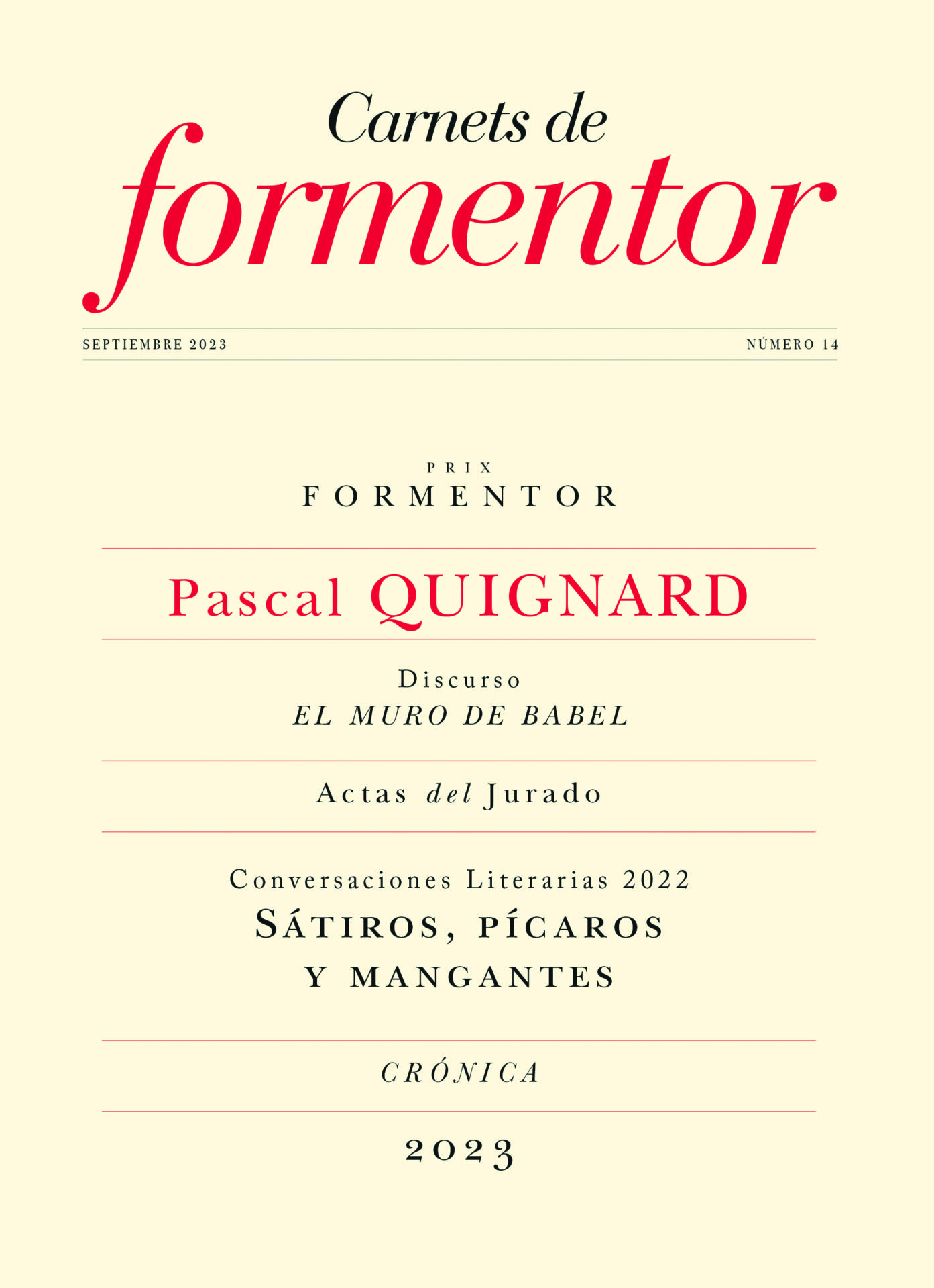
E.S.F-M.: Each year, on the occasion of the Prix Formentor and the Conversaciones Literarias de Formentor, the Carnets de Formentor are published, compiling the jury’s report, reflections by jury members on the honored writer, the acceptance speech, and conversations, along with photographs from the events themselves. How did the idea for these publications come about?
B.B.: I remember the first thing I did when I became editorial director of Seix Barral in 1998: I asked where—where were the publisher’s archives, the reports, records, contracts, originals, and manuscripts accumulated over more than thirty years of history… the correspondence! The correspondence between Víctor Seix and Carlos Barral and the authors, colleagues, and censors of the time—where was it? Nothing, nothing had survived the passage of time, the relocations, the moves, and the warehouses. Can you imagine? What a disaster! The desire to document the history of Formentor grew out of that disappointment. In the Carnets de Formentor, we publish chronicles of the Conversaciones, the proceedings and essays connected to the Prix, along with the contributions of guests, all in order to bear witness to what is said and done at Formentor—to preserve the cultural heritage of these gatherings and to leave future generations a vivid, living testimony of what has now endured for sixteen editions over the sixteen years since the Conversaciones were revived in 2008.
E.S.F-M.: Do you think the Carnets de Formentor, given their considerable intrinsic literary value, are sufficiently well known?
B.B.: Over the past fifteen years, more than five hundred speakers, writers, professors, critics, and editors have taken part in Formentor—along with a large and attentive audience. It seems reasonable to assume that Spain’s literary and publishing circles are familiar with our publications. Even so, I tend to believe that it is not always advisable to publicize what one does. If you have a mass-market product, then naturally the best course is to advertise it and sell as much as possible. Carnets de Formentor, however, belongs to a parallel circuit of readers who know how to seek out and find what they want. The Carnets have published immensely valuable texts, along with ever-enlightening speeches delivered by authors honored at Formentor. The words spoken by those who have since left us—Carlos Fuentes, Juan Goytisolo, Javier Marías, Ricardo Piglia, and Roberto Calasso—spoken at dusk in Formentor, now take on renewed meaning. The reader will find them there, intact, in the Carnets.
E.S.F-M.: The Asturian publisher KRK recently published your book El intelectual rampante, a title evocative of Italo Calvino’s Il barone rampante (The Baron in the Trees). As has been said, “the characters, figures, and authors who traverse its pages attest to the artistic power of imagination.” Kafka, Mircea Cărtărescu, Rembrandt, and Goya all pass through these pages. Is the book a kind of journey through some of your favorite cultural figures?
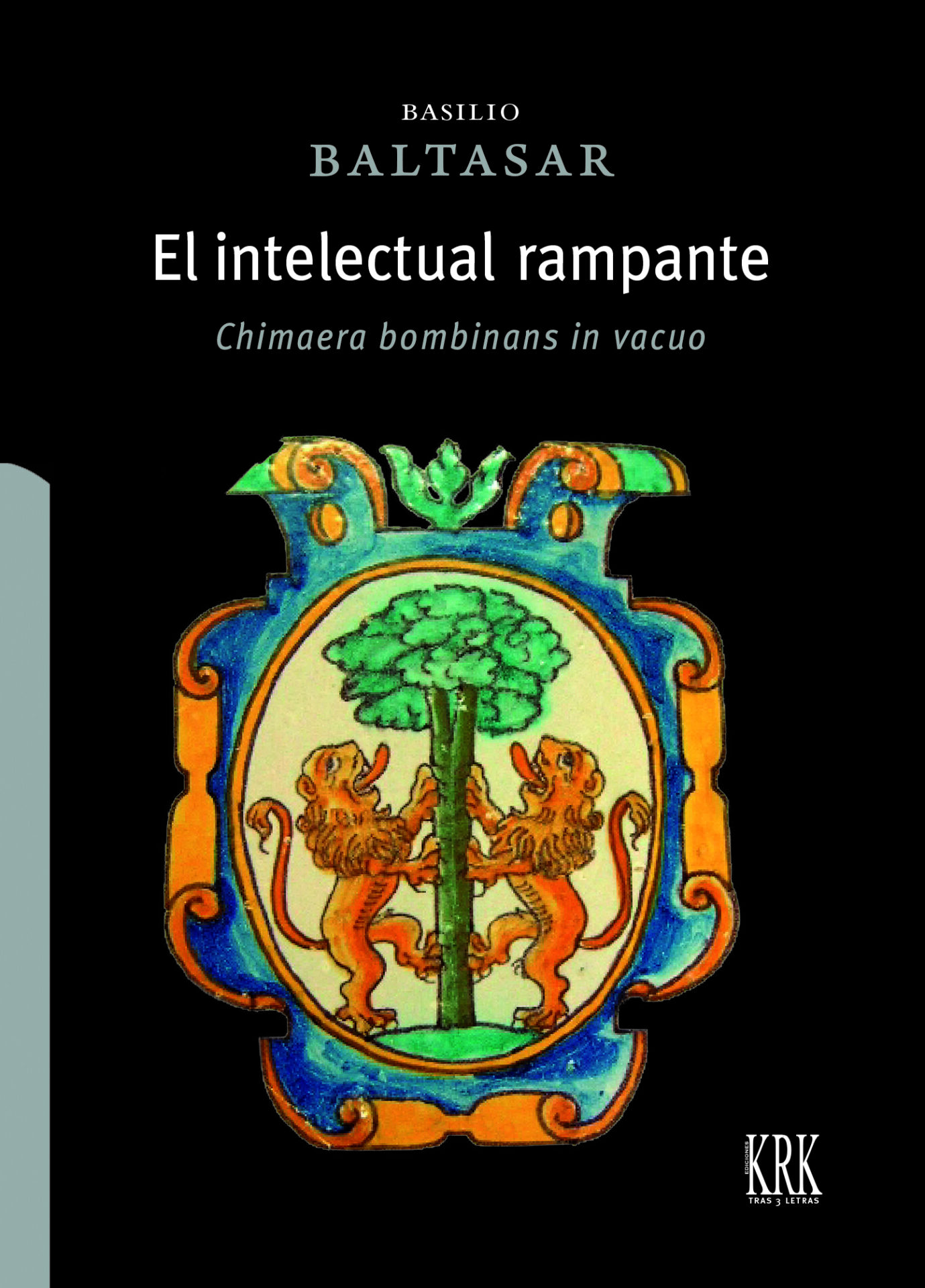
B.B.: El intelectual rampante is a collection of literary essays—some previously published and revised, others unpublished and expanded—assembled for this volume by the exquisite KRK. A reflective thread on literature and art runs through its pages. The figures and characters explored there reveal previously unseen aspects of our latent constitutions. In a way, the book seeks to answer questions that have not yet been formulated. This is what I mean by the title: the intellectual who ventures out along invisible branches.
E.S.F-M.: You once described Pastoral iraquí, published by Alfaguara in 2013, as a “journey toward the heart of darkness in the desert that belongs to all of us.” How did you come to write this novel?
B.B.: Certain images settle into the imagination of their own accord and ferment there while awaiting to be discovered—beyond reason and will, beyond the author’s purpose and narrative desire. The moral engineering of novelistic characters may well originate there. In the case of Pastoral iraquí, I might cite the androgynous Adam and the naked woman abandoned in the morgue of a Spanish barracks in Iraq. The novel is an apocryphal version of the world’s foundational narratives. The protagonist’s dream (inspired by a senile god) and the native’s fantasy (guided by an unknown god) speak to our decline. It is the destiny of a human race condemned to massacre itself. Man’s sacrificial lamb is man himself.
E.S.F-M.: Returning to the Prix Formentor, in this second phase its recipients have included Ricardo Piglia, Roberto Calasso, Cees Nooteboom, César Aira, and Liudmila Ulítskaya. What qualities do you think unite the work of these writers and make them deserving of the prize?
B.B.: The voices that make up literature’s vibrant spectrum express personality, character, and genius, resounding constantly throughout the immense universal library. The prize jury does not try to force harmony between one author and another, nor does it attempt to gather stylistic affinities. Rather, it seeks to recognize in each author the mettle with which they adopt and adapt literary heritage and the creative power with which they construct their narrative universe. The philosophy of the Prix Formentor gives shape to this search. In colloquial terms, one might ask who will win the prize, but the truth is that no one “wins” it; it is neither a sports trophy nor a decoration. It is not a competition; no one may apply or nominate themselves. The jury—which since 2011 has been made up of around fifty writers, editors, and critics—seeks out the author and their work, proposes the candidate, deliberates, sifts, postpones, and ultimately chooses. The prize is a recognition of the authors’ literary integrity and, at the same time, acts as an informed recommendation to readers.
We once said that the Prix Formentor pays tribute to masterpieces, encourages their fearless lucidity, and fosters good taste and the creative energy of literary imagination, the certainty of excellence, and cultural elegance. It sharpens the distinction between composition and writing, between cleverness and creation, invention and imagination, entertainment and knowledge. I believe this declaration clearly identifies the literary values the Prix Formentor seeks to recognize.
E.S.F-M.: You serve as director of the Fundación Formentor. Could you tell us a bit more about this institution?
B.B.: When the Barceló family purchased the Hotel Formentor in 2006, Simón Pedro Barceló—its president and a good friend of mine (during the 1990s, I had directed the newspaper El Día del Mundo, owned by his family)—wrote me a compelling letter to share the news and his intention of restoring the hotel’s glorious cultural past. With his patronage, leadership, and commitment, we set to work, and the Conversaciones Literarias were set in motion. At the time, I was director of the Fundación Santillana, and together we collaborated intensely to give the Conversaciones the momentum they have enjoyed ever since. In 2020, after fifteen years, my time with Santillana came to an end and the Fundación Formentor was established to organize the Conversaciones, the Prix (supported through the patronage of the Barceló family and the Buadas family, the former owners of the hotel), the publications, and the itinerant sessions of the Conversaciones that have since taken place in Seville, the Canary Islands, and, this year, in the Aragonese Pyrenees.
E.S.F-M.: Following Saul Bellow’s selection for the Prix International, Gabriel Ferrater stepped down as a member of the jury. Ferrater had championed the candidacy of Witold Gombrowicz, who would win the next award. At the time, the debates surrounding the selection of the prize recipient were intense. Is that still the case today, or are the deliberations calmer now?
B.B.: The editors who sustained the Prix Formentor during the 1960s conducted their deliberations with elegance and diplomacy. They had the time and space—and the patience and good humor—to defend their candidates with a vehement eloquence. However, little by little, certain difficulties began to emerge. The prize’s most notable contribution to the European literary and cultural landscape was the agreement that each editor would publish the winning author’s work in their country’s language. But how could this be done if the author’s rights were already tied to another publishing house? And what if that publisher happened to be a serious competitor in the national market? Was the allied publisher within the Formentor group expected to finance the prize while resigning itself to watching its stubbornly fortunate competition benefit from the enormous publicity? Commercial reality proved to be an obstacle both insignificant and insurmountable. Even so, I do not believe this is why Ferrater was displeased. His genius had powerful aesthetic reasons of its own. In any case, Bellow and Gombrowicz were both worth fighting over, and in the end both received the prize.
The restoration of the Prix Formentor in 2011 allowed us to establish a different format. Thanks to the patronage of the Barceló and Buadas families, the prize became an initiative independent of any outside ties. The Prix Formentor was reborn to honor literary authors writing in European languages, and each year the juries investigate and seek out the candidate who best honors the philosophy and aesthetic program of the prize. Those are the only criteria that matter. Discrepancies in criteria or priorities are resolved with good reasons—and with good humor.
E.S.F-M.: Not long ago, the Oviedo-based literary magazine Clarín closed its doors. As the founding director of the magazine Bitzoc, do you think it is difficult nowadays for a print magazine to survive?
B.B.: When the general public finally comes to understand the aberrant cognitive atrophy that screens produce in the minds of their children—and when they take away the tablets now recommended by educators and sold by every kind of expert—there will be a massive return to the healthy habits fostered by books in print. People will then understand that books and print magazines provide us with the tempo and disposition required for reading comprehension and for the aesthetic pleasure of reading—without burning our retinas or unsettling our neurons. The editors, printers, and booksellers who continue to resist today, and who have already happily witnessed the defeat of the artifact known as the “ebook”—a triumph worth reflecting upon—will see their efforts rewarded and the path leading readers toward intellectual fulfillment set back on course. In the meantime, let us try to contribute to this front of cultural resistance with clear heads.
E.S.F-M.: Pascal Quignard was one of the most recent recipients of the Prix Formentor. What can you tell us about the French writer?
B.B.: Earlier we spoke about the contents of the Carnets de Formentor, including the essays that jury members dedicated to the work of the author honored at Formentor. Each member of the jury addresses different aspects of Quignard’s literary imagination, and together the published reflections allow for a circular and transversal approach to a complex and profound body of work.
I can quote here a passage from the jury report, a synopsis of the qualities that led us to celebrate Pascal Quignard’s candidacy:
“For the mastery with which he has reclaimed the genealogy of literary thought, for the skill with which he eludes textual banality, and for having brought forth the most unexpected dimensions of writing… for the extraordinary elaboration of metaphysical, anthropological, historical, artistic, and philological legacies, and for the composition of his great treatise on the literary enigmas of the human soul… the jury awards the 2023 Premio Formentor de las Letras to Pascal Quignard.”
Translated by Iyan Smith Williams
Buy books by the authors and translators featured in this issue on our Bookshop page!
Photo: Spanish writer and editor Basilio Baltasar, by Cati Cladera.