Hablemos, escritoras: Episode 706
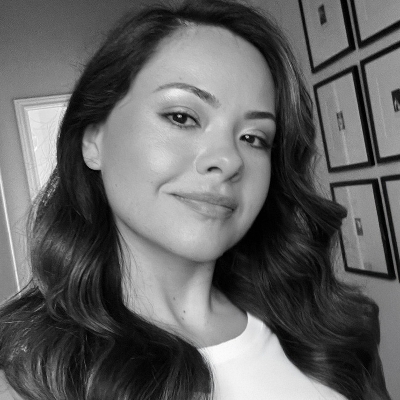
Cynthia Rimsky (Santiago, Chile, 1962) is a Chilean writer, journalist, and academic living in Argentina. Her work is characterized by a hybrid form of writing that moves between travel chronicle, autobiography, autofiction, and essay. Her books explore themes such as memory, displacement, identity, and contemporary forms of storytelling. Her literary debut came with the novel Poste restante (2001), inspired by a personal journey through Europe after finding a family photo album at a Persian market. Since then, she has developed a body of narrative work that combines research, travel, and autobiographical exploration. In 2024 she published Clara y confusa, a novel that won the Premio Herralde de Novela, making her the first Chilean woman to receive this award and the second Chilean person after Roberto Bolaño.
This is an adapted excerpt from a conversation on the Hablemos, escritoras podcast, hosted by Adriana Pacheco.

Adriana Pacheco: It is a pleasure to welcome Cynthia Rimsky today, a journalist and academic with a truly singular body of work. In this conversation, she tells us how humor has saved her from melancholy and how she sees curiosity as a form of knowledge. Cynthia, welcome to Hablemos, escritoras.
Cynthia Rimsky: Hello, thank you. Thank you very much for the invitation.
A.P.: I would like to begin by talking about the Premio Herralde de Novela that you won with Clara y confusa. What excitement, what joy. What did receiving this prize mean for you, Cynthia?
C.R.: It was very surprising, because I was going through a somewhat sad moment, where I had some trouble publishing, because they said my books were hard to understand or that they were heavy. So I was going through a kind of energy slump, because my latest novel published in Argentina had been rejected; they found it a bit too complex. And when the Herralde came, it was like a surprise, it was like saying, no, that’s not true, I don’t have to be sad, it’s not like that. One has to find one’s readers. So it was a pretty big boost at that moment. And also in terms of readers, it was as though my readers, those more anonymous readers, whom I say are like scattered castaways, suddenly found themselves together and somehow supported me, I feel.
A.P.: How did you begin in literature? You spent some time at the newspaper El Mercurio, right?
C.R.: Well, since I was little I wanted to be a writer. I remember graduating from journalism school, moving to Valparaíso, doing my internship at El Mercurio, from which I was fired. I hold the honor of being the first journalist whose internship was rejected, and I tried to write and couldn’t. I believed that in literature one had to express oneself, that it was about expressing what one feels, and it is actually the opposite. Because I expressed what I felt and then read it, and it was not what I felt, because words are not vehicles, they are living entities. So it’s not as though they will simply say what one wants them to say. It was a very long process until a friend, I always tell this story, gave me a travel book by Walter Benjamin, where he talks about many things, and then something changed, as though lightning struck me, and I happened to take that trip. So instead of looking inward, I began looking outward, and outside I found my inside, so I learned how to look.
A.P.: Cynthia, you were born in Chile, but you live in Argentina; two countries where there was repression under totalitarian systems and dictatorships. How does literature recover the memory of something like that?
C.R.: For me it is important not to remain with the idea of recovering linear, direct memory, but rather to question it. I am interested in questioning the “goodness” of the left, that everyone was good, saintly, and the others were the bad ones. Digging a little deeper into that. I always say that one must begin from forgetting. The work seems more enriching to me in terms of forgetting, because it allows fiction to work more than memory, especially a memory that becomes official so quickly.
A.P.: I find it more interesting to work with forgetting. Of course. There are even things that are forgotten, that people want to forget, and sometimes forgetting them is almost imposed.
C.R.: I think that precisely at one point during the dictatorship, when freedom of expression was so difficult, or when it was so difficult to combat that dictatorial “truth” that nothing was happening, that there were no disappeared people, that everything was wonderful, literature found itself compelled to write things in a more direct way, without much work on language. But today, now that there is some temporal distance from that, I think there is a richness there to take advantage of. To ask other questions.
A.P.: Of course. Cynthia, let’s talk about your writing, let’s talk about Clara y confusa. You have said that at first you only had the title and nothing else. Tell us about this strategy of beginning to break down an idea and then creating the characters, giving them a name, a face, a space, situating them.
C.R.: Yes, I work quite a bit like that, almost blindly. I am very interested in that state of moving forward blindly. And I had the title because they had told me that my texts appearing in newspapers, as a journalist, were confusing. So I decided, after reading a beautiful book called Fallar otra vez by Alan Pauls, to confront that confusion, because in that book Pauls proposes that there are certain writers who have a kind of flaw and who have managed to make that flaw their focus. So I said, well, if my flaw is that I am confusing, I am going to embrace it. And I asked myself, what will happen with clarity? I think what happens is that when one is very locked into an idea of a novel, there are many things that occur to you but that you set aside because you are trapped inside one idea of a novel. On the other hand, when you have nothing inside, when you have no idea of a novel, things begin to come to you as though you were a magnet, they begin arranging themselves on their own. I mean, this question I had always asked myself, why do some artists with such valuable work achieve popularity while others are never, ever recognized? And suddenly I remembered a character, Clara, who was an artist. And I said, well, there’s a character. Then I was obsessed with plumbers and I met a plumber who was incredibly handsome and kind of melancholic, and I loved him. And I said, okay, I have a plumber, I have an artist, why can’t a plumber fall in love with an artist? Then I remembered an image I had seen at the beach. Well then, what if I begin with this image? And it was like giving free rein to whatever was happening to me and whatever ideas came to mind.
A.P.: How beautiful! Of course, well, that is an invitation to read your work because if you begin a book like that, then it really is worth it. I’m fascinated. Cynthia, I see in your work a literature of travel, but you also have a very interesting focus on objects, on things. There is a kind of object-centeredness in the way you write and reconstruct. How do you think about constructing a story through objects?
C.R.: Well, I think things are connected in some way to your biography. I remember that my grandmother’s apartment was full—they were immigrants from Ukraine and Poland—full of objects, full of all kinds of objects, and they would go take a nap and I would stay there inventing stories with those objects. There was a camel, I remember, there was a dancer who danced with a music box, and there was a tapestry with a pyramid, and I would imagine myself going to those places and inventing stories that happened there, usually adventure stories, and I think it comes from there. I am interested in that type of thought that is constructed in that way. Being a child, I think, the passage through childhood or life was fundamentally about discovering what the world was like, right? It was like arriving here, having no idea what things are, and needing to name them. I see curiosity as a form of knowledge.
A.P.: Cynthia, I feel that writers born in the sixties—and I have several names that come to mind, Rosa Beltrán, Sandra Lorenzano, Carla Suárez, Ana García Bergua, and so many who were born in that decade—have this very much in common in their work: a great capacity for experimentation, but grounded in curiosity and observation. It seems to me there is much less of this writing of the self, with exceptions always, and I think there is much more of a gaze directed outward, toward context, toward surroundings. Do you feel there is also something generational there? Because all of them, including you, are great readers, and they primarily base their writing on reading, and only afterward do they write.
C.R.: Tentatively, I think we were like the last fold in this idea of the writer, who is a person who searches, who discovers, who thinks, and not a person with fame, with all these promotional activities, with arriving on the scene and publishing in order to become an influencer, I mean, with everything so immersed in this commercial side of literature. And also, like the last generation that believed literature had a role in bringing about change, that took itself seriously in that sense, as agents of change, that a book could change someone’s mind, for example, change someone’s life. I think we saw the writer as a rather secluded person, not as someone who has to go everywhere constantly circulating among journalists or the press. I think there is something there connected to the figure of the writer, that we were like the last link in that. And also, there was a distinction between intimacy, a barrier or separation between intimacy and writing and public exposure, which today no longer exists. And there is also something about literary formation, I mean, I think all of us were formed by the Russians, by the existentialists, by Marguerite Duras and—I mean, there is a formation rooted in those classics that obviously produces something different.
A.P.: Moving on to another topic. In your book El futuro es un lugar extraño you are talking about the Chilean dictatorship, and you have said that you do not write about politics; however, this book, which you wrote in 2016, is now reaching ten years since publication. As a Chilean who has seen everything that has happened in Chile in recent years, perhaps if at some point you had to rewrite this book, would you add something more, something you feel would now update it in relation to what is happening in Chile and in other countries regarding dictatorships and totalitarian systems?
C.R.: No, I don’t think so, because perhaps I would write—in fact, I am now writing a book that will most likely be set during the dictatorship—I think perhaps I was left with some questions that I will probably work through now. But in that book, what I proposed to myself, which was something new for me, was that I did not want any kind of explanations about the dictatorship, nor descriptions of the dictatorship. What I wanted was to bring readers, even for one second, into that space so they could feel through the senses, through emotion, what it is like to live under a dictatorship. Something very small that I wanted, and at the same time, well, something quite enormous.
A.P.: Cynthia, several of your books have been translated, and these translations open up these pathways. What do you think about the topic of translation?
C.R.: I question translation. For example, what gets translated from Latin America for Europe or for the United States, and what does not? Thinking before about the boom, or about this fantastic literature that they liked so much, and now, for example, it’s horror, mystery, crime fiction, or politics. I say this because there was a publishing house that at first wanted to publish Clara y confusa, an important English-language publishing house, and then they said no, that the editorial committee had said no, that the story of a plumber was too insignificant. There is also something about translation: what is exported? Which perspective gets exported? And one has to pay attention to that.
A.P.: In your books you mix genres. There is chronicle, autobiography, essay, and fiction. That hybrid writing in your work is incredibly rich. Tell us a little about this curiosity as well, this impulse to jump between genres and not cling to just one.
C.R.: Perhaps it has to do with the way I work, because inspiration does not descend from the heavens for me; rather, I have to search for it. And in searching for it I go toward real elements. And I manipulate them, so I think it is a kind of search that expands through all materials.
A.P.R.: What is humor in literature for you?
C.R.: Humor has saved me from a great deal of melancholy, because my first books were very melancholic. My father was deeply melancholic and at one point I said no. There is something here, this suffering, this thing about nostalgia that does not work for me. Well, and my great readings were also very nostalgic. And I began to ask myself why I didn’t transfer that into literature. And instead of looking at the sadness of things, I looked at misunderstanding, or I looked at the tension between appearance and form, between what people thought and what they truly believed. And I began shifting my gaze toward that place, and it seemed incredibly interesting to me because I think people were even getting somewhat bored of the tone of denunciation. Besides, I love it because writing itself is tense and requires a lot of work, until one also begins to laugh while working, so laughter begins to become incorporated into your own work, and that is very encouraging.
A.P.R.: Cynthia, what a pleasure, thank you so much. This has been a most delightful and enriching conversation, and you leave us curious to read your books.
C.R.: Thank you very much to you as well.
Translated by Andrea Macías Jiménez