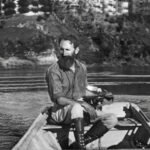
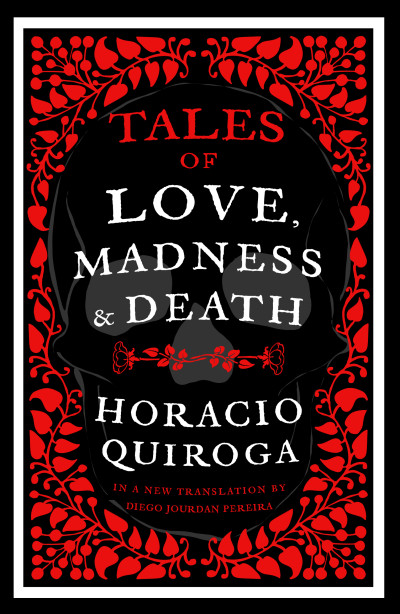
An extraordinary writer whose work has long been woefully neglected in English translation, Quiroga’s tales—and the life of the writer behind them—are a fever dream of morbidity and horror. Frequently compared to the works of Edgar Allan Poe, this avant-garde collection is staggeringly modern in its content, and is suffused with the themes and settings of his later works.
Quiroga’s first published short-story collection, Tales of Love, Madness and Death is presented here in a brand-new translation, and also includes his lauded tongue-in-cheek “Ten Commandments for Short-Story Writers,” readying some of the great writer’s finest work for a new generation of readers.
Tales of Love, Madness and Death is available now from Renard Press.
BARBED WIRE
(El alambre de púa)
For a fortnight, the sorrel horse had searched in vain for the path through which his partner was escaping the paddock. The formidable hedge—consisting of inextricably interwoven bushes—didn’t even allow enough room for the horse’s head to get through. Evidently, this was not where the chestnut was getting through.
Then he walked around the farm, trotting uneasily with his ears on high alert. From the depths of the woods, the chestnut responded to his partner’s vibrant neighing—his calls short and brief, no doubt the fraternal promise of abundant fodder. It was most irritating for the sorrel to see the chestnut reappearing two or three times a day to drink. When he came back he promised not to abandon his companion an instant, and truly, for a few hours they fed in admirable harmony. But suddenly, the chestnut would plunge into the bushes with its rope in tow, and when the sorrel realised he had been left alone and set off in pursuit he found the hedge to be impregnable. That said, from within—very close, even—the wicked chestnut responded to his desperate neighing with a satisfied neigh of his own.
But that morning, the old sorrel found the opening easily. Crossing in front of the brick wall which protruded fifty metres into the field from the woods, he saw a faint diagonal pathway leading into the forest. There was the chestnut, munching leaves straight from the trees.
It had all been very straightforward. Crossing the brick wall one day, the chestnut had found a gap in the hedge caused by an uprooted bush. He repeated his journey until he knew perfectly well how to reach the entrance to the tunnel. Then he used the old path he and the sorrel had carved along the edge of the woods. And herein lay the sorrel’s difficulty, as the entrance to the path joined their pathway so diagonally that—used as he was to walking it south to north but never north to south—it took him a while to find the opening.
He joined his partner in an instant, and together, with no other concern than clumsily munching the young palm trees, the two horses decided to get further away from the field they already knew so well.
The woods, quite thinned out, allowed for easy passage, even for horses. In truth all that was left of the forest was a two-hundred-metre-wide expanse. Behind it, a two-year-old clearing adorned itself with wild tobacco. The old sorrel—who had spent six months of his youth prancing around such pastures—led the way, and in half an hour the tobacco plants were stripped of leaves, as far up as a horse’s neck could reach.
Walking, eating, perusing, the sorrel and the chestnut crossed the clearing, until a barbed wire fence stopped them.
‘Barbed wire,’ said the sorrel.
‘Barbed wire indeed,’ said the chestnut.
And both looked over the top, watching attentively. From there they could see a tall grazing pasture, white with frost, a banana plantation and a new plantation. None of this was very tempting, no doubt about it; but even so the horses followed the fence to the right.
Two minutes later they found a gap—a tree, ravaged by fire, had fallen over the wires. Traversing the whiteness of frozen grass, which muffled their steps, and around the reddish, frost-scorched banana plantation, they discovered what these new plants were up close.
‘It’s maté,’1 stated the chestnut, his lips trembling half a centimetre away from the leathery leaves.
Disappointment couldn’t have been greater; but the horses, although greedy, aspired above all to roam free. So they continued on their way, cutting diagonally through the maté field, until a new wire fence brought them to a standstill. Going around it with sombre and patient ease, they reached a gate—which stood open, to their joy—and the visitors suddenly found themselves in the middle of a main road.
Well, now, to the horses what they had just accomplished seemed quite the feat. From the boring paddock to this present freedom lay an endless distance. Yet, infinite as it was, the horses wanted to extend it even further. So, after lazily surveying their surroundings, they cleaned the dust from each other’s necks, and in meek happiness they continued on their adventure.
In truth, the weather motivated their happiness. The morning haze in Misiones had just fully dissipated, and under the newly clear skies the landscape glittered with magnificent clarity. From the hill the horses now stood on, the red dirt road cut the prairie before them with admirable precision, descending into the white valley of frozen wire grass and climbing back up a faraway hill. The wind—very cold—crystallised the golden morning even more sharply, and the horses, feeling the still, nearly horizontal sun, squinted at the glorious splendour.
They continued like this—alone and drunk with freedom—down the dazzlingly bright road until, rounding the corner of the hilltop road, they saw an unusually green expanse stretching away from the path. Grass? No doubt—and yet it was the middle of winter…
With their nostrils dilated with gluttony, the horses approached the barbed-wire fence. Yes, fine grass, admirably so! And they, free horses that they were, would go in!
It must be said that the sorrel and the chestnut, since early that morning, had held themselves in high regard. No gate, no wire fence, no woods nor clearing was an obstacle to them. They had seen extraordinary things, surpassed unbelievable odds, and they felt contented, proud and empowered to make the most outlandish decision they could devise.
In this heightened state, they saw a number of cows standing on the side of the road a hundred metres away, and trotting over there, they arrived at the gate, blocked by five robust logs. The cows stood still, staring at the unreachable green paradise.
‘Why don’t you come in?’ the sorrel asked the cows.
‘Because it isn’t allowed,’ they answered.
‘We can go anywhere,’ the sorrel boastfully asserted. ‘Since last month we’ve been finding our way wherever we want.’
Their glistening adventure had made the horses lose track of time.
The cows wouldn’t even look at the intruders.
‘Horses cannot,’ said one cheeky heifer. ‘They claim they can, but never make it through. We do.’
‘They are roped,’ added an old mother, without turning her head.
‘Well, I am not roped!’ exclaimed the sorrel quickly. ‘I used to live in clearings, and have been through many.’
‘Yes, after us! We go through and you cannot.’
The cheeky heifer intervened again. ‘Master said the other day, “A single wire will keep horses away.” What then? Can you go through?’
‘No, no we can’t,’ replied the chestnut simply, convinced by evidence.
‘But we do!’ maintained the cows.
To the honest chestnut, however, it suddenly occurred that the cows—daring and cunning, unrepentant violators of farms and the Code of Good Agricultural Practice—wouldn’t pass the gate either.
‘It’s an evil fence,’ objected the old mother. ‘But he can! He can dislodge the gate logs with his horns.’
‘Who?’ asked the sorrel.
All the cows turned their heads to him, astonished.
‘Midge,2 the bull! He’s stronger than any wicked wires.’
‘Wire fences…? Really?’
‘Everything! Barbed wire, too. We go in after him.’
The two horses, reduced to the peaceful condition of animals a single wire can contain, felt naively dazzled by that hero who was capable of facing barbed wire, the most terrifying obstacle their desire to go through could happen across.
Suddenly, the cows moved away tamely. The bull arrived at a slow pace, and before his flat, obstinate brow, which directly pointed towards the gate, the horses humbly accepted their inferiority.
The cows moved apart as Midge, passing his head under the lock, tried sliding it aside.
The horses raised their ears in awe, but the bolt would not budge. The bull tried removing the logs, one after another, but to no avail. The farmer, happy owner of the oat plantation, had fastened them securely using wedges the previous evening.
The bull ceased his efforts. Turning lazily around, he sniffed into the distance, half-closing his eyes, then grazed the barbed wire with his ribs, uttering muffled hissing grunts.
From the gate, the horses and cows stared. The bull came to a halt and passed his horns under the barbed wire, stretching it upwards violently with his head, and the huge beast slid under it, arching his back. Four more steps set him among the oats, and then the cows also headed over, trying to pass under the fence themselves. But cows evidently lack the male disposition which tolerates bloody scratches on the hide, and as soon as they slid their neck under, they swiftly withdrew, with a dizzying nod.
The horses kept looking on.
‘They can’t go through,’ observed the chestnut.
‘The bull could,’ replied the sorrel. ‘He’s bingeing.’
As the horses set off and followed the fence as they were so used to doing, a lowing, clear and bellowing, reached them. In the oat field, the bull was bellowing at the farmer and feigning lunges at him, as the farmer tried to hit him with a stick.
‘Ah! I’ll give you prancing!’ yelled the man.
Midge, always dancing and bellowing at the man, dodged his blows.
And so they feinted for fifty metres, until the farmer managed to force the beast against the wire fence. But the bull, with the muscular determination his brute strength allowed, sunk his head below the wire and passed through, under a sharp violin of wires and barbs thrown twenty metres away.
The horses saw how the man rushed to his home, and came out again with a pale face. They saw him jump the fence and walk straight in their direction. Faced with such a determined step, the companions retreated along the road towards the ranch. As the horses walked meekly a few steps ahead of the man, they were able to arrive together at the farm belonging to the bull’s owner, listening in on their conversation.
It was evident, as far as the horses could ascertain, that the farmer had suffered a great deal at the hands of the rancher’s bull. Plantations—no matter how deep into the woods—and barbed wire—no matter how great their tension, or how numerous the threads—were all overwhelmed by the marauding bull. They also inferred that the neighbours were fed up with both beast and owner too, due to the incessant destruction. But since the country folk rarely brought animal-related complaints before the Justice of the Peace, no matter how destructive, the bull continued to gorge himself everywhere but on the farm of his owner, who, on the other hand, seemed quite amused by this fact.
In this way, the horses saw and heard the following exchange between the irate farmer and the negligent Pole.
‘This is the last time, Don Zaninski, that I come to see you about your bull! He trampled all my oats! I can stand it no more!’
The Polish rancher, tall and blue-eyed, spoke with an extraordinary mellow falsetto.
‘Ah, bad bull! Not my responsibility! I tie it, but it escapes! Cows are to blame! The bull follows them!’
‘As you well know, I don’t own any cows!’
‘No, no! Ramírez’s cows! Make my bull crazy!’
‘And the worst thing is that it loosens all the wires – you know this too!’
‘Yes, yes, wires… Ah, I don’t know!’
‘Well, look, Don Zaninski, I don’t want any trouble with my neighbours, but for the last time, try and have a care for your bull so it doesn’t get through the fence at the back. I’m going to build a new one along the road.’
‘Bull uses the road! Not back!’
‘Well, now it won’t cross the fence.’
‘Bull will get through! Never mind barbs! Gets through anything!
‘It won’t.’
‘What are you installing?’
‘Barbed wire—but it won’t get through.’
‘It doesn’t do anything, barbs!’
‘Well, do your best to keep it out, because if not he will hurt himself.’
The farmer left. As before, the wicked rancher—laughing once again at the animal’s grace—pitied his neighbour for even attempting to build an impregnable wire fence against his bull. Sure enough, he rubbed his hands.
‘He won’t be able to complain this time around if the bull eats all of his oats!’
The horses rejoined the road that took them away from their farm again, and after a while they reached the place where Midge had accomplished his feat. The beast stood motionless in the middle of the road, staring with solemn emptiness at the horizon for a quarter of an hour or so. Behind him, the cows were dozing in the blazing sun, chewing the cud. But when the poor horses passed by, they opened their eyes in contempt.
‘It’s the horses. They wanted to get through the wire, and now they are roped.’
‘Midge did get through!’
‘A single wire will keep horses at bay.’
‘They are skinny.’
The latter seemed to upset the sorrel to his core, who turned his head.
‘We are not skinny—you are. Anyway, this isn’t going to happen again,’ he added, pointing to the fallen wires, Midge’s work.
‘Midge always gets through! Then we do. You don’t.’
‘It won’t happen any more. The farmer said so.’
‘He will eat that man’s oats. We will follow.’
Due to their better treatment by us, horses are noticeably fonder of man than cows are. So it stands to reason, then, that the sorrel and the chestnut had faith in the new wire fence the farmer was going to install. The partners went on their way and, moments later, before an open field, they lowered their heads to eat, forgetting about the cows.
Later, when the sun had just set, the two horses felt a craving for corn, and turned back. On the side of the road they saw the farmer changing all the fence posts, and a blond man on horseback by his side, watching him labour.
‘I’m telling you it will still happen,’ said the rider.
‘He won’t try it twice,’ replied the farmer.
‘You will see! It’s all a game for that damned Polish bull! It will get through!’
‘Not twice,’ the other repeated stubbornly.
The horses continued on their way, still hearing the odd broken phrase.
‘…last laugh!’
‘…we shall see.’
Two minutes later, the blond man trotted past them in the English style. The chestnut and the sorrel, a little surprised by the unfamiliar step, watched the hurried man vanish into the valley.
‘Would you look at that!’ observed the chestnut after a while. ‘The horse is trotting and the man is galloping!’
On they went, reaching the top of the hill, as they had that morning. Against the pale, cold sky, the meek, downcast silhouettes stood out in black, the chestnut in front, the sorrel trotting behind. The atmosphere, bleached in daytime in excessive sunlight, acquired during twilight an almost funereal transparency. The wind had ceased completely, and with the calm of the evening, when the mercury began to fall, the frozen valley’s dampness expanded, and condensed into a trailing mist in the shadowy depths of the slopes. From the cooled ground, winter’s burnt grass stench blew back, and as the road skirted the hills the atmosphere suddenly became colder and damper, and excessively heavy with the heavy perfume of orange blossom.
The horses walked through the gate of their farm, since the boy, who was banging their corn feeder, heard their panting. The old sorrel had the honour of being credited with the initiative of their little adventure, and was whipped with a rope as a consequence.
But the next morning, quite late, on account of a dense fog, the partners repeated their escape, crossing the wild tobacco field again, imprinting their hooves into the frozen grass with mute steps and crossing the still-open gate.
The sun already high in the sky, the morning reverberated with light, and the excessive heat promised a change in weather conditions. After crossing the hills, the horses suddenly saw the cows standing on the road, and the memory of the previous afternoon roused their ears and their trot—they wanted to see what the new wire fence looked like!
But when they arrived their disappointment was great. Stretched across the new dark and crooked posts there were two simple barbed wires. They were thick, perhaps, but only two in number.
Despite their stoic audacity, a life lived on the farm had given the horses some experience of enclosures. They gave it a closer look—especially the posts.
‘They are made of fine wood,’ observed the chestnut.
‘Yes, burnt edges.’
And after another long examination, he confirmed: ‘The wire goes through the middle – there are no staples.’
‘They are pretty close to one another.’
Close indeed, at three metres. But these two modest wires, replacing the five strands of the previous fence, were a let-down for the horses. How was it possible that the man could think such a fence suitable only for calves would stop a fearsome bull?
‘The man said he wouldn’t pass,’ dared the chestnut nonetheless. Being his master’s favourite, he ate more corn, which made him feel smarter.
But the cows had overheard him.
‘It’s the horses. Both roped. No dice. Midge already went through.’
‘He did? Through here?’ asked the disheartened chestnut.
‘Out the back. He will get through here too. He ate the oats.’
Meanwhile, the loquacious heifer tried passing her horns through the wires; and a sharp vibration, followed by a sharp blow on the horns, left the horses in suspense.
‘The wires are really tense,’ said the sorrel after a long examination.
‘Indeed. Couldn’t be more tightly stretched…’
And both of them, without taking their eyes off the wires, thought confusedly about how they could pass between them.
Meanwhile, the cows cheered one another on.
‘He got through yesterday. Went through the barbed wire. We will follow.’
‘You didn’t follow yesterday, and you won’t do so today,’ they heard the sorrel say.
‘Here’s the barbs, and Midge shall pass! Here he comes!’
Skirting the inside of the fence, by the hedges, still two hundred metres away, the bull advanced towards the oat field. The cows all stood facing the fence, attentively watching the invading beast. The horses, motionless, raised their ears.
‘Come and eat all the oats! Then we can go through the fence!’
‘The wires are very tense…’ observed the chestnut still, wondering what would happen if…
‘He ate the oats! The farmer’s coming! The farmer’s coming!’ bellowed the cheeky heifer.
Indeed, the man had left his house, and was advancing towards the bull. He had a stick in his hand, but he didn’t seem angry; rather he looked very serious and sported a sombre frown.
The beast waited for the man to reach him, and then started his bellowing and goring pretence. The man took a step further, and the bull began his retreat—still bellowing and laying waste to the oats with savage prancing—until, ten metres from the road, he turned on his haunches with a last bellow of mocking defiance and launched himself over the fence.
‘Here comes Midge! He shall get through! Get through the barbed wire!’ the cows managed to cheer.
With the momentum of his heavy trot, the enormous bull lowered his head and connected his horns between the two wires. There was a high-pitched groan along the wires, a strident crackle shot from post to post, and the bull crossed through.
But from his loin to belly, deeply sliced from forerib to flank, rivers of blood rained down. The beast, frozen in stupor, was left stunned and shaking. He walked away, soaking the grass in his blood, before collapsing with a rough grunt twenty metres away.
At noon, the rancher went looking for his bull, and cried an opera before the unmoved farmer. The animal had managed to stand up and walk a little, but the rancher, understanding it would be costly to cure him—if that was even possible—butchered him that very afternoon.
The next morning, as luck would have it, the chestnut found himself carrying home two kilograms of dead bull meat in his stomach.
Translated by Diego Jourdan Pereira
1 maté: A shrub used to make a bitter tea, high in caffeine.
2 Midge: In the original the bull is called Barigüí, from the indigenous Guaraní language, referring to the biting insect.
Tales of Love, Madness and Death is available now from Renard Press.
Buy books by the authors and translators featured in this issue on our Bookshop page!