New York: Seagull Books. 2025. 144 pages.
 Writing is a performative act. The author adopts a persona, a narrative voice, a lens through which they observe and interpret a work, much like an actor assuming a character. In a translation, the translator becomes an added element of the performance. Perhaps now, the author steps behind the curtain as the translator performs the script, respectively playing the roles of playwright and actor. Or maybe the author directs and acts alongside the translator, both inhabiting characters on the stage.
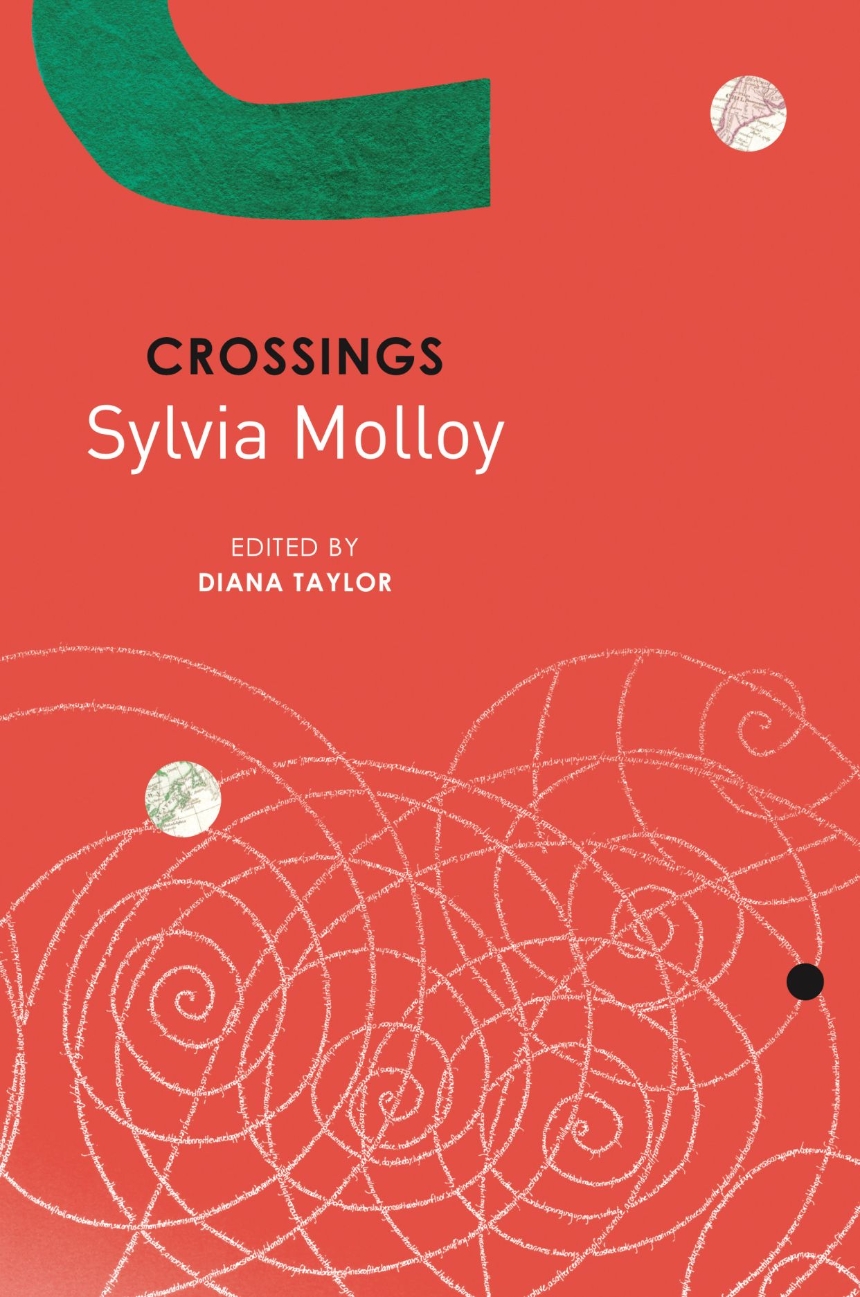
This is a familiar metaphor—one of the many translators may deploy when trying to convey what it is we do—though it becomes more complicated when author and translator are one and the same. In this case, where does the performance end? What of mediation and interpretation? What happens to the concept of the original? Is it the same writer if she’s writing in two different languages? Sylvia Molloy’s book Crossings (Seagull Books, 2025), edited by Diana Taylor and composed of two independent fiction pieces, probes the boundaries of these questions.
Crossings unites two works of short fiction written by Molloy in Spanish. The first, Varied Imagination (2003), features brief vignettes recounted by a first-person narrator (presumably Molloy herself) who relates memories of travel, family, language, and loss in sometimes witty, sometimes heartbreaking ways. The second, Living between Languages (2016), consists of mostly paragraph-length reflections on Molloy’s existence in and among multiple languages. Born in Argentina to an Irish father and French mother, Molloy was immersed in English and Spanish when she was young, and though her grandparents declined to speak French to their daughter, Molloy was determined to learn it and make up for her mother’s “poverty” of “monolingualism.” Language was bound up with power and political dynamics, and Molloy includes phrases in English, French, and Spanish without feeling the need to translate them for her reader, whatever their language may be.
In her foreword, Diana Taylor writes of Molloy’s shifts between languages and the attendant sites of each, her experience of “shuttling back, forth, and between” them all, aware constantly of how each summons “a different self” and “an altered path to memory.” This sensation of inhabiting multiple identities and places through the past and present is recognizable to Molloy’s readers. Most of her work traverses this thematic territory with her characteristic incisive observations and deep considerations conveyed by deceptively simple prose. Memory and language mediate Crossings’ explorations of identity and home, with Varied Imagination walking through incomplete, or deliberately obfuscated, memories of Molloy’s past, and Living between Languages revealing the conditions and environment out of which her writing, and written self, emerge. But which self is she allowing the reader to see, and does that self change from the Spanish to the English?
“The linguistic performances of the two versions of the text are the same though not identical, like twin globes tilted along different axes.”
Taylor claims that Molloy has written distinct books, due less to the fact that a translation ought always to stand on its own and more to the different persona Molloy adopts when writing in a different language. She slips into her “‘English’ voice to address an ‘English’-language reader.” Molloy recognizes that altering her linguistic posture “affects the task and performance of bilingualism,” though what that does to the translation of her text proves thorny. In Living between Languages, the afterword and foreword are swapped. Molloy reworked many of the Spanish-language excerpts in Varied Imagination, omitting, retooling, and “scrambling” some of them to varying degrees. For example, in “Dying Words,” she adds Julius Caesar’s famous “Et tu, Brute” to a list of other notable, less-Anglocentric last words, a new item in the series for her English readers. In “Misiones,” the description of the Swiss hotel she visits in northern Argentina morphs from a menacing, though beautiful locale to one much more approachable and benign in the English. A bath basin transformed into a “serpentario” when overrun by snakes and a visit to a cemetery are both excised from the English, pivoting away from the original (if we can even call it that) focus on the setting’s “mezcla de Heidi con Conrad” [mix of Heidi and Joseph Conrad’s Heart of Darkness] to one highlighting other travelers’ misadventures in language and place-based food. The linguistic performances of the two versions of the text are the same though not identical, like twin globes tilted along different axes. The way the viewer receives and interprets the material has been fundamentally altered.
It seems this is also one of the ways Molloy approached her work of writing and translating: from a remove. When dealing with pesky beginnings and the daunting blank page, she describes relying on the intermediary of a second language as a means of approach. Beginning in whichever language is not the target, she can write, free and without pressure, before ultimately translating herself into the intended language. Despite its visible strings—the trappings of the performance are ever before her—Molloy accepts the effectiveness of this “laborious artifice.” This anecdote demonstrates an idea she explicitly references throughout Living between Languages, and one implicitly operating throughout her oeuvre: a bilingual person must choose a language as the point of support whence they establish a relationship to their other language(s) “as absence, or rather as shadow, the object of linguistic desire.”
Translators are intimately acquainted with this posture of “linguistic desire.” We read a text in one language and strive to bring it truthfully and carefully into another, but this exercise is asymptotic. We approach the original’s characteristics, but we can never completely reach them all. It is impossible. But out of this effortful engagement comes something dynamic, new, and recognizable. Translation is a fraught business for Molloy, who finds “nonentity” an appropriate description of the “task of the translator or the life of the bilingual subject.” Being between languages for Molloy is inextricably intertwined with being between homes, even identities or versions of the self. There is an alienation inherent in being bilingual, and the bilingual subject’s power is both “privilege” and “undoing.” Their writing is “always thirsting, always wanting, never satisfied.”
To read Crossings is to see Molloy as author and translator, playwright and actor. The companion texts move the reader beyond merely witnessing a performance to stepping backstage and seeing its hidden machinery. Molloy admits that she enjoys translating her own writing between Spanish and English because they “improve with this shuttling.” Such is the case here, though where that improvement lies is subjective. What is improved, and which text is improved upon? If we follow Molloy’s line of thinking, the Spanish versions of these works—which happened to be published before their English counterparts—are the arbitrary points of support where we begin. However, our concept of an “original” fractures, incapable as we are to evaluate one text, or one language, or one self against another. As Molloy asks at the end of Living between Languages, “In what language does memory speak, when the mind is shattered and reminiscence spent?” One answer could be to follow the disparate traces and see where the meandering journey takes you and who you become along the way.