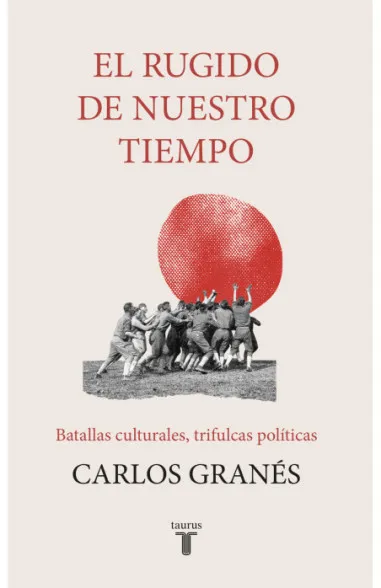
Anthropologist and essayist Carlos Granés is one of the most essential voices of our time, continually thinking and rethinking art, culture, and politics through a sharp, uncompromising lens. A recipient of the Premio Extraordinario de Doctorado en Antropología, the Premio Internacional de Ensayo Isabel Polanco, and the Premio Nacional de Periodismo Simón Bolívar, Granés offers us a new work, El rugido de nuestro tiempo (2026), on the challenges, discontents, ideas, and causes shaping today’s cultural battles, all unfolding amid ideological chaos and the uncertainty of contemporary moralism.
Juan Camilo Rincón: Where do we get the idea that the essayist is someone who looks back on the aftermath of turmoil or the effervescence of a moment with a cool, distilled gaze?
Carlos Granés: I think, to better understand the work of the essayist, you have to think about bad horror movies. They all have the same scene: a character hears some ominous noise and, instead of doing the rational, sensible thing (which is to run away), they light a match and walk straight into the lion’s den to see what the hell is going on. This is someone who cannot bear not understanding, someone even willing to risk their life to find out. I insist: the logical, rational choice is to run away and never find out what that creak, that noise, that whatever-it-is was. And yet, when someone goes down into the basement—and this is even more interesting—it works. It works because it appeals to an immensely powerful human need: the need to understand.
J.C.R.: The essayist is the one who goes down into the basement because they need to understand.
C.G.: Exactly—they can’t help themselves; they have to do it. That means plunging into the contemporary world and trying to make sense of the thousand things happening at once, things that affect us, shape us, and yet appear disordered, confusing, devoid of meaning. The essayist is the one who tries—the one who goes down into the basement or up into the attic—exposing themselves to blows, criticism, and labels, all in order to understand where those noises are coming from and to not leave loose ends unresolved.
J.C.R.: How does the essayist find the tools to become, as you so aptly put it, a forensic examiner of living matter?
C.G.: An essayist is someone who places great value on subjectivity, who works through their subjectivity, and whose only tool is the “I.” That “I” confronts this living matter, this thing that is happening, and tries, in effect, to slice it open in order to understand it. The scalpel they wield is their personal voice—their “I.” An essayist is someone who, with or without precision, with or without judgment, with or without reason, dares to judge the world from within their own subjectivity. That may sound banal or narcissistic, but it is fundamental as an exercise of freedom. Modernity was achieved and won because people began to question power, to question the institutions that dictated how things ought to be, and they began speaking from the self: a fragile, vulnerable, ignorant, limited self, but ultimately a self that, by offering an opinion about the world, created spaces of freedom.
J.C.R.: Why has the relationship between politics and the arts been—and why does it remain—so important?
C.G.: There are two things: there can be political art and there can be art interpreted through politics, or art that can be interpreted politically. For example, the art and poetry of the early nineteenth century did not aspire to be political but still contained deeply political themes. In 1823, Andrés Bello wrote a beautiful poem called “Alocución a la poesía,” in which he tells the Muses: “Hey, you’ve sung enough about Europe; here there is a virgin continent waiting to be discovered. Come sing of its valleys, its mountains, its flora and fauna, and also of its national heroes; there have been epics here too, Iliad-like wars of independence…” So he begins engaging with political themes tied to a patriotic affirmation, but that does not necessarily make it a political poem. The moment when art begins to see itself as capable of becoming a transformative—and even revolutionary—force arrives with the artistic avant-garde in 1909. At that point, it is no longer simply the case that the subject matter is political or that the work can be interpreted politically.
J.C.R.: Because it is political.
C.G.: Exactly. These are people saying: “All that dreaming about beautiful things is nonsense—it’s for dilettantes with their heads in the clouds. If we are going to dream, then we are going to make those dreams real and turn them into a weapon for transforming human beings and society.” That is the moment when art truly becomes politicized and turns into an instrument of social transformation.
J.C.R.: This is where you begin taking us through that trajectory, from Futurism to Dadaism…
C.G.: Futurism was the first to do it; then came Dadaism, Surrealism, Lettrism, Situationism, and so on. These were forces that challenged the moral status quo, that sought to forge new values and encourage people to live differently, to value different things. Futurism was a celebration of nationalism, war, virility, the destruction of the enemy, the struggle against the Austro-Hungarians—Filippo Tommaso Marinetti’s great enemies. In the end, it nearly succeeded in pushing Italy into World War I, and it ultimately became fascinated with Mussolini, who embodied all of those ideals, fusing Futurism and fascism.
J.C.R.: What role did Dadaism play?
C.G.: It did the opposite. It was a destructive project embodied by young people who had witnessed the First World War, who had seen their generation end up in the trenches, reduced to cannon fodder—the peak of barbarism, utter senselessness brought about by what Marinetti defended: nationalism. And they blamed culture for it: “If Schiller, Goethe, and beauty itself couldn’t stop barbarism, then they are useless; they reek of death. We can destroy it.” So their mission became the destruction of the Western civilization they believed was rotten. And what tools did they have? Not the machine, like Futurism, but its opposite: infantilism, irony, and humor. With these tools, they sought to desacralize everything held sacred in the West. These were political currents whose consequences we are still living with today. I think that is the difference: the avant-garde truly was a political tool—art as a political tool.
J.C.R.: One of the most interesting aspects of your recent book El rugido de nuestro tiempo is the way it traces the recent years of our part of the world’s cultural and political life. It made me think, for example, of the artist whose famous work consisted of several cans supposedly filled with his own feces.
C.G.: The 2008 economic crisis hit us very hard, especially in Europe and the United States. It produced a profound shift in cultural sensibilities because, for the first time since World War II, young people began to think—or became convinced—that they would live worse lives than their parents. Optimism declined. At the same time, the climate crisis emerged. So not only were they going to be poor, they also felt they would never even see old age because the world was going to end first.
J.C.R.: A dystopian future.
C.G.: To which we have to add all the moral crises erupting along the way: Me Too, anti-racism, Black Lives Matter, trans activism, and—not everywhere, but in certain places—decolonial critique. What did that mean for these young people? That they were living in the worst of all possible worlds. Unlike previous generations, they no longer felt they were living in humanity’s golden age—a time when people lived longer with access to healthcare and consumer prosperity and when there were no wars; the world was relatively pacified, and democracy prevailed. These young people have a completely different perception: like the Dadaists, they see a West that is utterly corrupt. The Dadaists sought to purge it through individualism, irony, and humor, as a counterforce to nationalism and imperialism. Young people today are trying to heal that world through moral causes: feminism, decolonialism, anti-racism, environmentalism. That shift has led cultural practices to abandon transgression, experimentation, shock, and playfulness altogether—which is what defined culture from the 1960s up through the first decade of this century, until 2008. From that point onward, everything began to change, and we entered a very different cultural landscape.
J.C.R.: Is that perhaps why culture has come under greater siege from moral concerns in recent years? What effects has that had?
C.G.: Exactly—it comes from that need to heal. Everything stems from the notion of art as therapeutic, from the idea that art possesses therapeutic powers. When society becomes sick—and for younger people, society is very sick—culture is expected to step in and fix it. The problem is that the artist-therapist has recipes and formulas, and ends up becoming a preachy Jiminy Cricket telling people how they should live, what they should think, which causes they ought to support. In doing so, the artist loses that somewhat anarchic, underground role that was more about shaking things up and instead begins propping up certain causes, standing at a pulpit and telling society what to think, how to assign value, where to focus its attention. Now, this is not entirely new; the Dadaists had something of this as well. Hugo Ball, the founder of Cabaret Voltaire, said artists were the priests of a new age. In other words, they saw themselves as purifiers. The difference, I insist, is that the tools used by Dadaism were very different from those used today. Back then it was irreverence; today it is the complete opposite: hypermoralism, cancel culture, and not the eruption of transgressive identities or personalities, but rather the affirmation of collective identities.
J.C.R.: In fact, your book revolves around two main characters: the artist and the politician. The latter seems to be allowed to do anything, as we see with Trump, Maduro…
C.G.: Petro too! He can go to brothels. If you and I went to brothels, we would be canceled, but a president can do it, no problem. It is absolute insanity because the artist is under constant scrutiny. Why? They brought it on themselves. Artists turned themselves into society’s watchdogs. They put the noose around their own neck by being moralistic. If they are going to judge others morally, they will be judged exactly the same way. As a result, their lives have to be spotless—not only in terms of how they act, but also in terms of the topics they choose to address. Take the case of Luisgé Martín in Spain. He decided to tackle an incredibly difficult subject: filicide. He wrote about a real case, a man who murdered his children as revenge against his wife, and that subject proved intolerable to contemporary sensibilities. The book was canceled; it never appeared, despite already having been edited and being on the verge of distribution to bookstores. The cultural establishment itself canceled the book because it was considered morally questionable to give a voice to the murderer—or even to talk about the case at all. It is both a grave and an absurd situation. Not only must you lead an angelic life, but you must also address angelic subjects. You can’t venture into thorny territory lest we become outraged and uncomfortable. Better, then, to avoid ambiguity altogether and draw a clear line between good and evil. Anything that falls in between, anything that forces us to think about the ambiguity of good and evil, is deeply frowned upon.
J.C.R.: Your book also made me think about writers and artists who end up in politics and politicians who turn to literature, such as Miguel Antonio Caro and his translation of the Aeneid.
C.G.: There are so many examples. Rómulo Gallegos was president of Venezuela; Juan Bosch was president of the Dominican Republic; Mario Vargas Llosa almost became president; Pablo Neruda was asked to run; Vicente Huidobro was a presidential candidate.
J.C.R.: Rubén Blades was a candidate too.
C.G.: Exactly. There is a very particular Latin American sociological explanation for that. The only thing our continent has truly produced of universal stature is culture. Our politics are a shit show; we haven’t produced a great universal political figure, but we have produced plenty of writers, painters, and poets of universal importance—not to mention musicians. So it becomes tempting to think that someone who has succeeded in the arts must also be a person of values and qualities that could prove useful in government.
J.C.R.: The problem is that they are two completely different things.
C.G.: Which is why mixing them is a mistake, and doing so has led to a great deal of nonsense. The great virtue of these Latin American artists is that they have aspired toward totality and created works that negate reality while inventing new worlds. Gabriel García Márquez is the most obvious example, but he is far from the only one. And in art, that is marvelous. Through your imagination, you negate real reality and invent a fictional reality made out of words—your desires, your obsessions, your affinities, your phobias, your entire world. You project all of that onto the page and create a magnificent cathedral of words. The reader enters it and believes in it; the whole thing holds together, and it is extraordinary. But doing that in politics is extremely dangerous because it is essentially sweeping everything away so that the politician can impose his own vision, create a new world, and disregard everything built over the last two hundred or five hundred years. That is when we fall into adanismo, into perpetual refundacionalismo, into constitutional refoundation projects—which, in their latest Latin American wave, have been an absolute failure—and into the assumption that before I arrived, everything was corruption, oppression, and calamity. There is a destructive, Dadaist impulse to tear everything down so that the politician of the moment can lay down new foundations for reality and create the world all over again. That is absolutely absurd because we—Latin America especially—have been systematically starting from scratch over and over again. This is why we always think of ourselves as young nations, even though we are some of the oldest countries around. And these Dadaist politicians are convinced that nothing has been accomplished here, that we must start again from zero because nothing has ever been done here. It’s one big lie.
J.C.R.: You made me think of Jorge Luis Borges and his Otras inquisiciones. In the opening essay, he writes about the Chinese emperor who burns books and builds walls—that idea of “history begins with me.” It’s a bit like how modern caudillismo works.
C.G.: They are figures who have a heroic conception of politics, who believe governing is an extension of epic heroism. But governing is incredibly difficult and incredibly boring work: attending meetings, thinking through public policy, doing the numbers, preventing the country from collapsing, understanding relationships. There is nothing grand or epic about it. But our caudillos experience politics as something epic, revolutionary, emancipatory, or aggrandizing. And, of course, these are not people who strive to govern; they strive to make history. They want to be great transformers, great world leaders, great names in human history. That is disastrous because anyone who thinks in historical terms—or who believes their true stage is History itself—the first thing they forget about is the concrete individual. And that is extremely serious, because real people mean nothing to them; what matters are grand historical deeds stained with blood, barbarism, violence, and the sacrifice of countless lives. Rafael Sánchez Ferlosio used to say that fascism was precisely this: refusing to settle for governing and instead wanting to make history. Because the person who wants to make history does not stop before constitutions, laws, pluralism, or other people; they simply dedicate themselves to sweeping everything aside. These figures are immensely dangerous and profoundly destructive.
J.C.R.: From that perspective, where are we headed? What existential doubts continue to haunt Latin America?
C.G.: There is a recurring obsession: asking ourselves about Latin American identity and, above all, asking who screwed us over. Not at what point we screwed ourselves over, but who did it to us. It is a fixed idea: that we are innocent, pure, angelic souls, victims of some foreign force that came and ruined us. That has been the greatest barrier preventing us from looking at ourselves and recognizing our flaws and mistakes—especially in politics—but also from learning from history and avoiding the systematic repetition of the same errors, like adanismo and refundacionalismo. If we are innocent, then someone else must be to blame. We can keep trying because, yes, we failed, but it wasn’t our fault; it’s always somebody else’s. That is one of the most harmful obsessions in Latin America.
J.C.R.: The book also made me think about why people in positions of great power speak so confidently—and with so little knowledge or grounding—about matters of culture, art, and literature.
C.G.: Because symbolic capital is enormously valued. They already possess political and economic power, but they tend to want everything; symbolic and cultural power matter to them, too, and they enjoy having it. That is why they try to co-opt artists. Power always tries to make the artist its servant, and there is nothing more grotesque than that. The artist who submits to becoming the mouthpiece, the publicist, the image-polisher of a politician or power itself is, above all, committing a grave error.
Translated by Iyan Smith Williams
Buy books by the authors and translators featured in this issue on our Bookshop page!