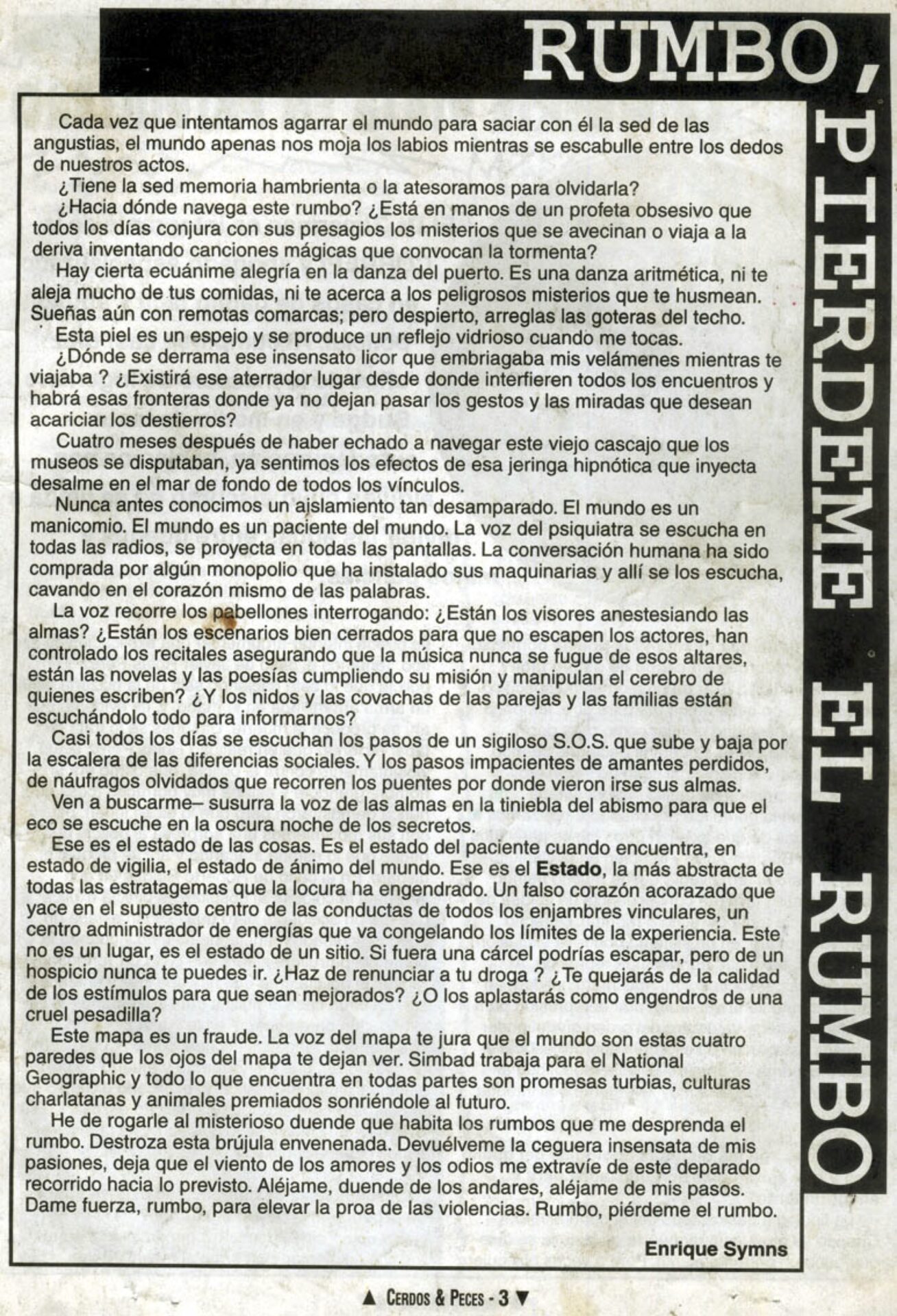
Every time we try to grab hold of the world to slake the thirst of our anguish, the world just wets our lips as it slips through the fingers of our actions.
Does the thirst of anguish have a hungry memory, or do we treasure this thirst in order to forget it?
Where is this path sailing us? Is it in the hands of some obsessive prophet who daily invokes mysteries to come with his portents, or does it float adrift, making up magic songs that summon the storm?
There is a certain level-headed joy in the dance of the port. It is an arithmetical dance—it doesn’t take you too far from your meals, nor does it draw you too close to the mysterious dangers sniffing around you. You still dream of distant lands; but, while awake, you fix the holes in the roof.
This skin is a mirror and it gives back a glassy reflection when you touch me.
Where did I spill that witless liquor that intoxicated my sails while I traveled you? Does that terrifying place from which all encounters meddle really exist, and are there truly borders that allow no passage for the glances and gestures that yearn to caress exiles?
Four months after setting sail in this old wreck contested by museums, we can feel the effects of that hypnotic syringe that injects callousness into the groundswell of all bonds.
We never knew such a forsaken isolation before. The world is a madhouse. The world is a patient of the world. You hear the psychiatrist’s voice on every radio, you see him on every screen. Human conversation has been bought out by some monopoly that has installed its machinery and thus listens in, digging into the very heart of words.
The voice runs through the wards asking: Are the viewfinders anesthetizing souls? Are the soundstages well sealed so the actors can’t get out? Are the concerts properly controlled so the music can never escape these altars, are the novels and poems accomplishing their mission and manipulating the brains of those who write them? And are the nests and hovels of couples and families all listening to it all so as to report back to us?
Almost every day we hear the footsteps of a subtle S.O.S. going up and down the stairs of social differences. And the impatient footsteps of lost lovers, of forgotten castaways who tread the bridges where they watched their souls slip away.
“Come and get me,” whispers the voice of the souls in the abysmal depths such that their echo can be heard in the dark night of secrets.
This is the state of things. It is the state of the patient when he finds, in a state of sleeplessness, the state of mind of the world. This is the State, the most abstract of all the schemes dreamed up by madness. A false hardened heart that lies at the supposed center of conduct of all the hives that bind us, an administrative energy center that freezes the limits of experience in place. This is not a place, it is a lockdown. If it were a jail you could escape, but you can never get out of a hospice. Need to give up your drug of choice? Will you complain about the quality of stimuli such that they might be improved? Or will you crush them like the offspring of some cruel nightmare?
This map is a fraud. The map’s voice swears to you the world is these four walls that the map’s eyes let you see. Simbad works for National Geographic and everything he finds everywhere is murky promises, phony cultures, and prize-winning animals smiling into the future.
I can only beg the enigmatic spirit who dwells along these paths to knock me off this path. Destroy this poisoned compass. Give me back the dumb blindness of my passions, let the wind of loves and hatreds pull me off this set course toward the foreseen. Take me away, spirit of wanderings, take me away from my footsteps.
Give me strength, path, to raise the bow of violences. Path, lose my path.
Enrique Symns
Cerdos & Peces
No. 51. April 1997
Translated by Arthur Malcolm Dixon
Buy books by the authors and translators featured in this issue on our Bookshop page!