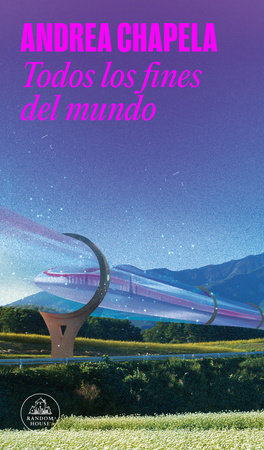
Mexican author Andrea Chapela has received awards that confirm her status as one of Latin America’s most interesting contemporary writers. A recipient of the Premio Nacional de Ensayo Joven José Luis Martínez (2019) and the Premio Nacional de Literatura Juan José Arreola (2020), and included in Granta’s prestigious list of the best young Spanish-language novelists in 2021, Chapela now gives us Todos los fines del mundo (Penguin Random House), a hybrid novel that mixes eras, spaces, ambiguous and complicated loves, natural disasters, and futures that promise little.
The novel’s protagonist, Angelica, writes to share her story and talk about the past. Writing becomes an act of faith, a way of holding on to Manu and Susana, with whom she has built a relationship full of ambiguities, where love and friendship mix, and questions are raised rather than answered with certainty. In the novel, the three spend their days together in Madrid (a city located in one of the “Países del Bienestar”), thrust into the unknown when a climate crisis brings days that reach up to 55° C. They survive and build their own small community, so as not to die of sadness, among rechargeable batteries and portable speakers, reading, talking, and dancing, despite the hostile world outside, although they know that any vision of the future is a mere pantomime.
On a day like any other, Angelica asks herself whom she would spend the inevitable end of the world with, now that environmental collapse is imminent. She has been forced to return to her native Mexico to seek refuge in a remote town with a new community and a present where Manu and Susana are only a memory. She survives with others and wants to believe, together with them, that there is a tomorrow, while at the same time she feels that, when talking about the past, it’s a fiction that she has invented. At the end, she tells us: “You should never trust the narrator.”
Natalia Consuegra: Your novel raises many questions about intimate relationships, love, and friendship: “What do we mean when we say, ‘It was nothing’? Do you think you would fall in love all over again with the people you loved before? How much of desire comes from within, and how much is learned? Can you truly love without thinking about the body?” Do you also ask yourself these questions? Have you been able to answer them?
Andrea Chapela: Yes, I ask myself those questions. In fact, even though the book isn’t autofiction, the book’s central questions are my own, and I think that writing it brought me to an answer that feels sufficient for the stage of life I’m in now: what relationships mean to me, which relationships make me happy, and what role desire and the body play in them. But above all, I think I came to the conclusion that personal relationships are exactly that: deeply personal. That our feelings also depend on where we are in our lives. That we need to let ourselves grow and change our minds, that things that happen to us now will probably be different in a few years, that we will probably fall in love with people we had never expected; and I like the idea of keeping this possibility open. When I started writing this book, I thought the way I felt and moved through the world, especially when it came to these themes, was wrong because I didn’t fit the mold. Now I realize that, instead, I need to open up my worldview so what I am feeling can truly come in, and I realize there is nothing inherently wrong with what I feel. In this sense, writing, publishing, and talking about this book has given me a lot of peace.
N.C.: How do you think people will experience cataclysms, climate collapses, and environmental disasters in light of their relationships, and vice versa?
A.C.: Intuitively, when I began writing this book, I thought there was some connection between the idea of the end of the world and relationships. At first, it was just intuition, a sense that the end of the world maximized a feeling of nostalgia, but this changed during the pandemic. For example, the issue of a lack of hugs, the distance between people, finding yourself after a cataclysm with a group of people who help you survive—but these aren’t the most important people in your life, the people who truly understand you and to whom you feel closest. For me, this is also a topic that emerged from the pandemic. In my view, catastrophes remind us how essential it is to have a community close by and how, much more than things or material goods, it is people who save your life. In this sense, I believe affective relationships are pivotal; they help us to endure catastrophes, to understand them. We have already settled in hostile environments, and I feel that the answer to trying to live in one is for people to stay close and care for one another.
N.C.: Let’s focus on those two “forms” of community in the future: the smaller one (Manu, Susana, and Angelica before the collapse) and the one after, those one hundred seventeen people living in the town. How do you imagine those communities beyond the novel?
A.C.: I wanted to explore, on the one hand, these kinds of communities where people are deliberately chosen and how they work. Often, the answer is that these kinds of things function primarily in isolation, where there isn’t an external danger. That small community functions, in part, due to the magic of science fiction: they have everything they need, but at the same time, are very isolated and this allows them to not be too worried about the outside world.
N.C.: Something similar happens with Manu, Susana, and Angelica, who also take on another sort of isolation.
A.C.: Yes, and as someone who lives in Mexico City, I think sometimes our communities and surroundings are so vast that it seems impossible to embrace it all and everything that comes with it. Perhaps I’m beginning to think from the small scale outward. I think the novel doesn’t spend enough time on this idea of future communities, but I wanted to explore two things: first, how the way in which we love one another on a microscale is replicated at the macroscale; I believe without a doubt that this is true. What’s true is that we have continued reproducing the model of a nuclear family as many small nuclear families living together amongst one another, and there need to be other forms of community. Here we break from that idea of the nuclear family with Manu, Susana, and Angelica, and we also break from the notion of the separated family, as you have a community in which everyone depends on one another. The second thing is to acknowledge that what one person does affects everybody, that the resources we have are all that we have. For me, this can be easily scaled up to what might be the importance of these communities in the future.
N.C.: How do you interpret the relationship between climate change and migration policies today?
A.C.: We are already starting to see what has come to be known as “climate migration” or “climate-driven immigration,” and I think this is a big issue. The novel touches on it in passing because it is focused on other things; it touches more on the idea that, when faced with a more hostile world, which, in many ways, is the product of climate change, there is much more insecurity and much less certainty in predicting the future. I think it has always been normal for countries to close themselves off when faced with these kinds of things and to try and maintain the status quo as much as possible. So restrictive immigration policies don’t surprise me, but of course, I am thinking about this after Trump’s intervention in Venezuela and at a political moment very different from when I was writing the novel, where climate change is also going to be a war for resources, which will bring with it human displacement, among other things. I think migratory policies will become even harsher with this type of migration.
N.C.: In your narrative work, you always raise a question about time—here, you raise it through theater, through love, and through the climate disaster. How do those two central moments of the novel shape different perspectives on time?
A.C.: The concept of time fascinates me, and it’s true that the novel addresses a question about it, about how we experience it and about how emotions alter it, and also about how the world itself changes it. The first section is governed by memory, and it plays a lot with the come-and-go of “I’m recounting this year, but I move back and forth through it, weaving the strands together,” trying to preserve the way memory experiences time. It is very different from the way we think of time in the present; when we remember, we compress time; things aren’t necessarily in chronological order, and there are other organizing principles shaping the narrative.
N.C.: The second part views time very differently.
A.C.: …because it’s as though time itself were frozen, along with the fact that a new sense of time takes hold. I was very interested in the idea that there is a clear concept of time—day and night—but then there is a concept of time that we’ve agreed upon and invented—clocks and calendars—and we could create another one that looks at time in a different way. That also fascinates me. Somehow, in this second part, that invented time no longer exists; it’s a more frozen time, not by love or by memory, but by the very same passage of time, which is moving slower. I also think it is a world where, because everything is more disconnected and there is no internet, and thus, no modes of communication, they would return to a more primordial, slower kind of time, a different one. I am very interested in how we experience and remember time. I think the novel tries to capture that experience. In fact, I was often worried that the second part was too slow, and I often wrestled with how to make it work despite that slowness.
N.C.: Tell us a bit about the idea of our need to tell stories, to keep records, to document everything that happens to us, to capture it within a story—like what Angelica does with her diary, for example.
A.C.: In the novel, there are three major narrative layers: the story of her year in Madrid, the diary that she keeps during the second part, and then the surprise that everything, in fact, is a novel. For me, everything comes from thinking about how the act of writing helps us think about and organize reality; it forces us to put things in chronological order, to tell one thing before another. It is one of the clearest ways we have of communicating with the future and learning about the past. For me, this book, as much as it focuses on collapse and important life relationships, is also about the need to capture things in narrative, to tell and share them, and how this act of sharing something also helps create those relationships.
N.C.: It’s one way of dealing with what has happened to us.
A.C.: The fact is that sometimes remembering isn’t enough. Until we do something with what we remember, it doesn’t become completely real. Angelica often doubts her own version of events; she always says that perhaps she is not presenting them as they were, and for me, it’s important to leave those uncertainties visible in this kind of writing: the possibility that there are other versions I don’t know, that events may have unfolded differently, and the uncertainty that arises when we’re trapped within our own perspective. Sometimes it is difficult to step outside of our own point of view even when we are trying to be faithful to what has happened.
N.C.: In this sense, do you agree with Manu that words aren’t enough and that the few we have end up pigeonholing our perspectives?
A.C.: This is a question that I probably first discovered and have been asking myself since my essay Grados de miopía, where I first confronted the idea that language is less reliable and more malleable than I had once thought. The same thing happens in my book of short stories Ansibles, perfiladores y otras máquinas de ingenio, a book about trying to communicate and the ways in which this can prove problematic, especially when technology is part of the equation. In a way, in Todos los fines del mundo, I return to this idea from another place: the issue that language is all we have for expressing ourselves, and in that sense it’s marvelous, but at the same time never enough. I think it is in that tension—between language being all we have and yet not being enough—that poetry, literature, and the need for more words to express what happens inside us emerge. I don’t know if I feel pigeonholed by language; I think choosing literature as a profession has led me to think—perhaps mistakenly—that I have greater control over language than most people. What I am certain of is that I am fascinated by those moments where language reaches its limits.
N.C.: What was the most complicated part of the exercise of autobiographical writing?
A.C.: There were many complicated parts. This novel made me feel insecure, not because of the narrated events, nor the possible interpretation of closeness between Angelica and me, but because it presents a version of my ideas and questions about the world. It scared me a bit, made me feel embarrassed and a little ashamed, so this made the exercise more difficult. I wrote this novel over five years and Angelica’s voice became easier to find and to connect with over time, but it was hard to find all of the different ways to express that voice, to make her reflect on the things I wanted to reflect on. Above all, there was the worry about what others may think about me, not Angelica, when they read it. That was always there and was hard; there was a lot of noise around me and expectations I had for myself as I wrote. That was one of the biggest challenges.
N.C.: What questions about writing did working on Todos los fines del mundo allow you to explore?
A.C.: I thought a lot about the novel as a form; about different ways they are made, like more fragmented novels, and how each part can be a new formal experiment. I thought a lot about how to create different voices. For me, there was also the somewhat architectural exercise of making a structure work, of those twists, the gamble of this kind of narrative structure where each part recontextualizes the one before it, reshaping the rules of the game. I wanted to know if I could still write another novel. This book made me fall back in love with the novel itself and its endless possibilities; it also made me ask a lot of questions about fiction, climate change, and climate fiction. While many of them remain unanswered, I feel that those questions are guiding where I’m headed now. While with this novel I started to explore the possibilities of how to write about climate change, about the future, and about these collapses, I realized when I finished it that there was a thread I hadn’t followed all the way through and needed to keep pulling. This book also committed me to a particular kind of fiction—one I want to continue pursuing in the future.
Translated by Iyan Smith Williams
Buy books by the authors and translators featured in this issue on our Bookshop page!