Gurugram, Haryana, India: Penguin Random House India. 2025. 518 pages.
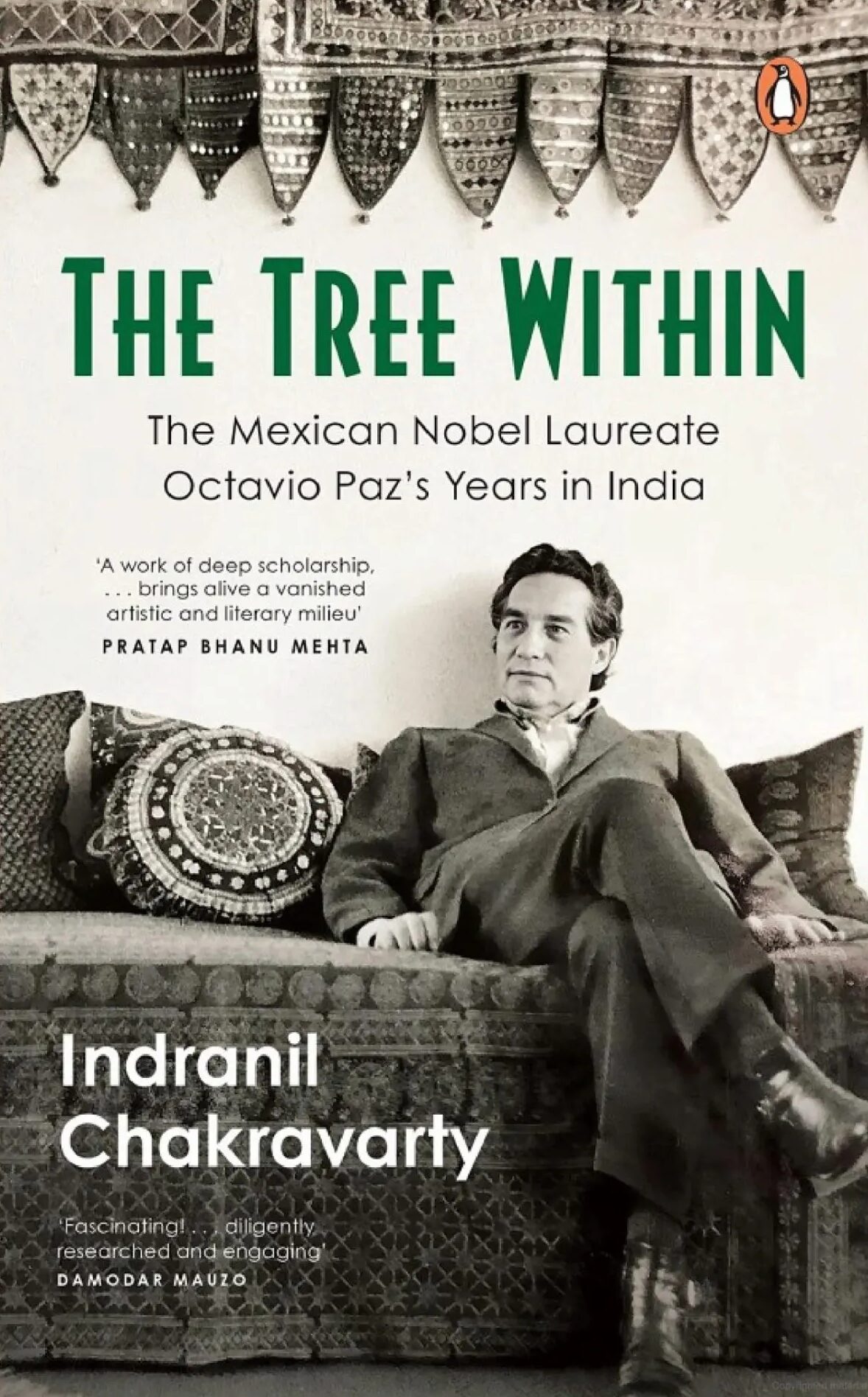 In 1951, Octavio Paz was serving as Second Secretary in the Mexican Embassy in Paris, where he had been posted since late 1945. He had recently published two of the most important books of his career, Libertad bajo palabra (1949) and El laberinto de la soledad (1950), and had successfully cultivated friendships with both French and expatriate Latin American writers, artists, and intellectuals. Paz was flourishing in Paris and was eager to remain there. Yet, all of a sudden, he was dispatched to India on a new diplomatic mission. As Indranil Chakravarty explains in his fascinating, thoroughly researched, and highly readable new book, Paz’s political and cultural activities in Paris had displeased his superiors. Earlier that year, he had embarked on a vigorous campaign to promote Luis Buñuel’s now-classic film Los olvidados (1950), which had earned the disapproval of the Mexican authorities for its at once brutal and poetic depiction of life in one of Mexico City’s poorer neighborhoods. Paz loved Buñuel’s film; the official view, however, was that it cast Mexico in a bad light. In short, the assignment to Mexico’s embassy in newly independent India was a form of punishment. Ironically, it opened the door to one of the future Nobel laureate’s most significant and enriching cultural experiences.
Paz did not enjoy his first sojourn in India, and it did not last very long. He arrived in December 1951, and by May of the following year, he had already been transferred to Tokyo. In 1962, however, Paz embarked on a second Indian phase, now as his country’s ambassador. He remained there until October 1968, when he left his position to protest his government’s massacre of students in Mexico City’s Tlatelolco Square, ten days before the opening of the Olympic Games, which Mexico was hosting that year. These six years in India were perhaps the most creative and joyful of Paz’s life. Not only did he produce a torrent of books, but it was in New Delhi that he met and married his second wife, Marie-José Tramini, “the turning point of his emotional life” (199) in Chakravarty’s words. He spent months traveling all over India and visiting neighboring countries. He engaged in a remarkably intense dialogue with artists, writers, intellectuals, and politicians in India and immersed himself in his host nation’s rich and complex culture and history. He was uniquely successful in building a bridge between India and Mexico (and Latin America more broadly). Paz himself described his experience as “a second birth.”
The Tree Within is a full-scale biography that covers the entirety of the poet’s life. Still, the book’s principal contribution lies in the chapters addressing Paz’s two sojourns in India. Chakravarty offers engrossing new information about Paz’s activities in India, the imprint left by the country on his thinking and writing, and his interpretations of Indian culture, religion, and history. Among the many intriguing stories related in this volume is that of the Indian painter Satish Gujral, who received a fellowship to study in Mexico, in large part thanks to Paz. Gujral remained forever grateful to Paz for his support. As a diplomat, Paz played a role in resolving the crisis over Goa, the Portuguese colony that finally returned to Indian control in the early 1960s. He promoted dialogue between Mexico and India through significant cultural exchanges. In addition to Gujral, Paz befriended numerous prominent figures, including the painter Jagdish Swaminathan, the novelists Santha Rama Rau and Nirad C. Chaudhuri, and the newspaper editor Sham Lal. Notably, Paz counted Indira Gandhi, India’s prime minister, among his friends. He hosted Latin American visitors in New Delhi, such as Julio Cortázar and Severo Sarduy, both of whom testified to the immense influence Paz had on their views of India. Chakravarty even discusses the friendships Paz established with some of the employees in the Mexican embassy.
“Paz pinpointed in the cultural, philosophical, and spiritual traditions of India a way of thinking that provided an alternative to some of the impasses in which Western culture found itself.”
Paz displayed a deep interest in different cultures throughout his life, and he was a firm believer in the plural nature of the world’s cultures. In short, he arrived in India eager to learn and with an open mind. He discussed the literatures of the subcontinent with eloquence and insight and wrote scintillating pages describing some of India’s most important monuments and artworks. He was particularly drawn to Tantra, which he saw, as Chakravarty explains, “not just as a spiritual discipline but as a profound way of understanding the relationship between the material and the metaphysical, the individual and the universal” (333). More broadly, Paz pinpointed in the cultural, philosophical, and spiritual traditions of India a way of thinking that provided an alternative to some of the impasses in which Western culture found itself. He liked to draw attention to how in India there was a tendency to dissolve the binary oppositions on which Western thought relied. As he was fond of explaining, the West explored reality in terms of this or that, whereas in India it was always a matter of this and that. These ideas were captivating from a philosophical point of view; they also undergirded much of Paz’s poetry of this period.
Chakravarty is passionate about his subject matter, and he speaks admiringly of Paz’s love for India. This does not, however, make the author blind to the Mexican poet’s occasional faults. Chakravarty notes that Paz’s understanding of India was mostly filtered through his readings of European authors. He takes him to task, moreover, for some of his distorted readings of Indian religious practices. And he devotes several incisive pages to analyzing a 1984 conversation on Mexican television between Paz and the Catalan-Indian scholar of world religions Raimon Panikkar, in which the Mexican poet repeatedly talked over Panikkar and treated him dismissively even though what Panikkar had to say about the religious traditions of India was more nuanced, in Chakravarty’s opinion, than what Paz contributed to the conversation. Chakravarty might have added that Panikkar had a far more up-to-date view of Indian society, drawing attention to the country’s role, already in the 1980s, as a top producer of engineers—that is, to a dimension of the country’s development that was out of step with the Pazian emphasis on India as a repository of spiritual values. Chakravarty rightly concludes this section of his book with a warning to the reader to “be wary of Paz whenever he ma[kes] categorical statements” (375).
The Tree Within is detailed and thorough in its approach to its subject. There is one noteworthy omission, though. Vislumbres de la India (1995), Paz’s combination memoir and essay about India and, significantly, his final book, includes a lengthy discussion of the impact of the British conquest on India. Paz offers a surprisingly sanguine assessment of the British contribution to India’s emergence as a modern nation. Even though he unhesitatingly sympathizes with India’s battle for independence and regularly uses his understanding of India to criticize aspects of Western culture, in particular its excessive individualism, he also suggests that the British contributed things of great value to the country they colonized, including the principles of democracy and nationhood. Paz believes that the British imperialist enterprise contributed to its own undoing by instilling values in its Indian subjects that prepared them to overthrow British rule. Chakravarty does not comment on this aspect of Paz’s thinking. This reader, for one, would love to know what he thinks of it.
All in all, The Tree Within is an outstanding book, indispensable reading for anyone interested in Paz or in the under-explored history of relations between India and Mexico.
Maarten van Delden
University of California, Los Angeles
Buy books by the authors and translators featured in this issue on our Bookshop page!