Dallas: Deep Vellum Publishing, 2025. 180 pages.
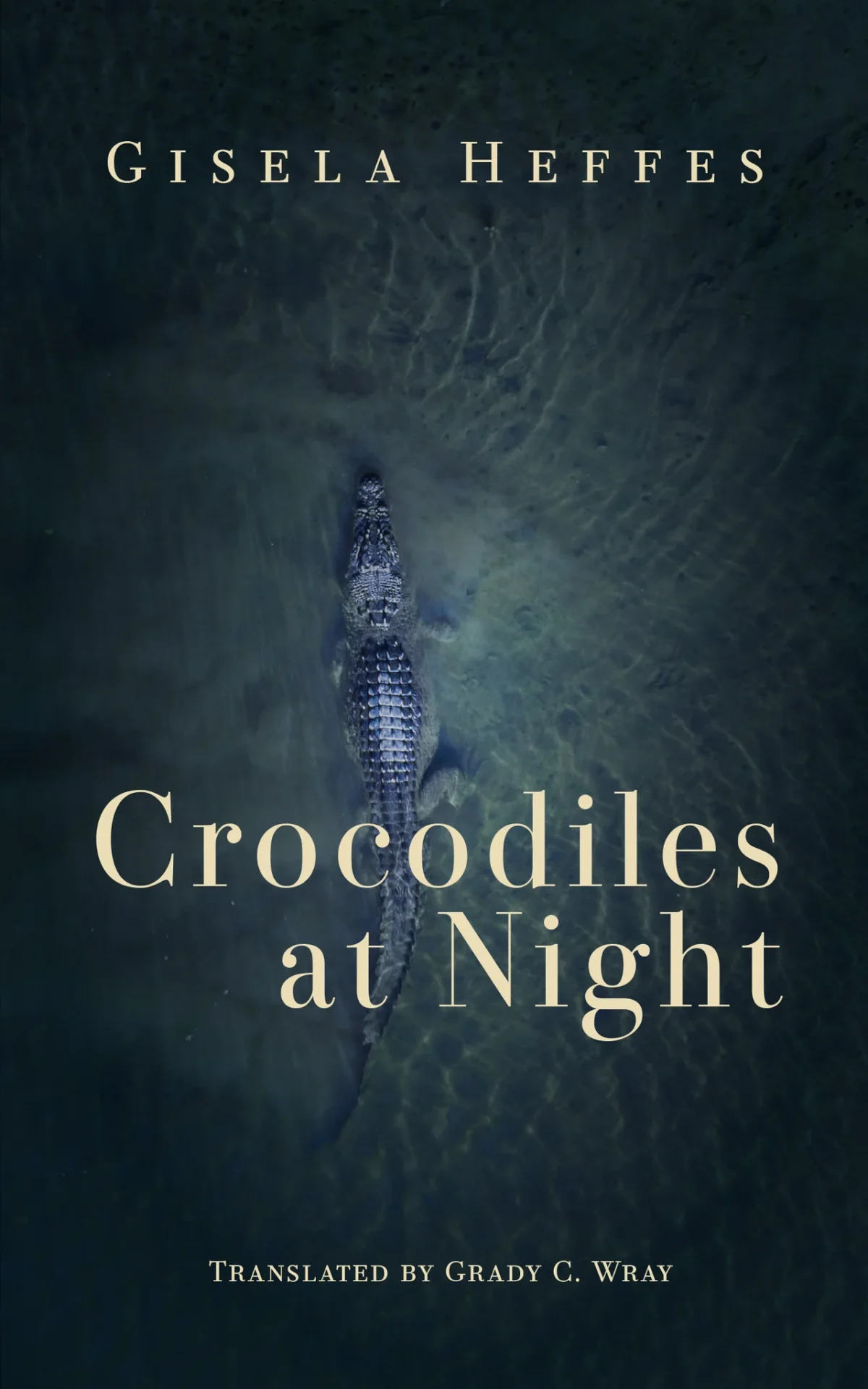 Crocodiles at Night is a book of many titles. Its main character, an autofictional stand-in for the author, proposes several options for the novel she is struggling to write: “The Devoured One,” “Latitude Penance,” “The Passion According to GH” (a fitting nod to Clarice Lispector), and “Imperfect Present,” which reflects the same obsession with verb tense that Heffes revealed in her all-conditional Ischia. A couple of other title ideas come to mind. One is “Medical Humanities,” an academic discipline that shows through in the book, and which would capture its effort “to extract what is human from the medical odyssey.” Another, perhaps ironically, is “Visualizing Loss in Latin America”: the title of a different book by Heffes, this one not a novel but a scholarly analysis of Latin American art, film, and literature through the lens of ecocriticism. Albeit in different terms, Crocodiles at Night also paints a portrait of loss—another of Heffes’ obsessions. Here, she endeavors “to write grief. To write degradation. To chronicle those steps that illness takes to prey on its victims. To honor the victim describing the penance. A penance that robs a person’s will. That takes away everything.”
The plot is simple: an Argentine academic living in the United States returns to Buenos Aires to be with her ailing father as he convalesces in hospital after an operation. Everything else is decidedly more complex. If I had to choose one adjective to describe Crocodiles at Night, I might go with “oneiric.” The book opens with the question “What about nightmares?” From that point on, we can read this novel as a sort of documented dream, a stream of subconsciousness in which time dilates and contracts and the reader is always at least one step removed from reality. The world Heffes depicts in Crocodiles at Night is familiar but sinister, menacingly artificial, like the way a dream feels when you realize you’re dreaming but can’t quite manage to wake up. In this sense, whether intentionally or not, this is a rather Lynchian novel; all the more so as Heffes (or, rather, her stand-in) describes her hospitalized father’s real-world surroundings as a “stage set” built around him.
Similarly Lynchian is the author/narrator’s self-conscious fragmentation into multiple characters, each of whom seems to be living through and writing about a different version of the same experience. We know the author is named Gisela Heffes, yet we are told to imagine the main character’s name is not “Gisela Guerenstein” but “Vera Heffes.” We hold in our hands a Russian doll of autofiction, with one stand-in inventing another until the lack of a cohesive identity becomes the whole point: “Who is she, Vera? And who is she, the one who’s writing? Will they all be the same at one time?”
This fragmentation of the self emerges not only from the book’s point of view, but also from its setting. Returning to Buenos Aires after years in the United States makes the main character feel like a foreigner in her own hometown, “as if the relationship between memory and reality had been interrupted.” Indeed, when we return to a place after a long time away, it can feel as though either the place or ourselves were not entirely real, as though our memory and the present were mutually exclusive.
As in Ischia—which, as I mentioned, is written entirely in the conditional tense—Heffes relies heavily on verb tense and mood throughout Crocodiles at Night to create an atmosphere of dreamlike ambiguity. The words that most characterize the narrative, to my mind, are “would,” “could,” “might,” and “perhaps.” This air of conditionality means the book, besides being about loss, is also about its own writing process. We get glimpses inside the “Notebook” in which “Vera” is preparing what will presumably become the novel we are reading, and we learn how, rather than writing in any programmatic way, she “jots down fragments and outlines on her iPhone,” ending up with a “constellation of scattered fragments.” The author, like her stand-in, appears plagued by self-doubt and prone to self-diagnosis, afraid the sought-after novel will end up a hodgepodge of “inconclusive narrations” and “incoherent fragments.” Appropriately, the finished novel’s fragmentary nature is indeed its most remarkable feature.
“We hold in our hands a Russian doll of autofiction, with one stand-in inventing another until the lack of a cohesive identity becomes the whole point.”
As an eminently autobiographical novel, Crocodiles at Night also opens a window onto its author’s scholarly interests. Heffes is an ecocritic as well as a novelist, and the former role shines through in Crocodiles at Night as the frail father’s body becomes a metaphorical stand-in for the urban environment of Buenos Aires. The narrator’s graphic depictions of medical procedures are reminiscent of the descriptions of waste and extraction we find in Visualizing Loss in Latin America, as nurses “extract cloths and gauze from the depths of his pale skin and collect filth from deep inside.” As her father’s body deteriorates, often in scatological terms, Buenos Aires (her erstwhile “patria” or “fatherland”) is characterized by “waste, trash, filth.” While interesting in principle, the father-as-city metaphor is sometimes heavy-handed, such as when “the transverse wound that bisects her father’s abdomen” is likened to “a Buenos Aires that is fractured between reality and memory.”
Last but certainly not least, I’ll address the meticulous translation achieved by Grady C. Wray, a former professor and translation mentor of mine at the University of Oklahoma. Grady has been translating Gisela Heffes for over a decade now, and his style of translation is a perfect match for her style of writing. Both could be described, especially in this novel, as “clinical.” Grady is an uncommonly exacting translator who focuses intently on the constituent parts of every phrase, sentence, and paragraph, making a diligent effort to capture every ounce of the original’s meaning. The finished product is an admirably thorough translation, and one that hews sometimes uncomfortably close to the source text, privileging the semantic over the aesthetic.
Without sinking too far into translation jargon, Grady “foreignizes” rather than “domesticating” as he translates, not because he seeks to maintain so-called “local flavor” (which, in fact, he seldom does), but rather because he is unafraid to write in English in a way that may sound idiosyncratic or unnatural as long as the precise meaning of the Spanish is preserved. For instance, he writes, “She lets herself get carried away by the expected Buenos Aires itineraries,” reproducing each noun, verb, and adjective of the Spanish with precise equivalents or cognates rather than straying from the original in favor of a more predictable alternative for the English-language reader. For a book marked by separation from reality, where writing about the world supersedes the very world being written about, this approach to translation is just as it should be.
Buy books by the authors and translators featured in this issue on our Bookshop page!