McEllen: Brown Ink, FlowerSong Press. 2024. 294 pages.
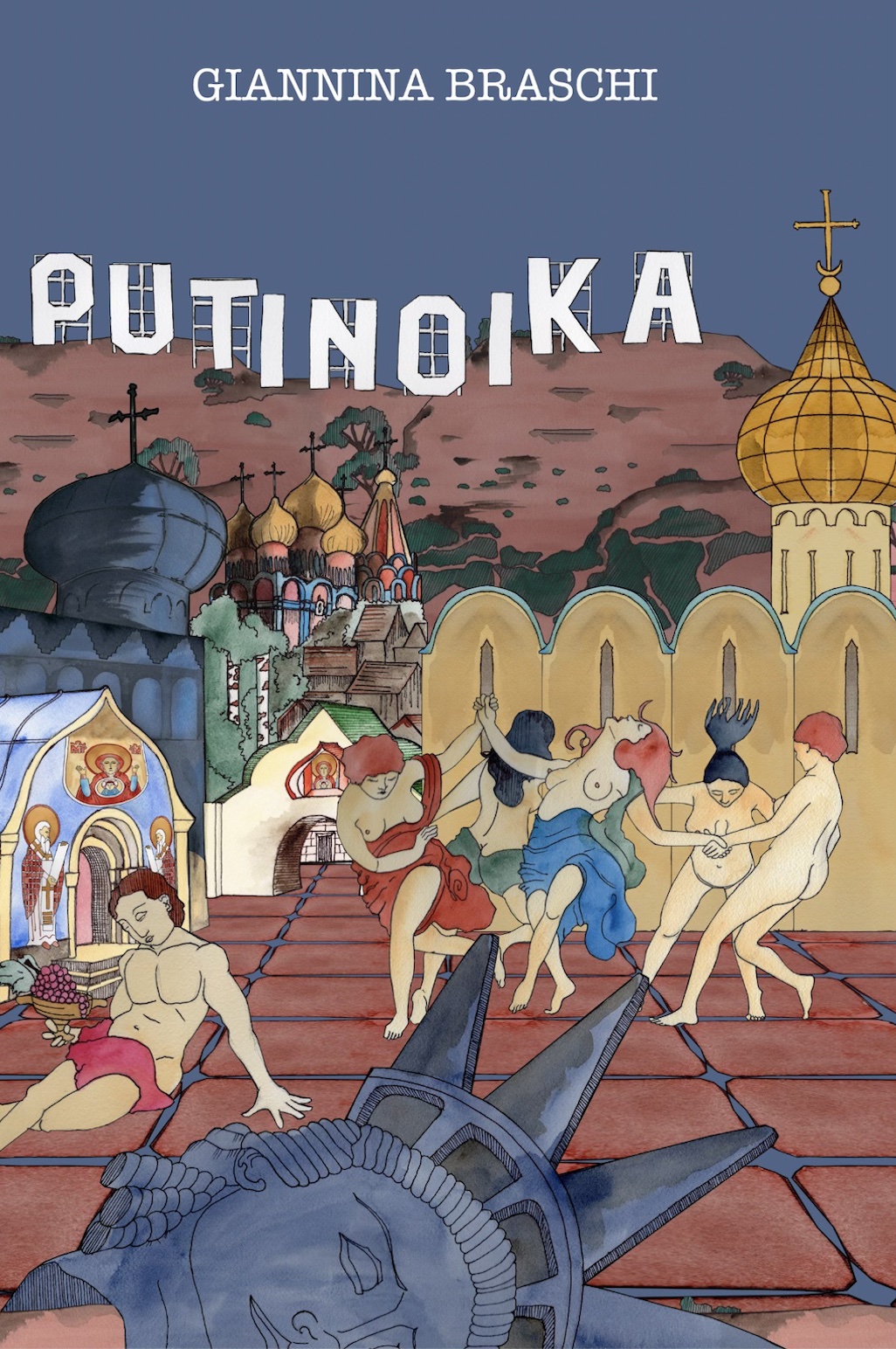 On September 25, 2024, in NYU’s King Juan Carlos Center, Puerto Rican author Giannina Braschi began her book tour for her latest project, Putinoika. She read a scene from the dramatic section “Bacchae” to a packed house, captivated by her frenetic narrative and charismatic delivery. Characters popped in-and-out without introduction or explanation, ignoring time and space. Her performance, like her entire oeuvre, reminded me of West African griots who used storytelling to record the past, present, and future. To witness a modern-day griot firsthand fueled a spontaneous desire to create: I wanted to go home and write poetry right at that moment. I experienced that same rush when I read the novel.
This is the impulse that rises from reading Putinoika: it encourages creation amidst ruination. This is evident in the opening chapter, “Palinode,” when the character Giannina explains how the Greek legend Medea “corrected her destruction with creation.” Similarly, Antigone follows the path of creation, drawing from her tumultuous history to find a second wind and craft a new narrative identity that transforms her into a “drama of herself in two parts: Anti and Gone.” Putinoika gives Antigone the opportunity to break old patterns, devise her own reality, tell her own story as she sees fit—an announcement directed to all the book’s readers.
Putinoika is avant-garde in its approach. The mixed-genre aesthetics build upon Braschi’s previous explorations of nonlinear time, mythmaking, and resistance to fixed definitions, as seen in United States of Banana (2011), Yo-Yo Boing! (1998), and El imperio de los sueños/Empire of Dreams (1988). Braschi’s writing is famously difficult to classify. Latin American Literature Today’s Dossier: Giannina Braschi cited a string of identifiers such as “a Nuyorican poet, a Latinx philosopher, a postmodern novelist, a social satirist, a magical realist, a feminist, a post-dramatic playwright, etc.” and her work with frequently associated terms such as “Spanglish, transnational, speculative fiction, hysterical realism, McOndo, and Post-Boom.” Her self-identification as a soothsayer serves to name and situate herself and her work within the literary canon on her own terms. This is reflected artistically and comically throughout Putinoika, particularly when the book personifies and speaks for itself, insisting that “everybody is talking about” it, and that it wants to “talk for itself.”
Straddling between an epic poem and a theater play, Putinoika echoes Greek classics, such as Aeschylus’s Oresteia, Homer’s Iliad and Odyssey, Sophocles’ Theban Plays, and several of Euripides’ tragedies, most notably Bacchae. However, Braschi liberates the allusions from their canonical constraints. Agamemnon, Creon, Oedipus, Eurydice, Teiresias, Antigone, and Bacchus and his muses converse with a diverse array of figures—from Euripides and El Greco to Maria Callas, Trump (“Pendejo”) and his agents, Vladimir Putin and his Putinas—Ivana, Ivanka, and Melania—as well as personifying concepts such as Frenzy, Covid-19, and the Economy. These interactions occur during the Trump and Putin era, marked by collusion, delusion, and pollution. As the world transforms under the weight of frenzy and disease, Braschi interrogates how these contemporary crises, figures, and forces intersect with myths and archetypes. Through these dialogues, Putinoika provides a sense of hope, empowering readers to shape their own meaning from the chaos and uncertainty around them.
“As the world transforms under the weight of frenzy and disease, Braschi interrogates how these contemporary crises, figures, and forces intersect with myths and archetypes.”
Braschi does not identify as a storyteller nor as a griot, but rather as a soothsayer: “We don’t need storytellers. We need soothsayers. I never said I am a storyteller. I said I am a soothsayer. I say the sooth.” She further notes, “They think it’s all about the storytelling. But I say it’s about the geometry and architecture,” highlighting that Putinoika is not only concerned with the narrative but also with the shapes, patterns, and structures of radical thinking that constitute it. By asserting that she is a soothsayer, Braschi is doing what she wants her readers to do: to seek truth while imagining a future. However, the very act of rejecting the role of storyteller and donning the veil of soothsayer is a storytelling gesture in itself—one of creation and re-categorization.
While affirming the power of prophesy, Putinoika also speaks to the unreliability of prophets and seers. The blind prophet Tiresias, who claims to have founded “fate news,” employs fear to create fake news so that he can orchestrate the destinies of Creon and Oedipus. It is fate news that returns Creon to the Theban throne and assists in the banishment of a blind Oedipus. Tiresias wields tall tales to determine fate. For him, seeing the future is about creating it in his own image or for the image of a ruler. For the seer Cassandra, foresight entails that every time she gives a prophecy, no one believes her. It means her imprisonment, servitude to Agamemnon, and death by Clytemnestra. However, in Putinoika, Cassandra is liberated from the curse of seeing and not being believed. Cassandra is not only believed, but beloved by the multitudes. The character Giannina, in turn, is a seer for the voiceless, who cares for the past and is concerned with securing a truly inclusive future. Her soothsaying is an avenue towards hope, love, and creation.
The essence of Braschi’s soothsaying is an invitation to name things for oneself, to create one’s own interpretations, to produce new stories and, with them, new outcomes. Braschi refuses to give her audience a singular, authorized version of anything. Instead, she leaves spaces within the liminal for the reader to participate in the generative process of mythmaking. She invites her readers to be soothsayers. In this way, Putinoika is a project of empowerment, encouraging readers to embrace the uncertainty, to resist fixed definitions, and to take ownership of the narratives that shape their lives. This challenging and entertaining book reminds us of the profound importance of questioning, of acknowledging our stories, and of engaging with our past to create a deeper, more meaningful future. These actions, according to Putinoika, offer a path toward greater awareness—a journey, as Giannina’s character observes of Antigone and Electra, toward “thinking free and new.”