Few literary traditions are as disproportionately rich as Uruguay’s, taking into account the country’s size. In the early twentieth century, Rodó published his Ariel, which would fuel conversations for decades; Horacio Quiroga laid the foundations of the modern Latin American short story and, not long later, Onetti would forge the path toward a radically modern novel, perhaps before its time. Poets like Delmira Agustini, Juana de Ibarbourou, Idea Vilariño, and Ida Vitale left unmistakable marks on Latin American poetry. This tradition of cosmopolitan openness also gave us critics like Rodríguez Monegal and Ángel Rama. I’ll stop myself there, as the list could go on and on.
In the twenty-first century, Uruguayan literature has been no less impressive. Many uniquely powerful writers have emerged. One of them is Fernanda Trías, whom we feature on the cover of the thirty-ninth issue of our magazine. This choice is not gratuitous. Her widely acclaimed literary career has earned her major prizes, both in Uruguay and internationally, and her books are sold and read in her own country and abroad. An heir to the Río de la Plata narrative tradition, Trías develops her personal conception of the short story in this issue’s interview with Juan Camilo Rincón. As she explains, her work involves “stringing together this Story Two in the in-betweens, the silences, in everything that Story One does not say.” The strange also comes into play as perhaps the aspect that most clearly links her work to a certain Uruguayan tradition: I would dare to call it a distinctive hallmark of her literature.
Besides being a reader of the great masters of the short story, Trías is also a novelist. This interview is centered on her most recent book, Miembro fantasma (Páginas de Espuma, 2026), whose title embodies a concern that permeates its pages: that which is no longer there—a person, a place, a relationship, a past—continues producing effects, like an invisible presence that refuses to disappear. Something similar happens when we read her stories: we keep thinking about them after the fact, as if some part of them had never left us. Impossible to label and with a personal poetics you can spot from a mile away, Trías is an essential voice in the Latin American literature of recent years.
This issue’s second dossier is dedicated to a single book: Chilean writer and researcher Braulio Fernández Biggs’ monumental study of English Jesuit poet Robert Southwell (c. 1561–1595), titled Robert Southwell: Jesuita, poeta y mártir (Fondo de Cultura Económica, 2026). This more than 800-page volume is the first book ever written in Spanish to be dedicated entirely to Southwell, and it comes complete with all of his poetry in bilingual edition, translated to Spanish for the first time in its entirety. Fernández Biggs’ book stands as a critical contribution to our knowledge of Robert Southwell in the Spanish language, and it is sure to hold the interest of lovers of English literature for a long time to come.
Here, two Chilean authors reflect on the book: writer Nicolás Bernales and historian Alfredo Jocelyn-Holt. The former sees Fernández Biggs’ endeavor as “the recovery of a writer” whose absence forces us to inquire into “the mechanisms of the literary canon” and the reasons why a given tradition decides who stays and who disappears. Bernales also highlights the volume’s multifaceted nature—it is “an academic volume, a biography, a work of religion, reference, or study”—and its success in reconstructing, all at once, Southwell’s life, his historical and religious context, his poetry, and his place in the English literary tradition. For his part, Jocelyn-Holt celebrates Fernández Biggs’ skill at “combining the varied facets of his biographee […] betraying neither the whole nor its parts.” Life and work come together into a whole in which poetry, faith, underground action, and martyrdom all shed light on one another. The result, as the historian tells us, “brings Southwell back, present and alive,” proving that, more than four centuries after his death, “what he has to tell us is still eloquent today.”
This work by Fernández Biggs upholds once again the maxim that Borges defended so vehemently in his famous essay “The Argentine Writer and Tradition”: Latin American writers and intellectuals are free to make the Western tradition their own. It is curious that an author from a Western country should find it necessary to publicly reclaim his right to this tradition. But reclaim it Borges did, and he went even further when he asserted, at the end of this brief essay, that “we must believe that the universe is our birthright” (tr. Esther Allen). The book by Fernández Biggs’ that we present in this issue of LALT seems to confirm, many decades later, that this claim from Borges is still valid, and is indeed one of the traits that, to my mind, characterizes a great deal of South American literature.
Also in this issue, Joaquín Castillo writes for LALT about El ejército ciego, the novel with which Mexican writer David Toscana earned the 2026 Alfaguara Prize, becoming the fifth writer from his country to receive this award. The Alfaguara Prize needed a novel like Toscana’s—one less anchored in realism and more open to the fable, myth, and imagination.
Here we also reproduce the prologue by Carlos Granés to the new edition of one of the most controversial Latin American essays of its time: Del buen salvaje al buen revolucionario by Venezuelan writer and journalist Carlos Rangel, published by the Fundación para el Progreso in Santiago de Chile in 2023. Granés hits us where it hurts: he maintains that Latin America must abandon the explanation of its history based on victimhood and examine its own responsibilities, from caudillismo, nationalism, and populism to authoritarianism, institutional weakness, and its fascination with utopian politics. As we all know, Latin America is not unlike that student whose bad grades never seem to convince him that he’s going to fail. That is, until he fails.
In this issue, we also share a fragment from “El afán europeizante” by Pedro Henríquez Ureña. We don’t want to forget the past, much less one of its most significant literary critics. This text was originally published in Seis ensayos en busca de nuestra expresión (1928), and we include it here in LALT as a sort of aide-mémoire, to ask ourselves once again what it means to be American. The spirit of our literature is deeply defined by its hybrid condition, its ability to appropriate diverse traditions and put them in dialogue with an experience all its own, and a cosmopolitanism that few other literary traditions have handled so naturally. Borges, who was a close friend of Henríquez Ureña’s, remembered him with words that speak for themselves: “Pedro felt American and even cosmopolitan…” Such an adverb is not for just anyone. You have to earn it.
We round out this issue with a series of interviews with Andrea Chapela, Nona Fernández, and Juan Gómez Bárcena; from the pages of World Literature Today, Haleh Liza Gafori brings us closer to the poetry of Rumi; and our section dedicated to translation brings together an essay by Miaad Banki and an interview with Spanish translator Jordi Fibla. In our poetry section, we feature Juan Carlos Galeano, Rosabetty Muñoz, Evodio Escalante, Alejandro Sebastiani Verlezza, and Jeannette Miller, while our indigenous literature section includes texts by Kalu Tatyisavi, Gloria Cáceres Vargas, Baruc Martínez Díaz, and Nadia López García. We highlight Brazilian literature with poems by Salgado Maranhão and Bruna Mitrano. In our previews section, we present texts by Horacio Quiroga, Miriam Reyes, and Xitlalitl Rodríguez Mendoza. The issue concludes with fiction by three essential voices of contemporary Latin American literature: Ariana Harwicz, Rafael Gumucio, and María Teresa Andruetto.
I’ll end this note with a reflection. We have often felt fascinated by other literary traditions. Those of Europe have been especially magnetic to us, and the literature of the United States has been no less significant. We have eagerly read French, German, Italian, and Russian writers, and many writers of the English language have left a deep imprint on Latin American literature. But this love has seldom been requited. The case of the United States is especially revealing: it is estimated that just around three percent of the books published here are translations, and if we look specifically at fiction and poetry, the most commonly cited estimate places the number at less than one percent. The English-speaking world, to an overwhelming degree, reads books originally written in English. The province is so vast that it sometimes resembles a metropolitan center. But this matters not. Perhaps this indifference has contributed, paradoxically, to our efforts to build ever bigger windows through which to look at what’s happening outside of our own countries and our own language. And this has also made us different: sometimes excessively (or even unjustifiably), we have been cosmopolitan. We are, in the end, the children of Darío and of modernismo. We look at what we have and think it’s not enough, so we look elsewhere. But the telescope can’t help you see what’s in your own backyard. This is our paradox. And this search brings with it a passion for an ancestry that is ours as well. Perhaps it is not the West we’re looking for, but rather, as Borges said, the universe itself.
Translated by Arthur Malcolm Dixon
Buy books by the authors and translators featured in this issue on our Bookshop page!
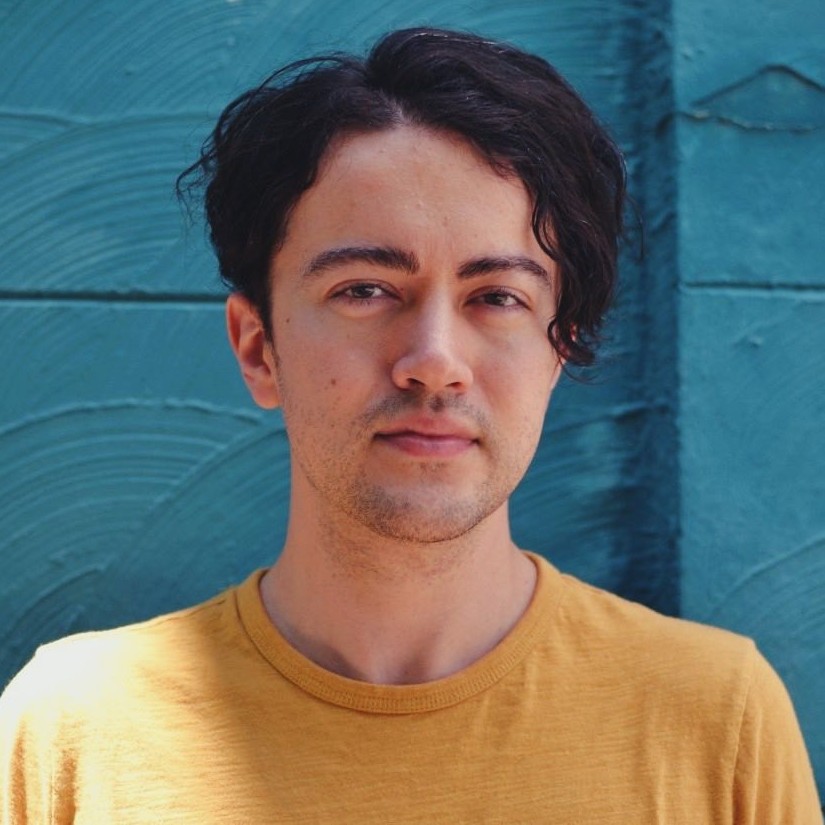
Photo: LALT editor-in-chief Marcelo Rioseco, by Carolina Rueda.