Skip to content
LALT-Iso-Black
  • menu
  • English
  • Español
Issue 36
Featured Author: Christopher Domínguez Michael

A Letter to Christopher Domínguez Michael

  • by Guillermo Sucre
Print Friendly, PDF & Email
  • November, 2025

Caracas, October 15, 1997

Christopher Domínguez Michael
Vuelta Magazine
Mexico City

Dear friend,

I write to you because I recently finished reading Tiros en el concierto, one of the books of the second half of your Literatura mexicana del siglo V that has truly impressed me most. 

As soon as I began leafing through the pages, reading the index of authors and subjects with which I am not entirely unfamiliar, pausing over certain passages and noticing the system of footnotes (a work of art unto itself), I immediately felt I would find it interesting. But I did not know to what extent. I anticipated a pleasant read, as I had experienced many times before thanks to the author. An ideal book from which I would delight in learning, in the throes of a postoperative convalescence in which I still linger. But this book did nothing but unsettle me. After reading the first two chapters (Reyes and, above all, Vasconcelos) in one fell swoop, I felt I was holding in my hands something more intense and dramatic, even dark. I jumped to the “scenes of the fifth century” and then to “Contemporáneos, the enemies of the promise” (alas) and did not feel particularly relieved. 

“Well, stop reading for now,” my wife said to me, seeing that it was keeping me awake, like when she sees me reading Bloom or even Steiner. It was not the same. My reaction was not one of outrage or opposition. What I felt was that something very deep (among Latin Americans) was being elucidated through what I was reading. I do not wish to somberly dramatize my reading of your book; I think nothing could be further from your intentions. Your book is like the (re)birth of a true critical conscience in all our language’s literature. I see it as an example of courageous lucidity, and I was moved by its immense understanding and commiseration. What it gives us, in the end, is tragic pleasure after great catharsis. 

So I thank you kindly for having had your book sent to me, which I consider a sign of friendship. Take good care of yourself after this lengthy effort, and care for your soul. The vultures must be circling above you. 

With warmest wishes,

Guillermo Sucre
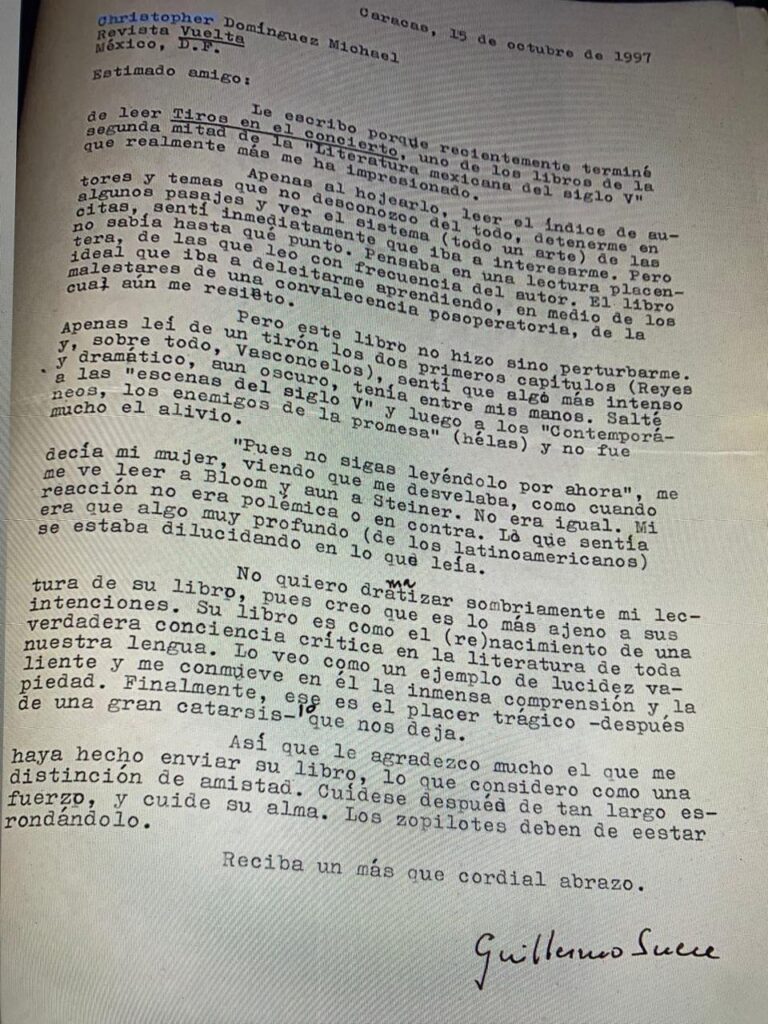
A Letter to Christopher Domínguez Michael


Translated by Arthur Malcolm Dixon
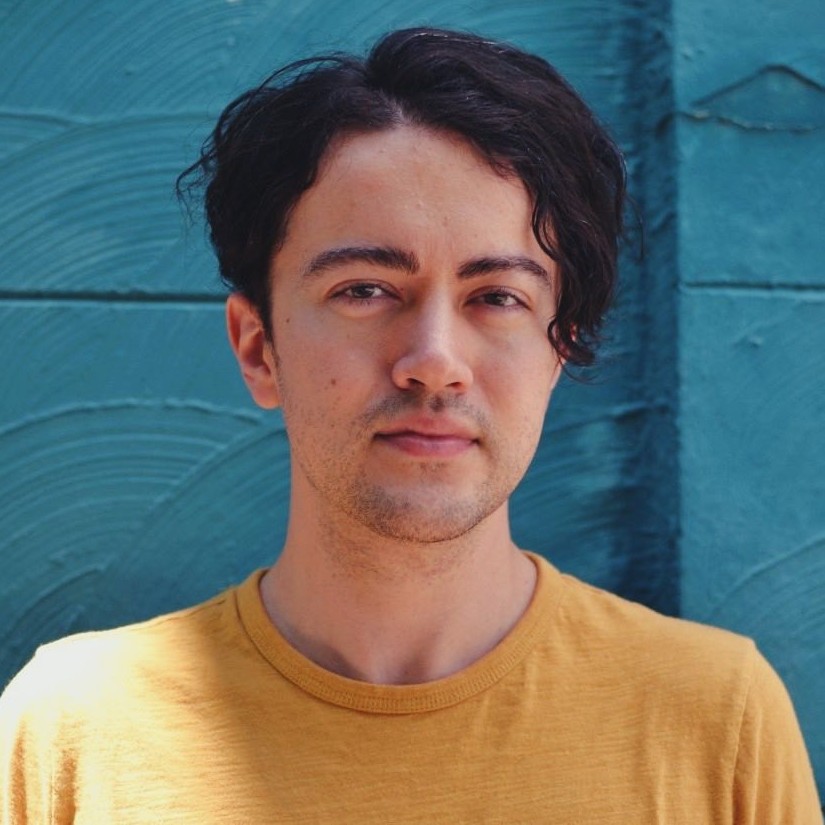
Photo: Venezuelan poet and critic Guillermo Sucre, by Roberto Mata.
  • Guillermo Sucre

Photo: Roberto Mata

Born in Tumeremo, Bolívar, in 1933, Venezuelan writer Guillermo Sucre was also an essayist, translator, literary critic, and educator. A cofounder, in 1957, of the literary group Sardio, he taught at the Universidad Central de Venezuela, the Universidad Simón Bolívar, and the University of Pittsburgh. He was awarded, in 1976, the Premio Nacional de Literatura for his nonfiction volume La máscara, la transparencia (1975). Among his books are En el verano cada palabra respira en el verano (1976), Serpiente breve (1977), and La vastedad (1990). He also wrote Borges, el poeta (1967), a study on the work of the Argentine author of “The Aleph.”

  • Arthur Malcolm Dixon
headshotarthurdixoncroppededited1

Photo: Sydne Gray

Arthur Malcolm Dixon is co-founder, lead translator, and Managing Editor of Latin American Literature Today. His book-length translations include the novels Immigration: The Contest by Carlos Gámez Pérez and There Are Not So Many Stars by Isaí Moreno, both from Katakana Editores, and the poetry collections Intensive Care by Arturo Gutiérrez Plaza and Wild West by Alejandro Castro, both from Alliteration Publishing. He works as a community interpreter in Tulsa, Oklahoma, where from 2020 to 2023 he was a Tulsa Artist Fellow.

PrevPreviousQuestions for a Necessary Critic: A Conversation with Christopher Domínguez Michael
NextDomínguez Michael and OverwritingNext
RELATED POSTS

From Freeway: La Movie

By Jorge Enrique Lage

Some Observations on the Present Collection

By Ismael Gavilán

Any collection or poetic selection of an anthological nature, however brief it may be, will always be a curatorial exercise that should be aware of its precariousness: wishing to be…

Mothers and Daughters: Generational Conflict and Social Change in the Work of Dubravka Ugrešić

By Emily D. Johnson

Footer Logo

University of Oklahoma
780 Van Vleet Oval
Kaufman Hall, Room 105
Norman, OK 73019-4037

  • Accessibility
  • Sustainability
  • HIPAA
  • OU Job Search
  • Policies
  • Legal Notices
  • Copyright
  • Resources & Offices
Updated 06/27/2024 12:00:00
  • SUBSCRIBE
Facebook-f X-twitter Instagram Envelope
Latin American Literature Today Logo big width
MAGAZINE

Current Issue

Book Reviews

Back Issues

Author Index

Translator Index

PUBLISH IN LALT

Publication Guidelines

Guidelines for Translators

LALT AND WLT

Get Involved

Student Opportunities

GET TO KNOW US

About LALT

LALT Team

Mission

Editorial Board

LALT NOW
OUR DONORS
Subscribe
  • email
LALT Logo SVG white letters mustard background

Subscriptions

Subscribe to our mailing list.