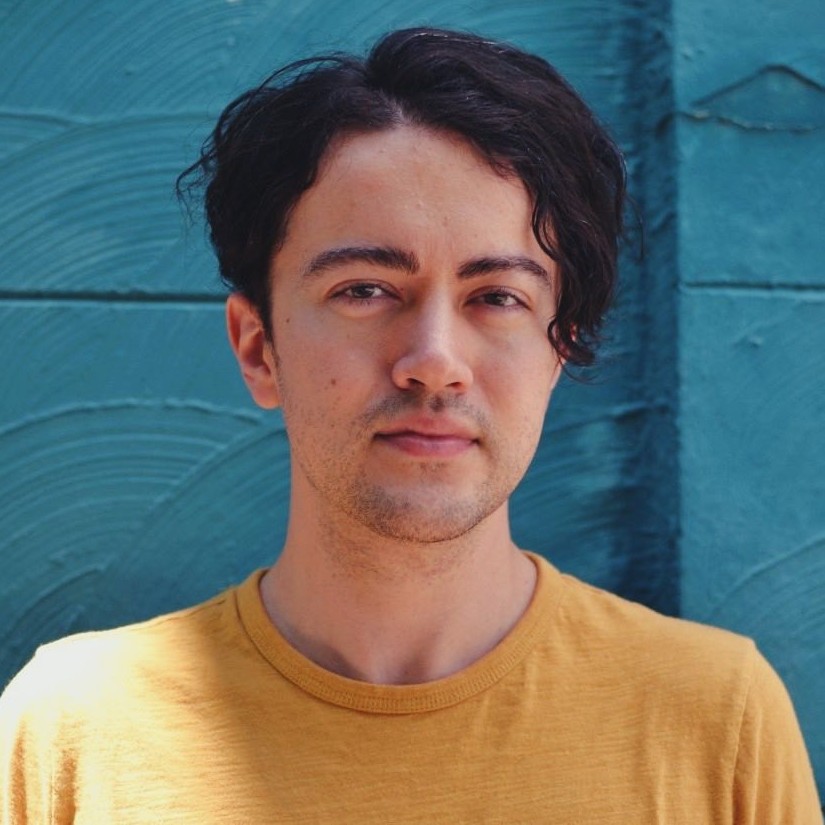
This interview comes at a time when the English-speaking elite, outside the academy, is shaken by the dismissal and cancellation of criticism in the humanities, and above all of reviews: a subject addressed in El crítico sin estatua, Domínguez Michael’s latest book. As V. S. Pritchett said of Cyril Connolly (one of the Mexican writer’s guiding lights), Domínguez Michael is “surviving in the ruins,” incomparable and inimitable, with no need for a sharp tongue. His books confirm that he is an aesthete, a jovial philologist, philosopher, and historian without getting lost in any of these fields, allowing ideas to reign over emotion. A global Latin American, and not a “Latin-Americanist,” he is a master of creative interpretation.
Wilfrido H. Corral: Another interviewer recently ascribed certain traits to you, which I would vouch for too: “His heterodox mentality, his freedom of thought and his documentary, ludic prose, biting and ironic and dizzying, make him one of the most relevant critics and essayists of present-day Hispanic America.” Add “practical” and “controversial” and we have a basic outline of how the evolution of your criticism is generally perceived.
What has not yet been asked of you about your work as a multidisciplinary critic, and what questions would you ask your own most influential critics—Sainte-Beuve, Connolly, Auerbach, Dwight McDonald—although they and their progeny have not focused whatsoever on Latin America?
Christopher Domínguez Michael: For starters, I don’t like the present-day understanding of “multidisciplinary,” because in the case of the great critics whom I admire, precisely for that reason, we know intrinsically that they were old-school humanists, which is not the same as latter-day professors of “cultural studies,” because what lay at the center was man, not identity. That’s why, when it comes to the great critics of the nineteenth century, I always mention the example of Menéndez Pelayo, who has been forgotten thanks to his being Spanish, and because the stink of Francoism stuck to him (even though he died in 1912!). At any rate, he was a great European critic, whose Historia de las ideas estéticas en España became a tremendous introduction to Europe when he realized that, in the Spain of his day and of the eighteenth century, there were no original aesthetic ideas.
Neither Sainte–Beuve nor Georg Brandes nor much less Connolly (who was at least honest enough to only talk about the books he could actually read in English and French) were as cosmopolitan as Menéndez Pelayo, who was, incidentally, the first Spaniard to study and anthologize Hispanic American poetry. We now find his pre-Romantic classicism hard to swallow, as Darío did in his day. The problem of the great critics not focusing on the Spanish language (although Don Marcelino did focus on the grand European tradition) is historical, on the one hand, and racist on the other. Curtius was the exception, one of the few.
Modern criticism was born after the Enlightenment, with Romanticism (Sainte–Beuve, and Friedrich Schlegel a little before him, the father of what we call “literary theory”), when the Spanish cycle was exhausted. Ortega said it himself: the eighteenth was the least Spanish century of all. The language of Cervantes and the Spanish Golden Age were in the distant past, and when Modernismo and then the Boom appeared, the Anglophone academy had already decided we were part of the “third world.” Before being described as such, our literature was already called “neocolonial”: an insult of inconceivable—and racist—intellectual lowliness.
I am still waiting for a “U.S. American” professor to explain to me why Sor Juana or Carpentier are “neocolonial” while Poe and Melville and Emily Dickinson aren’t… Not to mention the fact that, before 1776, there was no literature in North America north of the Rio Grande. The modern critical tradition was born leaving us out, which is paradoxical; the people of Jena in 1800 loved Calderón de la Barca becasue the sons of Goethe were then “third-world” themselves. That’s why we’ve had to persist in our modernizing rebellions: in ‘98, ‘27, and ‘67, which was the year of the Boom. As Paz used to say: if in the United States they don’t know that Darío and Machado are as important to modern literature as Pound and Eliot, too bad for them.
W.H.C.: Why do you think there is not a history of Latin American criticism? What are the most glaring absences?
C.D.M.: We haven’t put together that great history of our criticism due to an inferiority complex. There are more than enough figures: Bello, Sarmiento, El Nigromante, the critics of Modernismo, many poet-critics, Reyes, Henríquez Ureña, Jorge Cuesta and the Contemporáneos, from Brazilian Anthropophagy to Tomás Segovia and Paz, Carrión, Mariátegui, not forgetting Antônio Cândido, Rama, Cobo Borda, Rodríguez Monegal, Borges as a source of critical thought, Uranga, Sanín Cano, Murena, the wicked Gutiérrez Girardot, Guillermo Sucre, Volkening, Sarlo… The journals Sur (never forget Victoria Ocampo), Contemporáneos, Orígenes, Taller, El hijo pródigo, Hueso húmero, Eco, Mundo Nuevo, Plural, Vuelta… Spain does not have such a tradition, despite the distinguished Revista de Occidente.
The problem is that, until very recently, thanks to Delirio americano (2022) by Carlos Granés, our great cultural critic, people believed in the “extralogical imitation” that still paralyzed Paz in his early days: the idea that, since we appeared later, we only ever exported ideas. I believe in a single Hispanic American civilization divided into historical cycles: I swear by Vico, which means coming close to Marx, in a way. With certain exceptions (Vila-Matas, Marías, Valente, Ramoneda), peninsular literature has not entirely recovered from the Francoist blackout and its belief that it has to “extralogically” imitate the other Europeans. Spain’s twenty-first century reminds me of Latin America’s nineteenth. One need only read the dust jackets of Spanish presses to detect this deficit of modernity. Granés, who is Colombian, explains that in the twentieth century, since 1922 in São Paulo, Latin America exported the avant-garde. It was not by chance that Breton, Eisenstein, and Artaud all came, Duchamp and his brief stay in Buenos Aires, Huidobro writing in French, Trostky himself, the artists of German origin who worked in Mexico, and so many others. The modern makes a comeback, with a more drawn-out, longer-lasting echo, from the edges. For political and idiosyncratic reasons, I am not a fan of Frida Kahlo’s, but I can’t dispute her originality. Don Luis Cardoza y Aragón fell short when he said our only original contribution to the world was muralism. How strange: Orozco is more German Expressionist than he is Mexican, although he comes from the eminently Mexican José Guadalupe Posada.
There are no “pure” French surrealist poets on the level of La Mandrágora, Gonzalo Rojas, Westphalen, or the Neruda of Residencia… Where is the European Parra? I don’t say this out of some creolist patriotism. I maintain that we are one single literature on both sides of the Atlantic, and that the great writer of the second half of the twentieth century, of the whole planet, was perhaps Borges, along with Beckett, maybe… That would be the heart of this as-yet-unwritten history of Hispanic American criticism. Let’s hope some bright scholars will someday complete it. Has no one ever thought to analyze our tradition of treatise-writing? El deslinde by Reyes, El arco y la lira by Paz, Poética y profética by Tomás Segovia? Segovia, incidentally, is a Spanish-Mexican poet and essayist, as well as a translator of structuralism into Spanish, who is not nearly as famous as he deserves.
An academic who specializes in Australia and has no interest in France or Mexico, inside or outside the university, is not a literary critic, to my mind. Literature is universal or it is not literature. One who allows himself to be deformed by the university may be a good professor, in the best of cases, but nothing more.
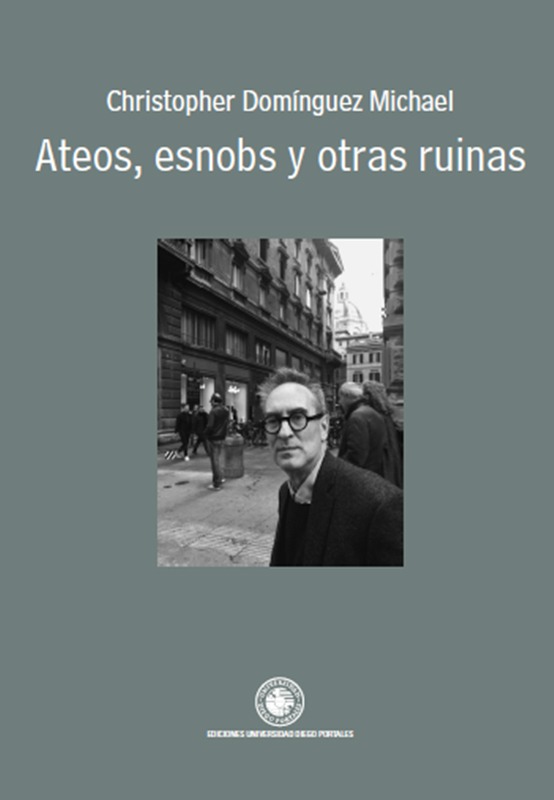 Ateos, esnobs y otras ruinas(2020) Ateos, esnobs y otras ruinas(2020)
|
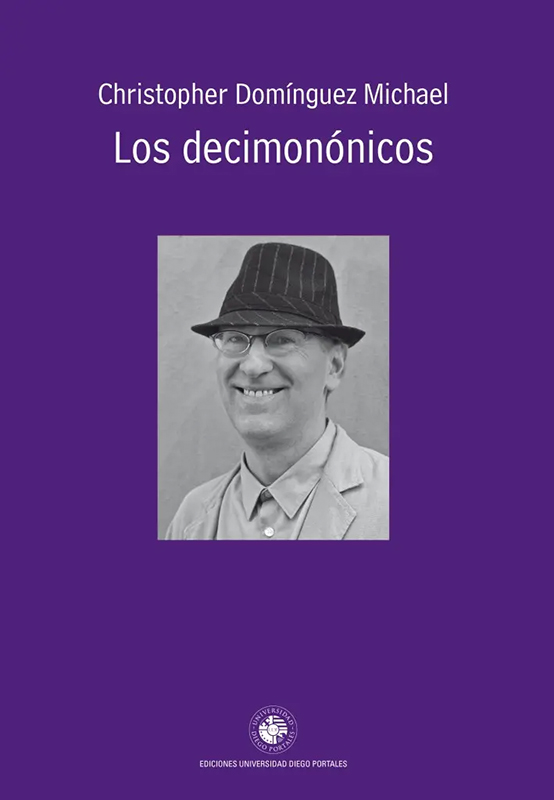 Los decimónicos (2012) Los decimónicos (2012)
|
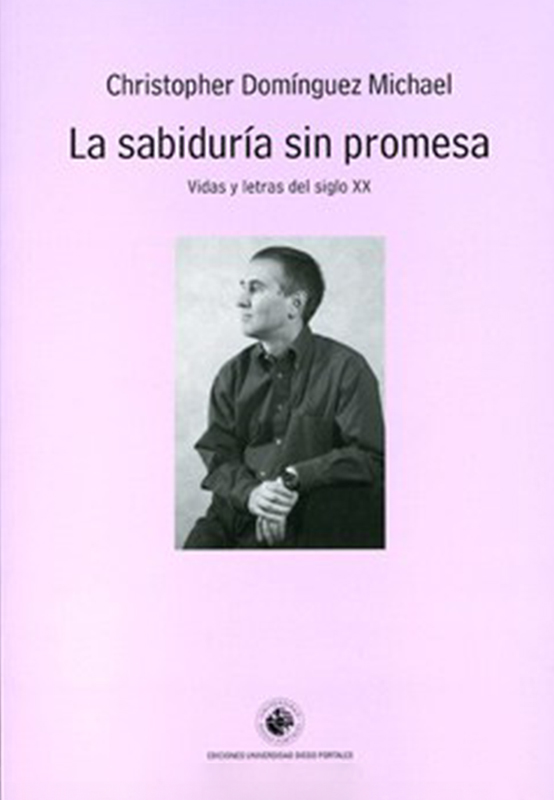 La sabiduría sin promesa (2009) La sabiduría sin promesa (2009)
|
Books by Christopher Domínguez Michael published by Ediciones UDP (2020, 2009, 2012)
W.H.C.: Following on from the previous question, Hispanic American novelists (take Vargas Llosa and Cortázar), as well as critics, have identified with Mario’s idea: “I discovered Latin America in Paris, in the sixties,” while others discovered theory, in translation, at that same time. What results does this bring for nonspecialized readers of literature?
C.D.M.: Vargas Llosa’s words reflect a Latin American custom, a happy custom. Darío, Nervo, and the draughtsman and painter Julio Ruelas discovered their Modernismo in Paris. But, unlike many others, the Vargas Llosas, the Nervos, the Daríos returned to build their body of work here. Beyond any personal contretemps, I was especially moved by the fact that Mario died in Peru. Thus he came full circle, and it told readers that, in reality, as Xavier de Maistre would say, it’s all “a journey around my room.”
W.H.C.: In a letter from 1967 included in José Donoso. Carlos Fuentes. Correspondencia (2024), the Mexican writer assures his Chilean counterpart that, in Latin America, no criticism meets the standard of “a fully developed literature,” owing to the ignorance of languages and specialized works of criticism. Sixty years later, even with criticism in translation and easy digital access, do you think the biggest change has been the domestication of our discipline?
C.D.M.: Fuentes and company felt there was no criticism here that lived up to their well-earned arrogance, and so they made their clientele of U.S. professors… some very effective, of course. They wanted to be García Márquez and Roland Barthes at the same time because their rivals were some rather stupid Raymond Picards. Because there is no history of our criticism, most are unaware of the devastating review Elena Garro wrote of the young Fuentes, not forgetting that García Márquez was also a Mexican writer, once; the critic and editor Emmanuel Carballo discovered El mundo alucinante by Reynaldo Arenas and many other little-known details of the current that became circular in our countries thanks to the Boom.
The early critics in Mexico, at least, took an interest not just in the Boom but in the whole world tradition. Musil’s finest reader was Juan García Ponce, and Juan Ramón Jiménez’s was Segovia. Lettered folk spoke more French in the sixties than they do today.
Today, English prevails, and the young postmodern writers (you’ve got to call them something) have accepted a shocking colonial submission to Anglophone literature. They write as if they were translating from English. They are the Afrancesados of 2025… They were domesticated by Marxism-Leninism and the structuralist and poststructuralist trends that you and Daphne Patai noted in Theory’s Empire. The eighteenth century was colonized (here and in France as well) by classicism, the nineteenth by romanticism, the twentieth by surrealism and the rest of the avant-garde, etc. They’re global phenomena. But, to be fair, such is the history of culture.
W.H.C.: Aira says he doesn’t read his recent contemporaries, while the Spanish press deifies him and his third-rate epigones. A good Mexican reader reads the Argentines, but the reverse is not true, as you’ve said (and other South Americans are not far behind). Is there a productive middle ground to these disquisitions on the real value of the canons we make up?
C.D.M.: It amuses me when writers say they don’t read their contemporaries. They do it in the bathroom, and they hide their rival’s novel behind a copy of Playboy (if Playboy still exists). A novelist is also a salesman, and nobody wins without checking out the competition. Reading your contemporaries is as natural as saying you don’t read your contemporaries. The parodist Aira himself, whom I respect a great deal, couldn’t parody Carlos Fuentes without having read him. Poets are even worse: they memorize the wobbly rhymes and fossilized metaphors of their rivals.
W.H.C.: As you said to Marcelo Rioseco, there are few of us critics in any literature; we don’t matter to the powers-that-be (except when we criticize them) and we disappear as soon as we become part of the U.S. academy, or because we’re not like the professionals of yesteryear. How are we affected by “Latin-Americanizing” subjects that are in vogue among foreign critics?
C.D.M.: Thinking in terms of world literature, praise be to Goethe, I don’t think any subject should be alien to us. Some, of course, come up for commercial or journalistic reasons; but they also buy succedanea, like the wrongly-named “magical realism.” I hope Roberto Saviano has read Fernando Vallejo and his Virgen de los sicarios: I think, after that novel, all others dedicated to the narco world in Latin America are superfluous.
W.H.C.: Some critics are reclaiming their mental health, while others bend to the pressures of the holy trinity of Diversity, Equity, and Inclusion, more in order to maintain well-paid jobs than for ethical reasons. Although these trends are now being questioned in the United States, they are exalted in Latin America. Do they have any effect on your practice?
C.D.M.: I couldn’t care less about what’s coming out of Spainsh and Portuguese departments in the United States… What was the last good book they gave us? We’ve been warned since the days of Robert Hughes and Harold Bloom that they’re not teaching literature and art, but rather identitary ethics, political resentment, and gender radicalisms. I feel bad for the dear friends of mine who are earning a living there, between wokism and Trump’s fascistoid politics. Hopefully, in half a century more, we’ll have another Lionel Trilling at Columbia. Sainte-Beuve was also a professor in Switzerland when the July Monarchy, which protected him, fell. Almost all the critics whom you and I admire were academics in more sensible times. The problem is the academic who tries to sell theories with holistic pretensions, who imparts a doctrine.
In 1995, after The Western Canon, I lamented the death of the humanist intellectual in the United States. An academic who earned his doctorate doing an impression of Deleuze and Guattari’s Kafka with José Revueltas was outraged when I called him a “terrorist critic.” He got really mad, he thought I was accusing him of planting bombs. No, I was applying the same rule to him as Jean Paulhan applied to those who sowed La Terreur in French letters. Professors who don’t read… The danger, Zaid says, is not that the butcher or the car salesman doesn’t read, but that nobody reads in the universities.
W.H.C.: In several interviews on your work, there is an underlying sensation that, by refusing to “theorize,” the criticism that only the foolish would call “traditional” has died out. Isn’t it true that the engaged critics are dying out, since they don’t offer novel ideas besides those that are intransigent?
C.D.M.: It’s impossible to do good criticism without theory. Last night I was reading what Boris Tomashevsky has to say about the fable, and it struck me as a true masterclass. The problem is when a professor decides literature can only be explained through Russian Formalism, which would make a Karl Popper break out in hives, being a fundamentally unscientific judgment, given its tautological nature, like believing psychoanalysis explains literature. Pierre Ballard—a Lacanian, as it happens—says literature explains psychoanalysis. What José Gaos said of philosophy applies to literature: it’s impossible to do literary criticism without literary history.
W.H.C.: Considering critical traditions, do you think a critic’s authority should be understood in political terms, or is that an ostentatious view of the critic’s place?
C.D.M.: A critic’s authority is political, always, because he acts in the city and the city has its arcades, its open-air markets, its academies. I still believe in the polis. If a critic acts on behalf of some political party and makes of this action a form of criticism—as bad critics do, as propagandists—that’s another story. For example, the right-wing extremist and collaborationist Charles Maurras, leader of Action Française, who saved his skin in 1945 thanks to his advanced age, was a writer who masterfully slipped in his anti-modern discourse, associating democracy with romanticism. People like him are able to distinguish their own ideology from propaganda. As a critic, Maurras was a political figure in that regard. His predecessor, Édouard Drumont, was not; he simply disqualified novels for being by Jewish writers, as a common antisemite. Or old man Lukács, who, upon reading Solzhenitsyn’s One Day in the Life of Ivan Denisovich, thought socialist realism had finally been put to use! His students used to say the old Stalinist considered “Soviet literature” rubbish, and he was not so sure that—upon attaining communism, the highest phase—things would get better. Not in vain did he write Soul and Form as a young man…
Sartre and Beauvoir with Castro, seeking a tropical compromise. Foucault, who dreamed of black masses, with the Ayatollah. Even our poor Father Ernesto Cardenal did the same, and died remorseful, persecuted, and punished. Or the Latin American critics who contracted the Guevarist pox and went to seek treatment—sometimes—at well-funded U.S. universities. In Sur, literary criticism and political criticism happened at the same time; it was antifascist and ancienne critique.
It’s no surprise that Blanchot and Paul de Man both come from European fascism. As the wise Brazilian liberal J.G. Merquior taught us, antihumanist literary theory almost always ends up in communion with the totalitarian mind.
Translated by Arthur Malcolm Dixon