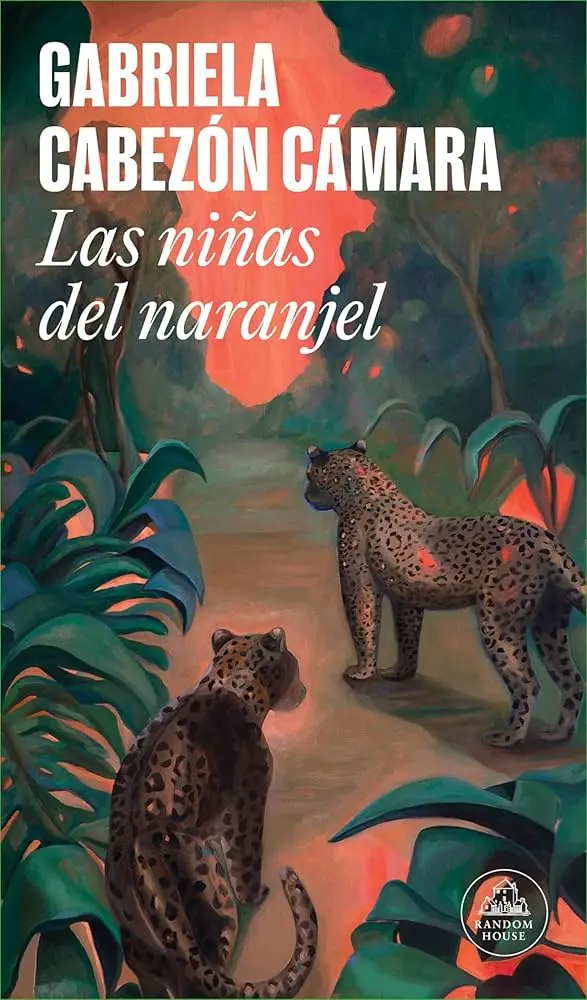
We spoke with the latest winner of the National Book Award for Translated Literature (alongside Robin Myers) and of the Premio Ciutat de Barcelona for Spanish-language literature in 2024, Gabriela Cabezón Cámara, about her book Las niñas del naranjel (Penguin Random House, translated as We Are Green and Trembling), a novel in which queer identity and the jungle, colonialism and violence, tenderness and the picaresque blend together to tell a story of conquests and tyrannies from a new perspective.
Antonio has fought battles, he has brandished a sword, he has fired an arquebus, he has murdered. In Spain, he was Catalina de Erauso, a nun born in 1598 who, at the age of fifteen, fled the convent to live a different life: “I knew I would need to dress as a man wherever I wished to roam.” Now, in America, he is a soldier, making his way through a jungle of potent aromas and home-brewed aguardiente, amid snakes and fungi, along with two young girls, Michī y Mitãkuña, and many animals, leaving annihilation behind and welcoming the comfort of the Indian children’s choruses: “A blind man who began to see. He was being summoned: they were singing to him. It must have been the Holy Virgin, leading him out of the dark.”
In his letters, he tells his new story to a distant aunt, the prioress of the convent, “immersed in the tale, as if everything he’s ever done has been for the specific purpose of telling her about it,” narrating this new life that is and is not his own. Catalina is Antonio, he has transformed more than once, he has claimed his place as a man and has once again softened, he has been a gentleman, a cabin boy, and a shopkeeper; he bathes in the river with the girls and explains to them that burning sinners pacifies God. Thus, the Argentine writer tells—by other means—the story of the Conquest that was a genocide, of battles that swept away what came before, and of tyrannies that never seem to end.
Juan Camilo Rincón: As soon as we start reading the novel, we come up against two different narrators. How did you construct this dialogue, these distinct musicalities?
Gabriela Cabezón Cámara: The first thing that came to me was Antonio’s voice, his letter to his aunt, a first-person narration in the style of baroque music, almost torrential, that tells more and more of the story like a river going down a mountain, abundant, rushing and free-flowing. And, not long after starting on that voice, I realized it wasn’t enough for me to tell the story the novel demanded. So there’s a more traditional narrator, in the third person, written in a non-satirical Spanish—Antonio’s Spanish is satirical—who can come and go and slip inside other characters, seeing things that Antonio doesn’t. That’s how these two voices emerged. The last thing to come to me were the voices of the girls, who, I think, give the novel light, meaning, and life.
J.C.R. “La Monja Alférez,” or “The Ensign Nun” as she’s known in English, is a very interesting character; she goes through a transformation with which you develop the idea of the strong bond between sexuality and religion. You’ve said she first “came to you” when you saw a painting. How did you give shape and life to a character who is so interesting and, perhaps, so unexpected in the colonial context?
G.C.C.: Over twenty years ago, at the home of a great love of mine, I saw a watercolor that showed a person with armor and a lance, murdering a female figure who was at his feet, half-naked with feathers in her hair. It was a scene from the Conquest, obviously, and underneath it said: “La Monja Alférez.” This surprised me and made me curious because, in fact, neither of the two figures looked like a nun. I was completely unaware that “alférez” was a military rank, as I learned not long after; I thought it was a surname. They told me a little about this man’s life, and I was blown away. I had not known there were characters of that ilk at that time, in the midst of the eminently Catholic undertaking that was the Conquest. But, after all, the Pope at that time was just as Catholic too, and he gave “The Ensign Nun” the right to use his chosen name: Antonio.
J.C.R.: Catholicism is also a historical phenomenon, in the end.
G.C.C.: Exactly. Catholicism is not monolithic—it changes and takes on nuance, and at that time it seems this nuance was within the realm of possibility for Urban VIII; no one fired him as head of the Church for it, if you will. I read Antonio’s autobiography and thought, “How crazy, this is wild!” And that was it. Six or seven years ago, I was writing other stuff and I had a little of this, a little of that, but it wasn’t coming together; they were bits and pieces with points in common. They shared a sort of melody or color or scent, but they didn’t link up, they just drifted apart. Then I was talking with my editor, Ana Laura Pérez, and she said to me, “Remember how much you loved that character, La Monja Alférez?”
J.C.R.: That was the jolt you needed.
G.C.C.: It was like, “boom!” And it fell into place. This was before the pandemic, when those huge fires broke out, on a geological scale, in Australia and in the Amazon. The images from that time were horrifying; they were the first fires of that magnitude I had seen in photos and videos; the looks on the faces of the charred animals, the barbed-wire fences keeping them from getting away, and, besides that, the knowledge that it was neither an accident nor an isolated incident, but rather a result of climate change produced by carbon emissions, fossil fuels, oil and gas, which have laid waste to so many of this planet’s once-wonderful, living places, and which, given the current geopoligical circumstances, threaten our very chances to keep existing. Besides all that, I was—and am—very fond of the Paraná rainforest, a beautiful place that starts in the north of my country, in Misiones, and goes up to the north of Rio de Janeiro; it’s thousands and thousands of kilometers of a huge, gorgeous jungle.
J.C.R.: Your previous novel ends up there, in a way.
G.C.C.: And I wanted to stay there, so all these ingredients came together. Somehow this character, La Monja Alférez, with all this barbarity and violence, and also with this plasticity, this capacity to change—because, in Las niñas del naranjel, her change in gender is in the past, in the novel’s background—has to face a much more radical change. She has that plasticity; since she has already undergone a transformation that, in society’s eyes, is important enough to persecute, revile, stigmatize, and torment those who go through it, she’s capable of undergoing an even more radical transformation. This character also worked for the story because of his role in the Conquest. If you think about the origins of this trend of tearing apart the whole fabric of life—a trend that is putting every complex life form on this planet at risk, including ourselves—I find that the Conquest is not the starting point, such that you’d say, “That’s where it began and you can’t think different.” There were probably many different beginnings.
J.C.R.: But the Conquest was a real milestone in that regard.
G.C.C.: So much so that the process of Spain and Portugal’s arrival—I think it was just Spain back then—in the land that is now the Americas, between 1492 and 1592, was a process of murder, of committing a genocide against more or less ninety-five percent of the native population. It was so beastly that forests grew where there had been crops before; the planet’s temperature dropped a little; in Europe, there was something known as a “Little Ice Age” (two or three years of very sparse harvests, if any); there was famine, people were thinner; a couple of rats got bitten by a bug and boom, the plagues arrived. The Conquest of America was a genocide on a geological scale. So the historical link is already there. I was interested in talking about that cruelty and violence, but also about tenderness. At a time when I was really stuck with the story because everything you heard about was violence, horror, torture, and massacres, and I couldn’t take it anymore, I went to sleep thinking, “How can I carry on with this novel?” I couldn’t get out of it, even if I had wanted to, because I was already inside it. And I had a dream. I don’t remember what it was about, but I know I woke up with four words on my lips: “As cruel as tender.” That’s when the two little girls appeared, and the novel could come into being. It let itself be written.
J.C.R.: The novel unfolds in two timeframes: Antonio’s present, with his encounter with the two girls in the jungle, with the monkeys, the horses, and the dog, and his past, which you show us through his letters. In the middle, there is a sort of rupture that leads him to write these texts, to understand where he comes from and why his present is taking place. Tell us about this vision of two different colonies that you create in the book.
G.C.C.: I’m from Argentina. I grew up and went to school in Argentina, a country that is built directly on the myth of the other’s absence. Argentina was a desert. They taught us about this empty, deserted land. At any rate, it was contradictory. I see you have a picture of Borges there; in his poem “The Mythical Foundation of Buenos Aires,” Borges mentions “the spot where Juan Díaz fasted and the Indians feasted.” There’s this notion that there were people who once lived here and still live here, but there’s also the notion of the desert, which is very curious and interesting. What was called “the Desert Campaign” was a military operation, on a massive scale, to conquer said desert. Well, if you need a massive army to conquer it, the place must not be deserted, right? It was horrendous. But most of us—even those of us who clearly have native ancestors at first glance, and those of us whose ancestry is a little less clear at first glance, like me—were taught this idea that there was nobody and nothing here before, and that whatever was here was worthless because they were cultureless people who didn’t build pyramids.
J.C.R.: Many people grew up with that myth.
G.C.C.: And with that lie, the lie of denying the other’s existence; there’s a fierce racism in Argentina, which denies the existence of people who are not of European descent. We have this myth of the Argentinean as an exiled European, which I think is now in decline, but up to my generation we were taught that myth. Sometimes, when I hear people from different humanities disciplines citing only European philosophers and writers, and I notice they see themselves as exiled Europeans, I say to them, “Well, guys, why not go back? Get yourself to Berlin, Paris, London, and say, ‘Brothers, I have returned.’ They’ll give you one hell of a welcome, guys, you’ll see.” There’s an alienation in which you don’t realize you are the other in this discourse; you don’t enter into that supposedly universal category. For example, when Adorno wonders how you can write poetry after Auschwitz, or if you can—which I think is a very legitimate question, since it was truly a nightmare—you want to answer, “Theodor, think back to what was going on in the Spanish Golden Age, buddy. And get real.”
J.C.R.: This idea tells us that anything that’s not European is inferior.
G.C.C.: And somewhat subhuman, as if it didn’t exist. The problem is that we think the same way. I think there’s a crucially important political operation we have to undertake here. We are wonderful, Latin America is a beautiful place, we are beautiful, we have myriad incredible cultures, people live among us who are able to prosper without killing everyone, without tearing apart the fabric of life on Earth. More rational people, I mean, because Western rationalism never realized that, with a finite planet, there can’t be infinite progress—plus, how do you define that “progress,” who does it include, what does it mean? Not all of us count in that progress, and besides, our planet has limits, our bodies have limits.
J.C.R.: So you were thinking about indigenous cultures?
G.C.C.: And, for example, Eduardo Viveiros de Castro systematized the notion of what has been called Amerindian perspectivism. For Amerindian peoples, or at least the peoples of Amazonia, humanity is a question of perspective. Every being capable of having a perspective—that is, the two of us, the dolphins swimming along, the jaguar—is human. Perspective makes you human. It’s mind-blowing, and it also allows for an approach to all other living things; you have to think more in terms of cosmopolitics. The point, then, is that you have to negotiate with the human other; you can’t just go and exterminate it without a second thought. There are counterexamples: we were talking about the Conquest, we talked about Auschwitz, we could talk about Palestine, Sudan, the Amazonian peoples, what they’re trying to do to the Mapuche in my country, etc. But, in principle, you have to negotiate and recognize some dignity in those other humans as well. The Amerindian peoples are extraordinary.
J.C.R.: And your novel starts with the idea that nature has to be conquered. It makes me think of La vorágine or Heart of Darkness, where it’s believed that, no matter what harm we might cause, the earth will always heal. Now, speaking of that human duality, it’s very interesting how you create this nun who is wicked, violent, murderous, thieving, criminal, but then the little girls and the animals come along with their tenderness and lead her to another of her many transformations.
G.C.C.: Well, there’s the first change, the change in gender, which he recounts to his aunt, the prioress of the convent where he was put away as a little girl. The nobles were beastly people; they sent their little girls away when they were four years old, saying, “Off to the convent, off to the seminary.” They were horrible. So he undergoes that first radical transformation that allows him to live as he chooses, which is very interesting. Then, when he gets bored of living like a young man of noble blood in Spain, he comes here, to a place where everything had its own order, but the king and court were far away. Somehow he could be freer here, as I understand it. The Europeans who came here had the chance to escape a little from that vicious caste system in which they lived—a little bit, nothing crazy, but there were more possibilities here than in Europe.
J.C.R.: Tell us what happened to Antonio when he arrived here.
G.C.C.: He saw nothing of what America really was. It’s very interesting: you read his autobiography and, at one point, he describes Lima. In Lima today, five centuries later, you see a ton of buildings, of faces, of monuments that are clearly not of Western origin. Imagine what it must have been like five centuries ago, when the Inca Empire had just fallen. It was an Inca city, but all he sees there is a monastery, a cathedral, a university, a town hall. Of course, what he’s talking about are the signs of European power, signs of the achievement of conquest, the achievement of progress, but he says nothing about what America really is. And, in the novel, he finds himself in a completely atypical situation; he is very much at peace because, in a way, he is cared for by the nearby Guaraní, in a very generous jungle when it comes to fruit, water, and beauty…
J.C.R.: And with the two wonderful girls.
G.C.C.: Two little girls who, from a place of childhood, put him through an unrelenting, endless Socratic questioning, and he is affected by their tenderness. Children give a lot of love, so he somehow recovers the joy of living, that love you see in children who are happy because you are caring for them, and he is also affected by the beauty of the land, the scents, the eyes of the other animals, that networked system of life that is the jungle. He is really being affected for the first time, and what’s more, he is not escaping, he is not being pursued by any army, he is out of harm’s way. He is affected by all these new things, and they transform him radically. Sometimes I wonder: how do we, who came up in the womb of the West, become truly terrestrial humans? I think about this question all the time, and it was floating around in my head while I wrote the novel.
J.C.R.: Along with, perhaps, a question about tenderness in the midst of all this ferocity?
G.C.C.: Our subjectivities are constantly exposed to things like the dead body of a little kid floating off-shore after he fell out of a raft of migrants, to give you one example, and then you see a puppy carrying a piece of bread to another puppy, and then you see a model wearing a designer dress, then you see a bombing and human remains lying on the ground, then a photo of a bowl of pistachio ice cream with chocolate and strawberries with a beach sunset in the background, then you see a whale swimming along with her baby, then you see another bombing—all of it with the same backing structure, with no break in continuity, as if it were all the same. They are numbing us; we voluntarily let ourselves be numbed. We like it and it amuses us, or it distresses us, but there we are, no one’s forcing us. This must be the first time in history that the oppressed are paying to be oppressed. I don’t know how much an iPhone costs, for instance, but we pay for it. It’s crazy! Faced with all of this, I don’t know how we can recover our chance to think, to be attentive, to feel. What’s horrible is horrible, what’s beautiful is beautiful, and tenderness can grow back, but if everything is at the same level, lasts the same length of time, and has the same magnitude, how do we get out of this current in which everything is the same? How do we feel again? How do we reclaim our ability to think and pay attention? It’s a question; I’m not saying I have the answer, but it’s worth thinking about.
Translated by Arthur Malcolm Dixon
Buy books by the authors and translators featured in this issue on our Bookshop page!