All That Dies in April, a novel by Argentine writer Mariana Travacio, was published in English by World Editions in September 2025, in co-translation by Will Morningstar and Samantha Schnee. In this conversation, Samantha and Will discuss the surprises and challenges of this team effort, the benefits of collaborative translation, and the lessons they learned through the translation process.
All That Dies in April is available now from World Editions.
Will Morningstar: What initially drew you to Quebrada?
Samantha Schnee: Christine [Swedowsky, the World Editions publisher]! We were both at the Sharjah Book Fair in 2023 and we saw each other at the hotel one evening. She told me about her plans to relaunch World Editions with an alphabet of world literature, starting with Argentina, and that she had just read an incredible book by an Argentine author. She asked me if I’d be interested in translating it, so I asked her if I could read it over the weekend and get back to her; it drew me in immediately, and the voices of Lina and Relicario captivated me, as did the mythical-seeming landscape of the quebrada, which is the title of the book in Spanish. Speaking of which, when we were casting about for the right English title I thought your idea to use the French title, All That Dies in April, was a stroke of genius.
How did you discover Mariana’s work?
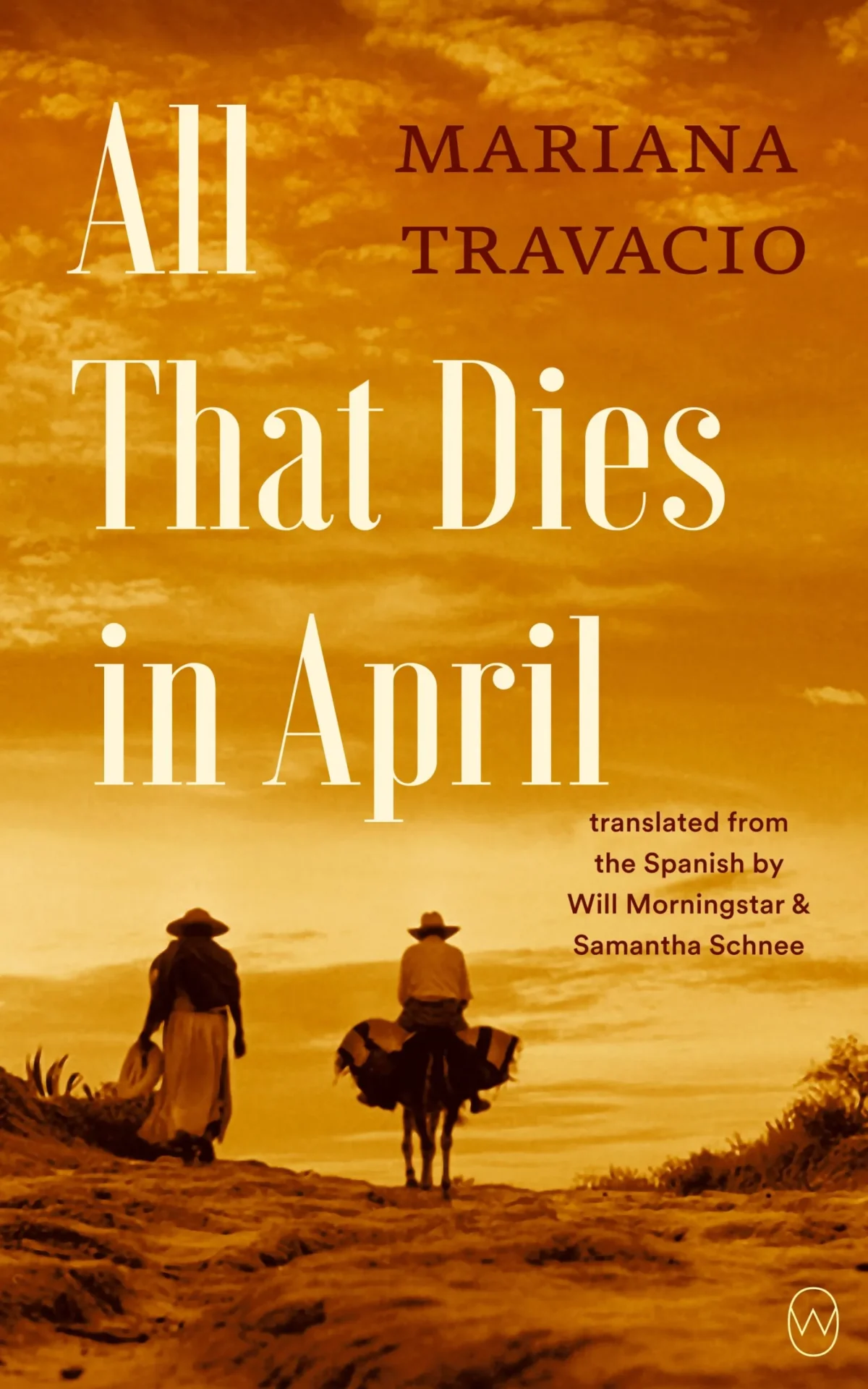
W.M.: I discovered Mariana’s first novel, Como si existiese el perdón, at La Central in Barcelona several years ago. I was drawn in by the cover of the Spanish edition put out by Las Afueras, as well as the strange title, and I immediately fell in love with the landscape and the world she evoked, which is closely related to the one found in her second novel, Quebrada (which, confusingly, is her first novel to appear in English). I was shocked to find that none of her work had been translated yet. She finished writing Quebrada a couple years after that first encounter and after I had been working on her other texts for some time, and I fell in love with it just as much as I had with the first novel. And, of course, the credit for the title goes to everyone who worked on the French edition, which is called Tout ce qui meurt en avril (which is a line from the book: “todo lo que muere en abril” in the original)—I saw that and it was immediately obvious to me that that should be our title in English. I love how it subtly points to the fact that the book takes place in the Southern Hemisphere, where April is indeed a month of decay rather than springtime and new life as it is in the Northern Hemisphere.
S.S.: Las Afueras does a fantastic job with its covers. I just finished a sample of another short novel they published, El paracaidista by Ana Campoy, which also has a striking photo on the cover. I was surprised to learn that the cover photo you mention from the Las Afueras edition (also the photo on the World Editions version) was taken by Juan Rulfo, author of Pedro Páramo—another novel about a character who leaves home on a quest, much as Mariana’s character Lina does.
W.M.: Yeah, I love pretty much everything Las Afueras does, including their beautifully understated covers. Using the Rulfo photo was such a good idea (who knew he was a photographer too?) because Mariana clearly sees him as an influence on her writing.
S.S.: How did you connect with Mariana and end up translating some of her work?
W.M.: Oh, this was fun! After I found her book in Barcelona, I emailed Sandra Pareja, who’s a literary agent, to see if she had heard about anyone translating Mariana’s work already. She said she hadn’t, but that, as it happened, she was actually hoping to represent Mariana herself and they had been talking for a while already (Sandra did begin representing her soon after). So she put us in touch and we had some great conversations over email (Mariana writes the most beautiful, thoughtful emails), and I started working on some of the stories, which were then published in Two Lines and LALT.
This was a first for both of us: my first book-length translation and your first co-translation. How has it been different from your previous work?
S.S.: I had been wanting to try co-translation for some time and this book seemed a great fit since it has two distinct narrative voices that are split into separate chapters. I thought the hardest part was setting up the arrangement: figuring out how to divvy up the work and what the process would be. I very much enjoyed the aspect of discussing lexical choices with you and having someone with whom to discuss the challenges of the text during the process of translation. Working alone, I have always had to wait until I’ve completed a translation to speak to an editor about my work, so it was a treat to be able to consult with you throughout.
What about you? How was this translation different from your previous work?
W.M.: I agree! Once we got the organizational stuff out of the way, I thought it was pretty smooth sailing. It was great to talk to you about everything while we were still in the midst of translating, and really interesting to try to craft the two different voices in such a way that they would be distinct from each other but also clearly inhabiting the same world (and family). I love that co-translation seems to be becoming more popular, and I think it’s especially useful for a book like this with multiple voices (and when two translators are both really interested in translating the same book). It was really amazing to have my first full-book translation be a collaboration; I learned a ton!
Were there any surprises?
S.S.: I picked up on the symbolism of the names but I didn’t know that jumento was another word for donkey. And it was interesting to discuss with you the nuances and associations of donkey vs. burro; I think that was the only aspect of the translation where our views diverged. It was also a bit surprising to me that when we sent our draft to Mariana she came back with a request to find English equivalents for the Argentine expressions we had opted to preserve, such as comadre, which runs against the current trend to locate translations in their source language and culture by leaving words that are culture-specific in the original language (quebrada is another good example of this). Since you had worked with Mariana previously on some of her stories, you had a clearer understanding, I think, of her authorial intentions.
W.M.: I also had no idea that jumento was another word for donkey, and neither did any of my Argentine friends! For me it’s a fun little Easter egg. I think the fact that we came to the book at different times was part of what made it work so well: I had been working with Mariana for a while and so had some pretty set ideas about how everything should be, and you had a fresh take on a lot of it that pushed things in a different direction in a lot of ways, which I think was really good for the book as a whole. My sense was actually that I had landed somewhere in between you and Mariana on the issue of leaving words in the source language (I was definitely in favor of it in several cases), but I thought what Mariana said to change our minds really made sense in the end: she wanted this to feel like it could be taking place anywhere and at any time and so didn’t necessarily want to remind readers at every turn that we were in Argentina. There was also a moment we discussed with her about how to translate a metaphor involving light, and she was quite clear that she didn’t want to suggest either way whether the characters inhabiting this world had access to electricity. It all made sense to me, when she explained it, and really fits in with the mythical feeling of the landscape that she created.
S.S.: Were there any parts of the text that you particularly struggled with?
W.M.: I think—aside from preserving that mythical atmosphere while also not shying away from the fact that this is a translation that takes place in a landscape quite foreign to most readers in English—I find the rhythm of Mariana’s prose so particular and crucial to the way the text feels, and that’s always a bit of a challenge to render in English. Because the prose is so spare, paying close attention to seemingly little things like commas makes such a huge difference. I think it took a few drafts to get to a place where the text was really breathing as we wanted it to.
How about you?
S.S.: I wouldn’t call them struggles, but of course we faced some of the typical challenges of translating from Spanish to English, such as verb tenses switching back and forth. And, of course, identifying and figuring out how to preserve the distinctive stylistic characteristics of the text in a way that makes the co-translation appear seamless.
W.M.: What’s up next for you?
S.S.: I translated a debut, prize-winning novel by Basque author Irati Elorrieta last year, and Sundial House has just added it to their list, so I’ll be responding to the edits on that and preparing for publication in 2027. And I’m looking forward to translating The Letters of the Boom, which collects the correspondence of Julio Cortázar, Carlos Fuentes, Gabriel García Márquez, and Mario Vargas Llosa between 1955 and 2012. I’m also halfway through two novels by Carmen Boullosa, who keeps winning awards, and a collection of her poetry for Broken Bowl Books as well.
And you? Or will you be switching to your editing hat for a while to launch Diptych?
W.M.: Wow, that’s so much cool stuff coming up! At the moment I’m translating a midcentury Argentine novel from Yiddish for my fellowship at the Yiddish Book Center, but other than that I will indeed be spending most of my time on Diptych, aiming to launch our first books in Spring 2027. I also hope you and I finally get to meet up in person to do a reading this year!
S.S.: I hope so too!
Buy books by the authors and translators featured in this issue on our Bookshop page!