Hablemos, escritoras: Episode 568
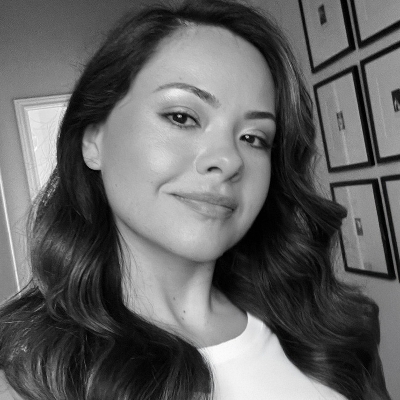
Mariana de Althaus, from Peru, is a constant voice in theatrical direction and playwriting. A graduate of La Casona, one of the most prestigious theater schools in Barcelona, Spain, she was also a student of playwrights such as Rafael Dumett, César de María, and Alonso Alegría. Some of the plays she has directed are El lenguaje de las sirenas, Trucos para ver en la oscuridad, and La vida en otros planetas, and her play Quemar el bosque contigo adentro was invited to participate in the contemporary playwriting festival La Mousson d’été 2022 in Pont à Mousson, France, and the playwriting festival “Punto Cadeneta Punto” 2023 in Bogotá. Her book Drama de Familia speaks about herself and about what theater is in her life.
This is an adapted excerpt from the conversation on the Hablemos, escritoras podcast, led by Adriana Pacheco.

Adriana Pacheco: Welcome, Mariana de Althaus. Tell us, why theater, Mariana?
Mariana de Althaus: Well, I always liked theater since I was a child, even before literature I liked theater. I went with my grandmother or she would want to take all the grandchildren, but I remember that only I would go. And theater made a big impact on me from childhood, even adult theater. Since I was a child I went to it, and I always wanted to do theater. In truth, I wanted to be an actress, which is the entryway into all the trades in theater. And in fact, I trained as an actress. After finishing school, I studied literature here at the Catholic University. And while studying the literature major, I was training as an actress in workshops with private teachers. And that, sooner or later, led to writing for theater and directing for theater.
A.P.: Tell us about some of your professors who gave you the foundations for this training.
M.D.A.: Well, there was Ricardo González Vigil, whose classes I will never forget because they were passionate. Carmela Zanelli showed me the world of women writers, who were somewhat relegated in the major’s curriculum, but in my final years she introduced them to me and they opened up a world for me. I had very good professors in playwriting workshops, for example, Alfredo Bushby, who also taught me about Latin American theater. But while studying the literature major, I also read the classic playwrights on my own: Ibsen, Chekhov, Tennessee Williams, Arthur Miller.
A.P.: Mariana, when we talk about theater we have to recognize that, in reality, it doesn’t have as many followers as we would like. What is going on with theater?
M.D.A.: Theater has never been very mass-oriented, nor has literature. Unfortunately, the space gets a bit smaller over time, but theater truly is an art for few people, because to start with, few people fit in the theatrical venue, which is the theater hall. That doesn’t mean it has to be an elitist art; it’s for the few who are interested. In an ideal world, anyone could have access to theater, but it’s not like that. In any case, the world we live in today, in which we are looking at a screen all the time and everything is fast and easy, increasingly distances us from a space like the theater. And, at the same time, we also need that space of presence, of living a story from beginning to end alongside other people, which is a very different experience frpm reading a book in your room; it’s a more private, individual experience.
A.P.: Do you think there is also something in education, that we are not very exposed or even less exposed to theater?
M.D.A.: Yes, the theatrical experience is there from the beginning of schooling in most schools, but there is no training of spectators. So, of course, going to the theater is an experience that feels almost old-fashioned, something older people do, grown-ups, grandmothers, like with me, my grandmother took me. What’s also missing is that from childhood we take children to the theater, that we take children, young people, adolescents to the theater, for example, but that training doesn’t necessarily exist.
A.P.: What is going on with playwriting and with directing?
M.D.A.: Well, directing is traditionally a more masculine role. Generally girls are not taught—perhaps now much more—but at least in my generation we were not taught to be the ones who direct things, except our home. But that empowerment, that self-esteem someone has to suddenly say, “I think everything has to go this way, everyone needs to follow me along this path that I envision,” that empowerment is not necessarily something we women have from a young age. I had to make an effort to believe in myself, first as a playwright, to have at least three plays that had some recognition in the small theater world of Lima, in order to believe that I could lead a group, that I could tell people what to do. And it was a path that wasn’t easy, but I think that’s what generally distances women from the role of directing. Now it’s happening more and more, but in my time it was men who were a bit more invited to assume that role.
A.P.: And what about producing? Because theater requires resources.
M.D.A.:It’s the hardest job of all, but I think there are no gender roles there, no issues of gender division; in fact, most producers here tend to be women, because we are good at managing assets, funds—we’ve done it since the beginning of time—by having to manage our household we know how to manage resources, how to care for people. Because the role of production also has a lot to do with care; you have to take care of the team, you have to provide the environment and the necessary goods so that there is a comfortable, welcoming space to create, and that is very feminine.
A.P.: What are your principles when you are directing? What do you prioritize? What is your way of protecting this team?
M.D.A.: Traditionally, the role of the director was, in a much more hierarchical position, much higher than the rest. I don’t see it that way; to me it seems much more productive for the space to be a bit more horizontal. You have to generate a space in which care is above everything else, a space in which I am interested in the other person, a space supported by the principle of enjoyment, of pleasure. We are there because we want to play, we want to imagine, we want to create together.
A.P.: Let’s talk about your plays and let’s start with El sistema solar. Tell us about Edurne, about the family, about the father-daughter relationship.
M.D.A.: I wrote that play honestly without knowing what I was going to write about, and it came from capturing many anecdotes and stories that had to do with my relationship with my father, but also with my mother’s relationship with her father and my own father’s relationship with his father as well. The play began to condense a lot of stories, images, wounds, and loves related to my two families, maternal and paternal. And obviously, of course, it is an exploration of the gaze of a father from the point of view of the children and that difficulty in forgiving their mistakes, their absences, their betrayals, and how children take on that inheritance in order to move forward and then, in turn, become caregivers themselves, to later raise future children. Parenting is a topic that interests me a lot, which I have addressed in several plays, and I think El sistema solar was one of the first.
A.P.: Do you think that, in some way, what is being done in theater in Peru is also very related to a history of violence behind it that affected masculinities?
M.D.A.: Yes, of course. It is very difficult for a country to have a theater that does not reflect its most urgent wounds. In this case, in Peru, in recent years many plays have been made that explore that conflict that still shows open wounds. And in every way, every time you stage a play about family, it is inevitable that in that micro-world a slightly larger world is reflected, that perhaps those idiosyncrasies or that type of relationships established among the communities, among the people of this country, are reflected.
A.P.: Mariana, there is also the problem of racism, of poverty, of division between social classes. In what way do you feel that theater has approached this topic—your theater, or any other theater you follow, or the playwrights you follow?
M.D.A.: It’s still a topic that hasn’t been explored very much, although there are several plays that have in fact examined it in relation to that. I have a play called El lenguaje de las sirenas, which is about a chola mermaid who appears on a beach for white people. At that time, there wasn’t much talk of racism and discrimination in Lima theater, but we see it a lot now. And now, for example, I am working on an adaptation of The Seagull by Chekhov, brought to Peru in the 1970s, when Sendero Luminoso, the armed conflict, had not yet erupted. And precisely there, it is inevitable—when you bring a Chekhov play to Peru, for example—it is inevitable that classism and racism appear.
A.P.: Let’s go to Dramas de Familia. There is a phrase there that says a lot about you; you say: “All my plays begin from a discomfort, a disagreement with reality, or an anguishing question.” What are those anguishing questions for you?
M.D.A.: Oof, the truth is they appear and change. And I think it also often happens that I can’t formulate them until I’ve finished making the play. Many times it happens that I make a play that ends up formulating the question. That is, it’s the play that allows me to put into words, or at least into images, that thing I don’t understand, or that gives me angst, but that I can’t articulate in a sentence or a question. And the plays are closely tied to my circumstances and to what is happening in my country as well.
A.P.: This book opens with an autobiographical note. Was it hard for you to write it?
M.D.A.: Yes, yes, I suppose so. That was many years ago. I wouldn’t write it the same way now. It was an effort to try to express why one does things, and why put three plays together in a single volume, and why write about that. At that time there weren’t many plays that portrayed the middle-class, well-off family, let’s say. So perhaps it was a need for justification.
A.P.: Trucos para ver en la oscuridad comes out in 2022—tell us about it.
M.D.A.: Trucos para ver en la oscuridad was a monologue I had to write to help myself do theater at a time when all the theaters in Lima were closed. It took us two years to reopen; I think we were the last country in the world to open theaters again—well, I don’t know if in the world, but in Latin America for sure. And the only way to do theater was with a small cast, and better yet, with a single actress or a single actor. I had never done a monologue, and I wrote it for that purpose, but also to talk about what had happened to me on an individual level and what I believed had happened to my community during the pandemic. And so I used autofiction, although I had never done autofiction theater—autofiction seen from the perspective of Sergio Blanco, which consists of a text, a monologue, a play, being told by a character who identifies with the author. So the experience was very beautiful, very emotional, because it generates a question: What is true, what is false?
A.P.: And what about La vida en otros planetas?
M.D.A.: That is a documentary play; it is the first documentary play I have done, and in it I gather some testimonies from teachers—men and women—from rural schools in different parts of the country, public schools, to talk a bit about public education in Peru. It talks about how the State, how governments, have been destroying it little by little. I brought together six actors and actresses who in turn studied in public schools, and they also share their own testimonies as students of those public schools in different rural areas. I started from a book called Desde el corazón de la educación rural by Daniela Rotalde, in which she gathers the experiences of teachers who work in a program called Enseña Perú, which trains them to go to very abandoned little rural schools in the country. And they are graduates from universities who devote two years to teaching these children who are practically abandoned by the State. So, inspired a bit by Daniela’s book, we made that play, and the audience response has been impressive, especially the response from teachers.
A.P.: Of course, I believe it. Mariana, you were born in the seventies, so your early childhood—not as a baby, but your early childhood—was also the era of Sendero Luminoso. What was that like? How do you see it in retrospect? How do you remember yourself, Mariana, in that Peru? And tell us about that Peru you grew up in.
M.D.A.: Above all, adolescence hit me during terrorism, right? Obviously I lived in Lima, which wasn’t the highlands, where the war was truly taking place, but yes, in Lima we grew up with a fear of car bombs, right? I mean, our parents would leave us at the movie theater and before that they made us practice how to cover our heads, how to cover our eyes if a bomb went off. We were used to rehearsing the ritual of throwing ourselves to the floor. The possibility of a bomb exploding while we were at the movies or when we went to a friend’s house was incorporated into our daily life. We say we’re from the car bomb generation.
A.P.: Tell us a little about your community within what theater is, within what literature is, teaching, your colleagues, your friends.
M.D.A.: Theater requires community work, teamwork, so we are made for that, for community projects, group projects. Although we shouldn’t idealize it either, because it’s true that there is a bit of evrything, but, in general, we’re a bit more interested in the other person, right? We’re not so focused on saving ourselves. If my colleague is saved, I am saved.
A.P.: Well, thank you so much, Mariana, what a pleasure to have spoken with you today.
M.D.A.: Thank you very much to you. Truly a pleasure.
Translated by Andrea Macías Jiménez
You can listen to the full interview on Hablemos, escritoras.