
This text by Carlos Granés serves as the prologue to the new edition of Del buen salvaje al buen revolucionario by Venezuelan essayist Carlos Rangel (1929-1988), published in Santiago de Chile by the Fundación para el Progreso in 2023. Rangel’s book was originally published in 1976, first in French in Paris, and then that same year in Caracas by Monte Ávila Editores.
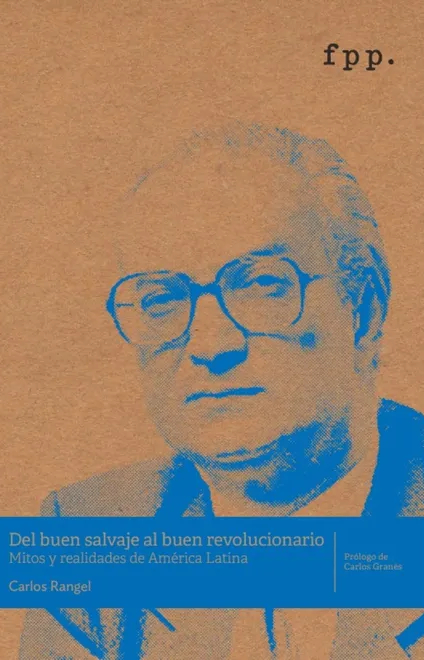
In 1976, when Carlos Rangel published Del buen salvaje al buen revolucionario (released the following year in English as The Latin Americans: Their Love-Hate Relationship with the United States), Latin America’s political landscape was far from encouraging for those who believed in the democratic, liberal, or social liberal project. Up north, in Mexico, the PRI had become a conveyer belt of temporary monarchs who monopolized power with no checks or counterweights, and down south, in Argentina, Juan Domingo Perón had instituted a populist regime that adapted fascist rituals to a democratic system of government, thereby achieving the unlikely feat of derailing the finances and debasing the social cohesion of the richest, best educated country on the continent. Between one extreme and the other lay yet more antidemocratic experiments. The military controlled countries like Brazil, Peru, Bolivia, and Chile—Argentina would join them a few months later—while intellectuals and universities somatized marxist grievance and fascination with Fidel Castro’s revolutionary project.
Just five years before, Eduardo Galeano had published Open Veins of Latin America, an essay that renovated Latin American obsessions sparked by the Spanish-American War of 1898—especially a fanatical anti-Yankeeism and Latin frustration at the overwhelming power of the Anglo-Saxons. This book reinforced an old myth that satisfied deep-held psychological needs common to Latin Americans. Our poverty was not our own fault: rather, the Yankees and Europeans were to blame. We were poor because they were rich; our wealth had been sating northern stomachs for five hundred years. Since time immemorial, our fate had been submission and exploitation. First we were victims of colonialism, then of imperialism and its local underlings. We had been stripped of everything except the virtue and moral superiority with which to decry, accuse, and point out the guilty.
How pleasant, above all for intellectuals, was the victimhood brought up to date in Eduardo Galeano’s essay; what peace of mind it offered, what clarity of purpose, how easy it made the work. The concoction that emerged from mixing Marxism-Leninism, dependency theory, and the everlasting anti-imperialist appeal forged in Rodó’s Ariel yielded diagnoses that gave perfect explanations—because myths are perfect. Nonetheless, these explanations were of little use when it came to understanding Latin American realities, for one simple reason: they always looked outside, never within; they stressed the treachery of our enemies and their allies, their nefarious appetites, but never our own mistakes, never our fascination with useless ideas—primitive Christianity, the Jesuitic mission, Napoleonic autocracy, millenarian utopias, identitarian purity, the teleology of progress, the socialist paradise, racial homogeneity, fascist nationalism—which came to us as leftovers from Europe and which some redeemer carburized with local delirium so as to get them up and running again.
We must bear in mind this political and ideological context, this analytic complacency and easy comfort in an error that dignified the soul and weakened the body, if we are to understand the irreverent and transgressive quality of Rangel’s book. Like the little boy who pointed out the emperor’s nakedness, in these pages the Venezuelan intellectual sought to identify the myths—if not lies—that clouded minds and prevented Latin Americans from correctly diagnosing their reality and their problems. This book is, among other things, a story of mistakes, an account of the abstractions and illusions that have been superimposed over reality and have kept us from relating to it without victimhood or redemptive violence, which are two sides of the same coin.
Rangel begins his demystifying endeavor, with neither painkillers nor half measures, at the beginning, with the conquest. Latin America, he says, at that initial moment, became a screen onto which Colombus and the other conquistadors projected their fantasies and desires. All the images of wealth, wonder, purity, and human goodness that floated in the medieval headspace found, in the newly discovered New World, unequivocal referents that seemed to confirm the words of the Bible and of medieval fictions. Here was the earthly paradise, the golden age, the human being just as he was created before the fall, before he knew sin. These lands were home to the Fountain of Youth, to El Dorado, the legendary California, and the Amazons. They were also home, of course, to the noble savage who so astonished Bartolomé de las Casas, that angelic being who had not suffered the pitiful corruption that rotted the soul and could only arise from Western civilization.
Here was the ferment of the great Latin American myth. At the hands of a foreign power, the noble savage had been torn away from this paradise in which he enjoyed an authentic, free, and happy life and dragged into a new, painful colonial condition marked by alienation, poverty, and dependency. Redemption from this suffering lay in the rejection of the corrupting civilization, despite the fact that by that point, when thoughts of liberation started coming to the fore, almost five centuries had passed since the Spanish arrived. Millions of people who prayed to a Catholic God, spoke Spanish, and bore the surnames Morales, Reyes, Martínez, and López had to exclude themselves from the West and refute any connection to Europe, the United States, and Western civilization in general. Thus the delirium and mythification of Latin American reality began. Perhaps the path back to the noble savage was barred—although today’s decolonialists argue the contrary, that it is indeed possible to deny five hundred years of mestizaje and recover the purity of ancestral values and knowledge—but we could at least evolve into a new creature, one equally ascetic and good-hearted, superior in the aptitude of its convictions: not the noble savage, but the noble revolutionary. His mission, clearly, would be to put an end to our economic, political, and cultural subordination to the United States and the West, to extirpate the colonial and imperial inheritance that polluted us.
These noble revolutionaries had a prerogative they did not share with the noble savage: guns and violence. The version of Marxism-Leninism that spread through Latin America at that time legitimized emancipatory action. Unlike Marx, who argued in favor of modernizing exchange between the metropolis and its colonies, Lenin realized that communism and the Soviet Union would gain greater returns if they pitted them against each other. This was the origin of third-worldism, a subject to which Rangel dedicated another book. The end of imperial rule would come through fostering national liberation movements around the world, and especially south of the United States, with these peoples joining the anti-Western crusade.
With these ideas smoldering in many minds, and after the great revelation, after realizing that all of Latin America’s ills were imported and the causes of its misery came from the Yankee empire, the path grew clearer. Young people could discard the option of reform, avoid the need for self-reflection, and turn to the jungle or the mountains to form guerrilla cells and kick off an unhinged campaign of sabotage. In the sixties and seventies, while Rangel was writing his book, imperialist agression and economic exploitation were to be repulsed through subversive action.
Nationalism in Latin America started taking on a red tint. Former fascists who believed in national purity, like the young Argentines of the Tacuara movement, now began to form left-wing guerrilla groups. Curiously, and disturbingly, they were pursuing similar ends. The example of Fidel Castro and Leninist discourse had convinced them that the fatherland was to be defended by taking up arms and expelling the external enemy. While in the thirties it was right-wingers and clero-fascists, like Argentina’s Julio Meinvielle, who had legitimized the use of violence in politics, now it was leftists like Che Guevara who did so. It made little difference that the former wanted to excise the Jewish and anarchist contamination that came from the east while the latter were concerned with the Yankee contamination coming from the north; nor that the military strongmen—Stroessner, Castelo Branco, Videla, Pinochet—then came along to excise communism, another foreign plague. They all followed the same mental scheme. They feared the corrosive or subjugating contamination that threatened the nation, which they were willing to defend with bombs, bullets, or cattle prods. In terror of the external or internal enemy, the noble savage proved to be much more savage than noble.
After laying out this general framework, Rangel then goes on to sweep away the myths that prevent a clear view of reality. The first and most pressing at the time in which he was writing is dependency theory, the most influential economic discourse of the day. In his book, Rangel demonstrates that the United States did not get rich at our expense, swindling us out of our raw materials or forcing us into unfair contracts. The Yankees had already gotten rich before coming into contact with Latin America, and this fact—their political stability and economic strength—allowed them to come to our shores and intervene in our affairs in imperial terms. This is worth clarifying: far from gratuitously defending the United States, Rangel points out all its faults, including its military landings and strategic relations with tropical dictators, the “consular caudillos” who did so much to weaken democracy on the continent. There is no interest here in polishing the Yankees’ image for the Latin American reader. Rather, Rangel is interested in taking apart the myth such that we might start accepting that our weakness in the face of Yankee imperialism is the result of our own mistakes.
Indeed, the habit of blaming the empire for all our ills is an intellectual vice of the most noxious and useless kind. Instead, we would do well to start acknowledging certain facts. For example, the fact is that while the U.S. succeeded in forging a homogeneous country with a clear sense of its destiny, we, two hundred years after gaining independence, continue refounding our countries and subdividing the common citizenry into ever-smaller ethnic nations. In a show of postmodern novelty or neo-indigenist marxism, now we call it “plurinationality,” as if Latin America had not sinned enough in turning a single political entity, which went from Mexico to Chile, into a lush display of national fragments, each prouder than the other of its borders, its glories, and its heroes, all buttoned up in military uniforms and bathed from head to toe in blood.
The worst part is that Spanish America had a headstart. In the sixteenth century, what’s now the United States was a wasteland of famine and ignorance while Peru, Mexico, and the Dominican Republic had universities and flourishing colonial cities. The America that grew south of the Yankee border, our America, was the one destined to sow some kind of enlightenment in the swamps, deserts, and frozen coastlands of the north, but what happened was the opposite. This is the harsh reality—the shock therapy—with which Rangel confronts his Latin American readers. Enough passing the buck. The time has come to set aside comforting myths, to reject the role of the noble savage, which is frankly infantile: a way we have found to avoid the responsibilities of adulthood and justify the violent, self-destructive tantrums with which the noble revolutionary, from time to time, expresses his fruitless unease. The time has come to take a look at ourselves, to examine our own political systems, the ideas that have guided our leaders, strongmen, and dictators; to understand the role of the Church, to analyze the legalistic illusions that have so often enticed us, to reconsider the Black Legend that has perpetuated so many false conceptions, to recognize our own xenophobia disguised as nationalist emancipation. The time has also come, of course, to overcome our deep-seated resentment, that bad counselor that leads us to prefer any tyranny, even that of Vladimir Putin, as long as it is not on the side of the United States.
Carlos Rangel undertakes this task in this book. Del buen salvage al buen revolucionario is also a review of the shortcomings that condemned PRIism, Peronism, Allendism, and the military model (of the right as well as the left) to failure. He defends only one Latin American political project: the democratic project—social democratic, to be exact—that was pursued by Víctor Raúl Haya de la Torre in Peru with the APRA, and that found true success with Rómulo Betancourt’s Acción Democrática in Venezuela. This was the political creed that Rangel sought to promote at a time when intellectuals worshipped the radicalism of the left and mocked bourgeois democracies. Had this book been read more often and more closely, had it awoken a tenth of the fervor provoked by Open Veins of Latin America, perhaps our fate would have been different. The populist cyclone of the past two decades perhaps would have come up against greater resistance, and the place where this book was written would perhaps not be, as it is today, a scrapyard for the worst of our history: the demagoguery and victimhood of the noble savage and the violence and despotism of the noble revolutionary. The good news—there is always good news—is that it is never too late.
Madrid, 27/01/23
Translated by Arthur Malcolm Dixon
Buy books by the authors and translators featured in this issue on our Bookshop page!