

Finalist in the third edition of the LALT Literary Essay Contest (2025)
Editor’s Note: In 2025, “Bubblegum Pop: An Assembly Line” by Argentine poet and essayist Diego L. García was selected as a finalist in the Third Annual LALT Literary Essay Contest. Here, the author shows us how varied manifestations of art and music impacted the cultural and historical dynamics of the complex twentieth century. He also inquires into the influences of the so-called “minor genres”: “In the minor or secondary genres, the gestation of cultural power gets us dancing right away. They give us no time to take in their bundle of sensations with any sort of critical apparatus. The reader/listener/consumer must rely on their own experience to perceive the origins of whatever appears.”
If you develop an ear for sounds that are musical,
it is like developing an ego
John Cage
I
I’m listening to “Sugar, Sugar” by The Archies (1969). “Sugar / Oh, honey, honey / You are my candy girl / And you got me wanting you,” sings a band of cartoon characters; a precursor, in this sense, to Gorillaz (1998).
A simple, effective harmony, an easy melody, pastel pink for all the moms and dads, a danceable, four-beat rhythm… And some room cheekily left over for some sort of adolescent allegory?
The single spent twenty-two weeks on the Hot 100, knocking down The Rolling Stones’ “Honky Tonk Women,” no less. US audiences needed this sweet diversion. There was no respite from the Vietnam War, as the conflict intensified and Richard Nixon came into office after a pro-war campaign. The keys to this hit were not just the dance and the melody, but also the words, which echoed rhizomatically: “I just can’t believe / The loveliness of loving you / I just can’t believe it’s true.” And what could a young boy or girl believe back in those days? If the charms of love or the taste of a kiss were met with incredulity, how far had bodily and sexual liberation advanced in that society? Today, we see the hippie movement as something mainstream, but that was not necessarily the case. In many areas, conservative values dictated what the youth masses could and couldn’t say. And, in order not to become a pariah, you might have to succumb to said values.
II
Interestingly, in one interview the songwriter of “Sugar, Sugar,” Andy Kim, said: “There was no time to analyze and to pontificate and to see if it made any sense.” In the context of a quick, fun recording session, he relied on the spontaneity of his ideas and the sensations of joy that might be contained in certain words. But did he not consider that, beyond his intentions, this sequence of utterances was saying something on its own? We all know the text dispenses with its author.
The fact of not having time is a somewhat premature sign of the times, although some thinkers, like Herbert Marcuse in One-Dimensional Man (1964), had already trod this ground. The twentieth-century landscape was still under construction. The creative goes running and gets it done; I say this with no irony, but as a marker of the industrialization of culture. Dedicated professionals take charge of enjoyment and leisure. Leisure administrated, of course, by a rather limited realm of possibilities.
III
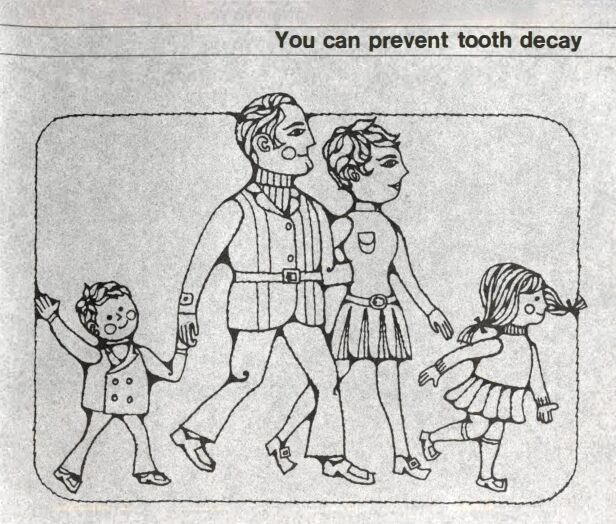
An American Dental Association pamphlet distributed in 1969 by Nixon’s Department of Health, Education, and Welfare was titled “You can prevent tooth decay.” One of its panels focuses on the importance of a healthy diet and on “eating less candy,” with an illustration of a smiling little boy who has in front of him some kind of cake, a soda, and a packet of sweets.
Is there some deliberate tension here with the song of the moment? What is this pamphlet up to? Its Arial font—clear, legible, and direct—expresses its titular message with no period. It goes in a single direction, as does the family that walks along. Toward the right, toward the future, toward the next panel. They come complete with tight belts and traditional height differences. Health is for conservatives.
 Cover illustration. American Dental Association, “You can prevent tooth decay” (1969).
Patient Dental Health Education Brochures. 351.
IV
Archie Comics, The Greatest Galaxy of Stars in Comics! Archie and his friends, stories of teenagers, crushes, consumption, style, and the sensuality of belonging to a stereotype.
The bubble of adolescence allows life to float in a state of “being lived,” with neither commitments nor seriousness, beyond any biological age. A philosophical age? Perhaps, but one ought not be mistaken for the other: the bubble to which I refer is born and dies in consumption; its greatest success consists of remaining there. Books like stacked bricks at fairs that smell of vanilla with white lights shining down everywhere; decorative objects, words that play their corporate role for “writers.” Back in 1967, a few years before, Guy Debord wrote:
The spectacle presents itself as a vast inaccessible reality that can never be questioned. Its sole message is: “What appears is good; what is good appears.” The passive acceptance it demands is already effectively imposed by its monopoly of appearances, its manner of appearing without allowing any reply. (Debord, 1967)
The idea of “what appears” is very helpful when thinking of pop, and such “bubblegum pop” in particular, as opposed to the “pop art” of the eighties. The radio translates the message: this is good because this is new (to paraphrase Debord). The passive, unidirectional subject has values to feed: the traditional family, elitist education, war and nationalism. We might add another, which is no less powerful: the right to have fun. But what kind of fun are they willing to digest? Better to chew something you can soon throw away. Sugar, pink candy kisses, and romantic fictions lined up on supermarket shelves.
V
Can art exist in this spiritual chewing gum? It is not the raw material of rock (even of the oft-misunderstood “Ob-La-Di, Ob-La-Da,” recorded a year earlier in 1968), or of punk: here, the poetic self is positioned as part of the accepted majority, of the security proper to good citizens, of a record able to hold a whole war on its B-side.
VI
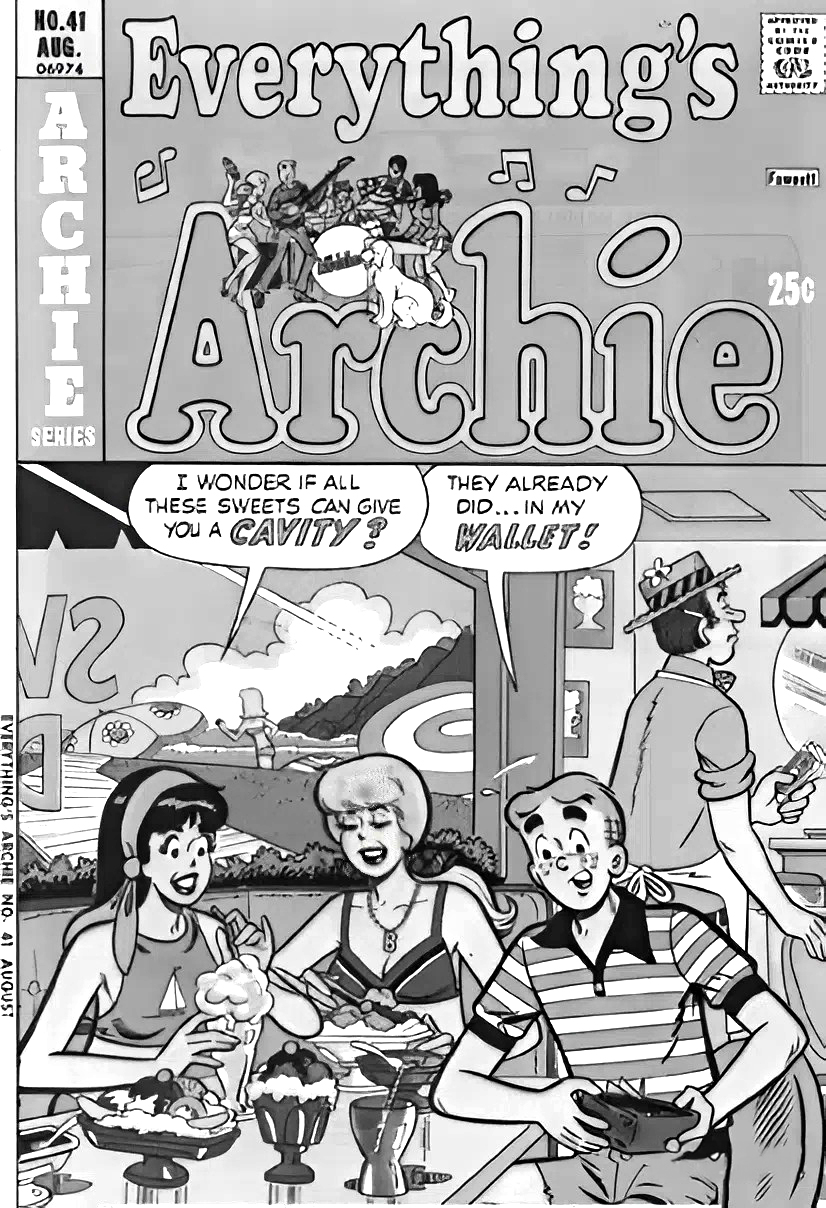
“Everything’s Archie” (No. 41), written in a fun font, with letters like balloons, somewhat wavy but not too much so as to avoid lapsing into psychodelia. Psychodelia Jr., perhaps? For fifteen cents, a little boy or girl could partake in the sugariest of sentimental educations.
“I wonder if all these sweets can give you a cavity?” says the sexy girl, concerned.
“They already did… in my wallet!” responds an ironic Archie in a polo shirt.
On the table sit three hypermassive ice creams with extra fudge.
 Everything’s Archie (1969) #41
VII
The boy on the pamphlet is not like Archie.
He has two circles on his cheeks and holds his father’s hand.
They are dressed like robots, with colorless clothes in geometric patterns;
he wears a button-up coat and his eyes are just two black dots.
The boy on the pamphlet is raising his arm. Is he waving?
He bears the happiness of knowing no other way out.
The hippies of Woodstock won’t come after him
(those kids’ teeth
don’t look healthy).
The boy on the pamphlet is not like Archie
He neither gives strawberry-flavored kisses nor pays for them with enormous
desserts, summertime promises:
their bodies are not those plastered up
over “three days of peace and music.”
They are the strength of the deal,
the love of demand,
the peace of occupying safe spaces.
VIII
How much more would sugar and love have to contribute to pop lyrics in the coming decades? After ’68 and ’73, edible love affairs multiplied with songs like “Yummy Yummy Yummy” and “Chewy Chewy” by Ohio Express, and the famous Coca-Cola jingle “I’d Like to Teach the World to Sing” by The New Seekers (1971).
1983 gave us “Candy Girl”—the debut single by New Edition, a teenage R&B/hip-hop group—which became a sticky hit: “Candy girl, you are my world / You look so sweet, you’re my special treat / Candy girl, all I want to say / When you’re with me you brighten up my day,” sang a childlike voice.
We could continue with the remakes of the classic 1958 song “Lollipop” in multiple languages, “Candy Rain” by Soul For Real in the nineties, then “Candy” by Mandy Moore (1999), and so on and so forth along the same sweet metaphorical lines.
IX
There is no counterweight to the totalitarian vacuousness of tutti-frutti. It makes no difference, nor is this the pop movement that, in the eighties, would turn the commercial into raw material for creativity (Andy Warhol did not invent pop; he redeemed it). Even still, the candy kids keep digging the very same “cavity” in culture.
Beyond trailing proper names, this society of the spectacle, which had already transcended to other spheres, has only grown more entrenched over the years. If everything, the very “Everything” that’s Archie, stands by the side of capital, what other line might forge a different literature through which to access “something” in modern life? This has been the challenge of the past sixty years.
Literature, poetry, songs, comics, and any other genre. The voice that fills the unsurprising gaps is the same. We have not been fundamentalists when it comes to their labels, knowing that discourses unfold in power relations without drawing distinctions. The reader consumes the reader’s own life, not programs put forward by the academy. And in “lives,” political positions are read, intersect, and are rebuilt through the ways language is used.
In the minor or secondary genres, the gestation of cultural power gets us dancing right away. They give us no time to take in their bundle of sensations with any sort of critical apparatus. The reader/listener/consumer must rely on their own experience to perceive the origins of whatever appears. The emergency—and the emergence—lies in delaying things a little more than we’re used to. Looking again, thinking again, wishing again to soak in the configurations of the new. Swapping the chewing gum for a good cup of coffee and a Radiohead album might be, for starters, a nice way to even the odds.
Translated by Arthur Malcolm Dixon
Buy books by the authors and translators featured in this issue on our Bookshop page!