
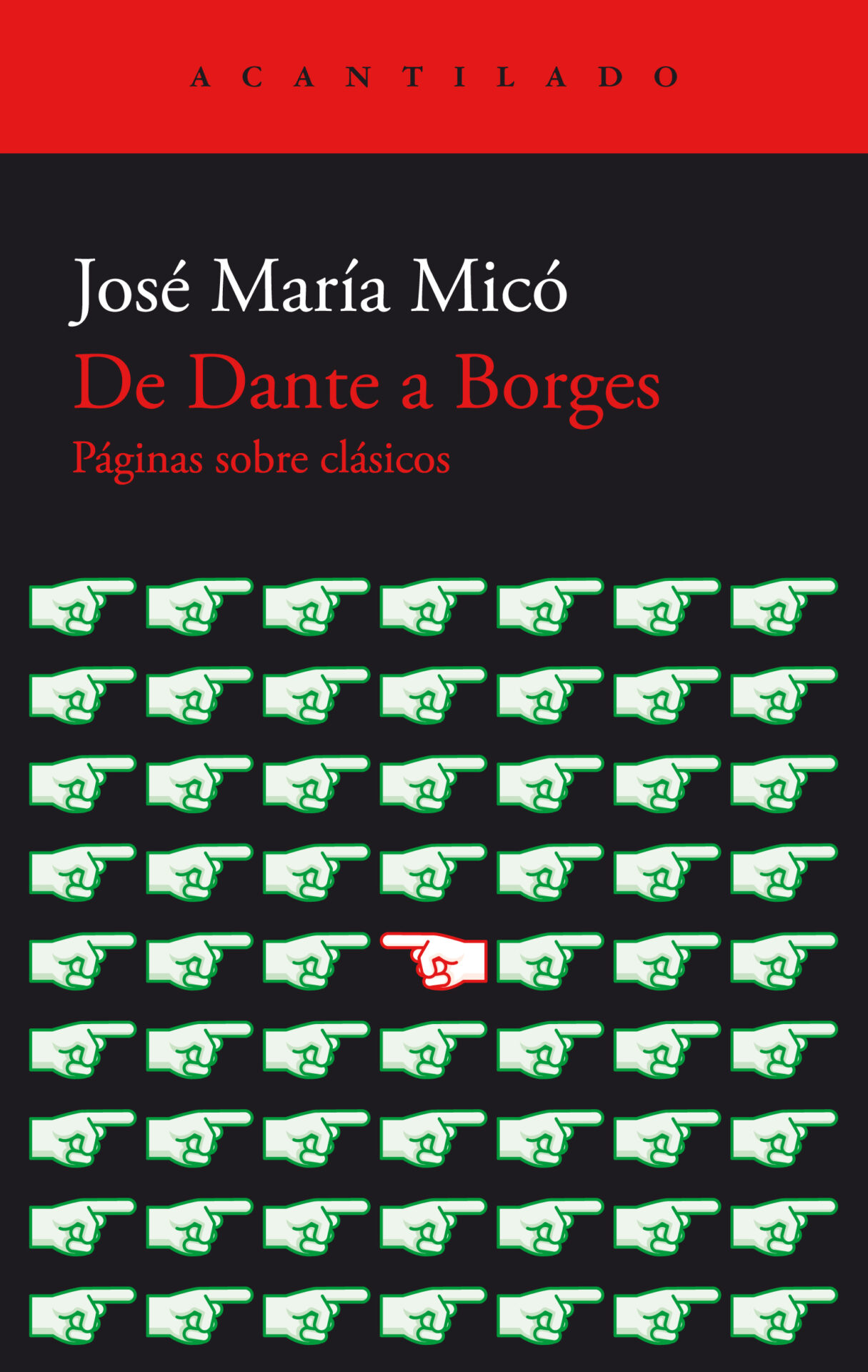
From poetry and translation to music, Spanish philologist José María Micó delves into the intricacies of writing to analyze some of the indisputable classics of universal literature, from Dante to Borges.
Micó tells us that transgression is what forged the classics. In De Dante a Borges (Acantilado, 2023), he explains how this rupture with conventions—this singularity and difference from the literatures that shaped them—helped elevate these voices to the highest ranks of literature. These extravagant men of letters continue to be rigorously analyzed and scrutinized to reveal their linguistic techniques—the telltale marks of their craft. Their range—from autofictions and dystopias to novels in verse, poetic fictions, virtual realities, sonnets, and versed tangos—alongside a natural, engaging dialogue with readers and a deeply expressive spiritual register, is part of what has secured Dante, Cervantes, Góngora, Rubén Darío, and Borges, among others, the stature of an undeniably universal literature.
Juan Camilo Rincón: Why do you believe we should continue updating our studies of the classics?
José María Micó: I have an earlier book called Clásicos vividos. I chose that title because it deals with classics that are alive, but they still need to be continually revived. Sometimes these great figures—Dante, Cervantes, Shakespeare—intimidate us. We know a bit about them, but it can be difficult to truly engage with their work because, for many readers, they can feel daunting. They are authors who are still alive and, for that very reason, we must continue revisiting them. After a lifetime as a professor, I believe that speaking about the classics does not have to be done in an academic and overly erudite way. At the same time, we cannot renounce rigor: the rigor of offering new information, of putting things in their place, or of addressing formal or historical aspects that may be somewhat complex. What we are always obliged to do, however, is to approach the classics—essayistically if need be—with the best prose we are capable of.
J.C.R.: Simpler, more accessible…
J.M.M.: …so that the literary essay can be read like any other book—not just within academic circles, or by specialists in Dante, Borges, or Shakespeare.
J.C.R.: That’s precisely one of the book’s key ideas: you move easily from boleros to discussions of transmedia, virtual reality, and performances. What tools can we use to encourage these new conversations about the classics, particularly with young people?
J.M.M.: One is the idea of the virtual world. Literature creates virtual worlds, with the advantage that it doesn’t do so from the outside, through electronic devices that can be displayed or shared, but rather—first and foremost—within us, in the reader’s own mind. The Divine Comedy, which I describe as a work of autofiction by Dante—because he is one of the great masters of autofiction, one of the genres that seems to be flourishing in world literature—is one of the best examples of first-person narration that reflects on itself, telling a story as if it were true, with the author as both protagonist and narrator. Virtual reality is one of those concepts that helps us understand works that may seem very remote today—written seven hundred years ago—not to mention Homer or other ancient authors. That’s one way in: autofiction, the world of virtuality, literature as the creation of an imaginary world that, to begin with, already exists inside us.
J.C.R.: Staying with this idea of autofiction, we often talk about it today as if it were a new concept even though it has existed for centuries. What other formulas, tools, styles, and forms have we inherited from the classics, though we tend to see them as present-day creations?
J.M.M.: I’m sure there are many more. This one stands out because, in relation to Dante, it seemed to me that it deserved special attention. But that is human nature; our lives move in cycles, and we keep reinventing the wheel. Following those cycles of academic fashion, we sometimes forget that these great authors are classics precisely because they spoke about the same ideas that concern us today. This is why Shakespeare is so devastating: in a single phrase, he defines the human condition—or the condition of a particular character. Dante remains just as enlightening because he is talking about us: about the lustful, the greedy, and the miserly, as well as the virtuous and saintly. In one way or another, we can recognize ourselves in a character from the Inferno or Purgatorio… Paradiso is more difficult (laughter).
J.C.R.: Why do you think we are more drawn to Inferno and Purgatorio than Dante’s depiction of Paradiso?
J.M.M.: I think this has a lot to do with the moment in which the work was written. Dante placed in the Inferno many figures who had just died—and even some who were still alive, but whom he assumed would end up there as well. That gave the work a strong sense of relevance, almost like a book of gossip from the period, filled with characters who actually existed. And not just major figures like popes, who were well-known to most readers, but also Dante’s own neighbors—along with all the petty politics and local quarrels of Florence.
J.C.R.: Is there a kind of diversity in the Inferno?
J.M.M.: From a stylistic point of view, it is the most varied of the cantos. There, Dante uses a wide range of language, allowing himself obscenities and coarse expressions alongside verses that are almost mystical, like those in Paradiso. The Divine Comedy has a comic element that is fundamental to the Inferno, and one that is justified stylistically through the use of vernacular language—a language to be understood by ordinary people, as Dante himself suggests at one point. Unlike what we sometimes imagine a great classic to be—that is, something distant from us—Dante wanted to remain close to his audience: not only readers, but above all, listeners, since not everyone was literate at the time. That sense of immediacy, alongside the fact that the Inferno initially circulated on its own, gave the work remarkable popularity during the final years of Dante’s life, which was only later confirmed by the release of Purgatorio and Paradiso.
J.C.R.: In everyday language, it has become common to call something Quixotic, Dantesque, Kafkaesque, or Borgesian. How did these classics end up becoming adjectives?
J.M.M.: This sometimes happens with other artists as well, like when we say something is Goyesque, in reference to Goya. I think these are authors favored by chance or fate, perhaps because they create archetypes that are distinct yet complementary to the human condition. That distinction always needs to be qualified, of course, because when we say something is “Dantesque,” we usually think only of Hell, yet Dante and his work are so much more than that. Kafka, too, is far more than what we tend to label as “Kafkaesque.” In any case, each of these terms effectively captures a recognizable portion of human experience. Their strength lies in the fact that certain parts of the human condition are so marked by an author that we can say without a doubt: this is Kafkaesque; this is Quixotic. The case of Don Quixote is interesting because the adjective refers to the character rather than the author. Cervantes endowed Don Quixote with traits that make him instantly recognizable—not just physically, but through his attitude, his presence, his madness, and his language. For that reason, both the character and his creator belong to that small pantheon of great figures who have, for one reason or another, become adjectives.
J.C.R.: In school, we were taught about Spanish literature—the Siglo de Oro, the Generation of ’98, and so on—and much of your book, in fact, focuses on Spain. Why is it important to renew our connection with Spanish literature, and how can we connect it to Latin America?
J.M.M.: These great authors of the Siglo de Oro found their way—voluntarily or involuntarily—to the Americas during the colonial period and consequently helped ensure that the finest Spanish was used there. I often say that in some Latin American countries, the Spanish spoken today is far superior to contemporary Spanish in Spain because it evolved differently. For various reasons, the language used by Cervantes may actually be better preserved in Colombia, Mexico, and Argentina than in the work of some contemporary Spanish authors, who have developed idiomatically in other directions.
J.C.R.: But the classics of the Siglo de Oro use Spanish with extraordinary beauty.
J.M.M.: They certainly do—not only for readers in the Americas, but also for us in Spain, who live in a very different time. These classics remain as examples of how language can be used in the most perfect way possible and for very different purposes. One case is the Lazarillo de Tormes, many of whose pages invite laughter or sharp irony, yet are written in a prose that is deceptively simple and deeply complex, guided by a strong communicative intent. Another is Góngora, a poet who was greatly admired in the Americas—and if there is any doubt about that, one need only ask Sor Juana Inés de la Cruz. Some literary traditions, such as Colombia’s, show that these extremes of maximum communicative simplicity and maximum poetic complexity can coexist within a single shared language. What is unfortunate is that there is not always enough dialogue between the literature of Latin American countries and that of Spain. That is why we must not lose sight of those great classics—which are not limited to the Siglo de Oro. I am thinking here about Rubén Darío, who became a great classic for the Spanish poets who came after him.
J.C.R.: Darío also maintained a constant dialogue with the literature of the Generation of ’98. What makes him so relevant today?
J.M.M.: I think it was Darío himself who once said, “My wife is from my homeland; my beloved, from Paris.” That blend proved fundamental to the renewal of Spanish-language poetry. In Spain, poetry was emerging from post-Romanticism and from a handful of noteworthy authors, like Ramón de Campoamor, among others. Then Darío came into this literary landscape, not only to Spain, but to Europe as a whole. He possessed a natural talent that we can all recognize, and which he himself sometimes mentioned with a certain perplexity. “Poetry,” he once said, “is something I was born with.” It was an innate talent that did not need to be perfected, though he did a great deal to refine it, drawing especially on his familiarity with the Parnassian poets and fin-de-siècle movements in France. He transformed poetic verse in Spanish in a way that, in my view, had not been done since the times of Góngora. Whether we like it or not, I think the two great peaks of poetic renewal in Spanish are Góngora during the Siglo de Oro and Darío during the turn of the nineteenth to the twentieth century—his major book, Cantos de vida y esperanza, was released in 1905. Even writers like Juan Ramón Jiménez spoke of him in these terms, calling him the great master of modern poetry and the figure who led the way for some key aspects of the Generation of ’27. Without Darío, later poetry in Spanish—particularly in Spain—would be unimaginable.
J.C.R.: You also quote “the great crank,” as you call him: José María Vargas Vila. What do you know about the Colombian classics?
J.M.M.: José Asunción Silva has long been one of my favorite authors to read. Also, I am drawn to some Colombian authors from the colonial era—if we can even call them Colombian, since at the time it was Nueva Granada or Nueva España. I also enjoy contemporary Colombian authors who, though they are still young, have already become young classics in Colombian literature. When I was younger, I read everything by Gabriel García Márquez, whom I also consider a classic. At the end of one of my prologues, I say he may be the last truly classic author, at least of my generation. Sometimes the classics are not the authors themselves, but their books: Don Quixote, One Hundred Years of Solitude. And I like to remember that behind each of those books is a person who wrote many other works as well. I feel the same way about Dante, Ariosto, and Cervantes: I am also interested in other works they have written, not just Orlando Furioso and the Divine Comedy.
J.C.R.: How do you read contemporary Colombian literature?
J.M.M.: I think the greatest of Colombia’s literature is being written right now, as it has a lot to say about the future. As a young man, I devoted myself almost entirely to Márquez, and I was also very taken with Fernando Vallejo. Through the students I teach now—many of them quite young—I have continued discovering new, contemporary authors. I am very familiar with those who are active today; in fact, my last visit to Bogotá was for a wonderful panel discussion on Don Quixote with Juan Gabriel Vásquez and Andrés Hoyos. I very closely follow what is happening in Colombia, and I hope that, after this fair, I will be even more engaged.
J.C.R.: Returning to the classics in your book, many of them were sonnet writers. What is it about the sonnet that holds such appeal to you?
J.M.M.: We could say that the sonnet is the most resilient metrical form in poetry—I was going to say universal poetry, but that would be an exaggeration. Across the Romance languages, and even in parts of the Germanic and Anglo-Saxon ones, the sonnet was invented during a very specific moment in Italy, almost certainly by one Giacomo da Lentini in Sicily. Working from the stanzas of the troubadours, he developed a form that was not originally two quatrains and two tercets, but rather an octave followed by a sextet, eight lines plus six. That structure later evolved into the form used by Dante and, above all, by Petrarch in the Canzoniere. There, it achieved such perfection that it was easily transplanted into other languages. The sonnets of Garcilaso de la Vega, Shakespeare, John Milton, and Pierre de Ronsard are works so perfect that, even across different literary traditions, the form endured. The Petrarchan canzone disappeared; the sestina disappeared, and other higher-art verse forms disappeared as well, but the sonnet survived. And as the Sevillian poet Fernando de Herrera said when commenting on Garcilaso’s poetry, the sonnet is the most perfect form because it can be used for anything. It is equivalent to the classical epigram: within those fourteen verses, one can say almost anything. That is why the tradition of satirical, obscene, political, religious, and moral sonnets is so rich and so compelling.
J.C.R.: Who has renewed the sonnet in Spanish?
J.M.M.: Throughout the history of Spanish-language poetry, there have been authors who have dared to intervene in what seems like an untouchable form—and they have done so in very intelligent ways. One of them was Darío, who wrote thirteen-line sonnets—he simply removed a verse. That missing line is somehow still there, implied by the thirteenth, and nothing seems missing; the poem is complete, a finished sonnet with thirteen verses. That, or using different meters: octosyllabic, eneasyllabic, decasyllabic, hendecasyllabic (the classical form), even Alexandrine lines, testing just how far the form could stretch. Perhaps Darío’s finest poem, “Lo fatal,” already identified as such by poets like the Spaniard Ángel González—who called it greatest poem in Spanish of the twentieth century—is a kind of suggested sonnet: one that ultimately breaks off and abandons the form all together.
J.C.R.: Anything from Borges?
J.M.M.: Instead of the Spanish or Italian sonnet—with its two quatrains and two tercets—Borges chose the structure of the English sonnet: three quatrains followed by a couplet. The best of Borges as a poet lies in those couplets, in those two final lines of his sonnets, which often read like devastating aphorisms. Around the same time, the Spanish poet Blas de Otero was also using the sonnet in a very original way, as was Federico García Lorca in Sonetos del amor oscuro. Believe it or not, the sonnet is still very much alive today, and I think it remains perfectly legitimate, at least as a form of poetic experimentation, to try writing a sonnet from time to time. Add a sonnet to your life.
J.C.R.: Why did you choose Borges’s work with sonnets to speak to his position as a universal, canonical writer—and as the closing point for your book?
J.M.M.: I wanted the book to begin and end with Dante and Borges, because Borges wrote about Dante in his Nueve ensayos dantescos, which are extraordinary. We know that Borges was an exceptionally perceptive reader not only of Dante, but of many other authors as well. For this reason, I wanted, symbolically, two writers whom I have always loved and to whom I have always devoted myself to appear at the beginning and end of this book. It is a book that does not deal only with Spanish or American classics; it also includes a small Italian section. It was a way of saying: “This is not a book about Spanish literature, but about world literature.” That is why I included the subtitle “páginas sobre clásicos,” or “pages on the classics.”
J.C.R.: Are there any other figures worth mentioning?
J.M.M.: Among the authors who have written both novels and poetry—and there are many more than one might think; Vladimir Nabokov and even Julio Cortázar, just to name a couple—I have always been drawn to those who are best known as narrators, novelists, or short-story writers, yet who also possess a more or less hidden body of poetic work. Borges’s poetry is no secret, of course, but he is usually admired above all for his short stories—that is, as Borges the prose writer, whose work is truly extraordinary from a stylistic point of view. Someone capable of writing such magnificent prose must have been interesting as a poet, especially since poetry runs through his work from start to finish, and perhaps with even more variety than his prose. He starts as a seemingly innovative and avant-garde poet—an ultraist, openly opposed to classical forms—but ends up embracing the classics in an exemplary way.
J.C.R.: That reinforces the idea that poetry is language par excellence.
J.M.M.: I do support the idea that poetry is the most perfect form of language—though, of course, that can be debated. Sometimes I say the best way to say something is through poetry. If something is said in an unsurpassable way, then it is a poem, even if it happens to be written in prose. Poetic language aspires to that perfection—or that illusion of perfection—which is part of the mystery of these great authors. Nothing and no one is perfect, but Dante, through The Divine Comedy, creates the illusion of perfection: there must be one hundred cantos, each with a certain number of versos, and so on. And Borges—to borrow his own words, when speaking about the classics—is one of those authors in whose work everything seems deliberate and inevitable; nothing can be altered. He went through a long period of silence, many years without writing, and then came back with remarkable force, above all, to the sonnet. For understanding poetic language, these authors who have written both prose and verse are particularly interesting.
J.C.R.: Was that because of his blindness? Would it have been easier for him to compose sonnets in his head?
J.M.M.: I think so. And even before losing his sight, Borges’s mind—which we already know was extraordinary—was capable of mentally composing texts and then dictating them. In the case of poetry, this works especially well: one can compose a sonnet, repeat it in their head, and preserve it without putting anything down on paper, until someone comes along to copy it down. What is fascinating in that process is imagining how many versions or small innovations might arise from that first mental draft. In the book, I talk about a few subtle variants that can be seen between an initial version of a sonnet published in a newspaper and its final form. They are minimal changes but extremely revealing.
J.C.R.: One can clearly see the change in his writing after he lost almost all of his sight.
J.M.M.: I suppose that is when his mind began to gravitate toward symmetry—and, therefore, toward poetry—which is a genre fundamentally shaped by memory, meant to be remembered. I like to say that poetry doesn’t ask for readers, but for re-readers, because what poets ultimately aspire to is for what they write to resonate in the reader’s mind and, eventually, to be remembered without needing to be read again. That idea—of remembering without reading, or even of creating without writing—was surely intensified by Borges, both through his genius and by the conditions brought on by his blindness.
Translated by Iyan Smith Williams
Buy books by the authors and translators featured in this issue on our Bookshop page!