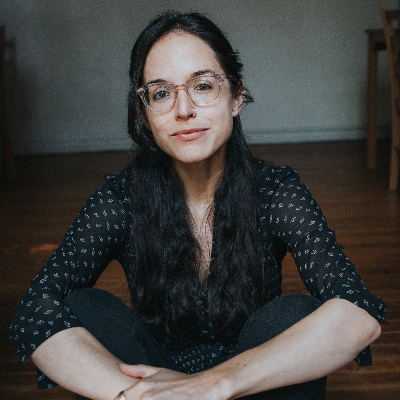
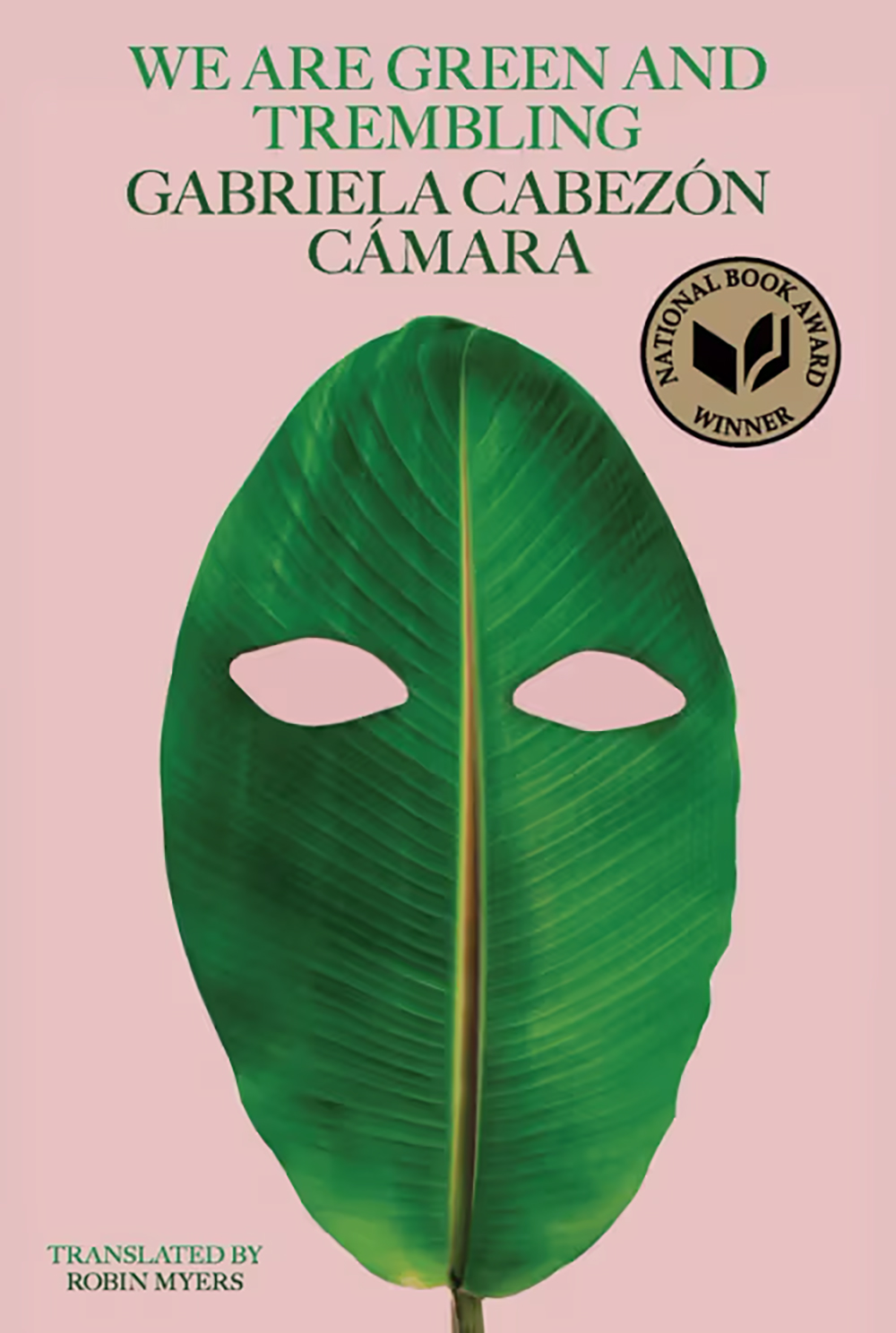
WINNER OF THE 2025 NATIONAL BOOK AWARD IN TRANSLATED LITERATURE
Deep in the wilds of the New World, Antonio de Erauso begins to write a letter to his aunt, the prioress of the Basque convent he escaped as a young girl. Since fleeing a dead-end life as a nun, he’s become Antonio and undertaken monumental adventures: he has been a cabin boy, mule driver, shopkeeper, soldier, and conquistador. Now, caring for two Guaraní girls he rescued from enslavement and hounded by the army he deserted, this protean protagonist contemplates one more metamorphosis.
Based on a real figure of the Spanish conquest, We Are Green and Trembling is a queer baroque satire, a surreal picaresque rich with wildly imaginative language and searing critique of subjugation, colonialism, and tyranny of all kinds. In this masterful subversion of Latin American history, Cabezón Cámara finds in the rainforest a magically alive space where transformation is not only possible but necessary. Lyrical and swashbuckling, tender and surreal, Cabezón Cámara’s new novel sees glimmers of hope for the future amidst a brutal history of colonization.
Mere days have passed, little more than hours, since he started pondering the letter to his aunt. But he’s immersed in the tale, as if everything he’s ever done has been for the specific purpose of telling her about it. He scarcely notices his own penmanship. A slow and laborious scrawling. He’s almost forgotten his promise, he wants the letter to arrive. Wants his aunt to read it. Wants her to know this about him, to know this life that somehow became his own. He rests the quill in the ink, his back against the tree. He crushes a tiger ant before it bites him. Barely aware. Shuts his eyes in meditation. What he writes both is his life and isn’t. It’s not that he’s lying. Though how couldn’t he be. He’s traveling through it once again. He chooses, of course, which parts of those days that were his to set down in the letter. Not all of it fits. And—this plunges him into perplexity—the account contains much of what hadn’t fit there while it was still happening. Or something like that, none of this quite makes sense to him yet. He writes aloud to the prioress:
“How do we experience something that was there, but remained unseen? Is it part of our life? What we allow to pass us by as if it had not existed? What we glimpse today for the first time but which transpired some forty years ago; did we indeed live it at all? Is it true, what I’m telling you now?”
He stops. Hears whispers. His skin bristles like fur. He doesn’t even think. He’s already standing, sword in hand. Body seized by lightning. All the air inside. The girls! He glances up. They’re still there. Mitãkuña points a finger down. Their two small heads peek out. He releases the air he’d gathered as if he were about to leap into the river. The sword drops too. He climbs. The monkeys scale his shoulders all by themselves. Not the girls. He descends. Spreads the cape by the fire. Arranges all the creatures there. Asks them to be still. Mitãkuña says yes. And keeps speaking. Saying what, Antonio doesn’t know. Or to whom. Maybe it’s a song. It is. A lullaby it seems. Mba’érepa? Mba’érepa? Michī joins the tune. A little drum. A rhythm. Antonio says he’s going off in search of fruit and water. He ought to tie them up. If they escaped, even a toothless jaguar cub could eat them. The fire deepens their hollows, marking the volume of their little bones, the sunken grooves under their eyes, their ashen skin. They’re not going anywhere. The monkeys leap, getting stronger. Into a tree that looks more like a bush, short and squat, croaking as with a thousand throats. Packed with toucans eating. The largest macaw drops a fruit to his feet. He tastes it. Sweet, acidic. Almost like a good orange. He picks some and doesn’t care that the birds shit straight onto his head. It doesn’t smell bad, toucan shit; it has a metallic, blue-black gleam. The ballrooms will have to wait. For now, food. He chews a bit for Michī. Will the mare want to nurse them? Mitãkuña says that the fruits are called ubajay and she doesn’t like them. But she eats anyway, the corners of her lips tugging toward her neck. At once he feels their rhythmic breathing. All is calm. He eats some fruit himself. Red curls up between his knees. And he picks up the quill.
You told me of the Admiral, my aunt, of how Christopher Columbus had sailed from Sanlúcar, of caravels like walnut shells, of how he’d wished to travel to one place but found himself in quite another, and founded a world there, of the Indians who sailed on rafts cut from the bases of trees, marvelously carved, you said. In your cell you told me of that other world, and you filled it with lords, with ships, with Indians, with strange lands, though all lands were strange to me save those of the convent, as they were to you, my dear. I was your little girl and you let your mind roam and led me into your American daydreams, with all those souls awaiting conversion to the one true faith, and in that moment I had no knowledge of it, but the thirst for world was growing in me, the thirst to leave that place, to meet those innocent people who gifted skeins of spun cotton and parrots to the admiral. Oh, parrots, a thing of beauty, if you could see them you would also see that the colors here are alive, made of flesh and feather, humming blues, shrilling reds, yellows, greens. And they also brought spears to Columbus, who gave them glass beads and bells in return, watching meanwhile for gold, and he saw that some wore a bit of it strung from a hole in their nose, and communicating with gestures he came to learn that in the South was a king with great cups of it. He embarked in search of gold, and said— our Portuguese, our Jewish, our Italian admiral of the Spanish imperial armada—that the island was very large and very flat and very green with trees and wet with many waters and an enormous lake in the middle, all without a single mountain, all green, a delight to look upon, and its inhabitants meek. The girl I was heard your words and begged you to repeat them until I learned them by heart, so I could remember them as needed, and I lost myself in ships, saw myself sailing away, my hair streaming like gentle waves, spreading over your prioress skirts, yearning for seas, becoming sea myself with sheer desire to melt into the cracks of the convent floors and go where water forever goes, which is toward water, have you noticed that water is apportioned into parts that are sometimes vast and sometimes very small, but that they always like to gather together?
“Hey, che.”
“What?”
“Tell me about the lady.”
“What lady, Mitãkuña?”
“The one called Virgin, che.”
“She is the mother of the Lord Our God.”
“Who is God? And his papa?”
“The papa of God is God.”
“And the mama is the Lady, Yvypo Amboae?”
“Mba’érepa?”
“Because she carried him in her womb and then gave birth to him. As mothers do.”
“Mba’érepa?”
“Because God chose her, Michī.”
“Who is God, che?”
“He who created the heavens and the earth.”
“No.”
“Yes.”
“And he had a mitã with his same name, che?”
“What is a mitã?”
“You know nothing, che. A baby.”
“Yes. No. The baby is Himself but incarnate.”
“I do not understand.”
“Mitãkuña, time for sleep.”
…Have you noticed that water is apportioned into parts that are sometimes vast and sometimes very small, but that the parts always like to gather together?
Water wants water and my soul longed to wander, dear aunt, and that is how I imagined a life lived far from the convent, far from the mournful discipline of dawns on my knees, of the endless, funereal lists of sins, and the brief lists of virtues for a woman, briefer for novices and briefer still for professed nuns; to obey and desire Jesus Christ alone. I did not profess, as well you know. Forgive me, aunt. I had an epiphany, a revelation, I felt the call and could not resist it, for no one can, my dear. I would not be a prisoner of the convent, or of anything else. I left. I had yearned to be a sailor but never, never, never did I know that such a thing could be, and the will for what cannot be ends up paining the flesh, and this pain was fierce; I felt it in my bones, in my muscles stiff from confinement, in the eyes I was obliged to lower, in my hands, bound as they had been. The pain kept me still and quiet until your keys pressed themselves on my eyes and heart and entire body, as the ground presses itself on what falls, and I felt my own little root snap inside, and I did not doubt, could not doubt, I knew of neither good nor evil, I did not ask myself if it was a sin, an affront against the Lord My God, against your good love, against my own soul; if I would later burn not merely in Hell but also in the bonfires of the Holy Inquisition. My body glimpsed the door and departed like the shoot of the walnut through the damp notch we made there. I spent three days and three nights in our Donostian woods, next to the convent you ruled almost with innocence—for our family ruled; does it still?—you must still rule with the ease of a cause on an effect. My family was a cause and I knew I would be no prisoner, just as you knew your lot and never doubted it, just as those in power do; just as it is known that thunder follows lightning. Such knowledge is given to the triumphant: the king and the Pope know and governors know, too. The others doubt their various doubts. Malleable on occasions and on others like an iron shackle.
Those who flee also know as if they ruled, because they rule themselves; if they doubted, they would not flee. Have you seen that those who leave because they simply yearn to leave are certain as well? The sureness of a compass, whose north is nothing but its distance from wherever it began, that’s how it is, and was. And will be. And so forth every time since then. I knew I would be no prisoner, I would sooner be a hunter, and I returned to the world I nonetheless did not know; I was summoned by the air of the woods, the horses whose hooves I once heard clopping from inside the convent, the voices of the outside, the metallic clanging of swords, the heavy footfall of men. Your sweet voice telling me tales of another world. The strength of my legs driving me to walk. Yet I had been afraid for years. Until you, my aunt, my family, everything I loved, sent me to fetch your breviary for matins, and I glimpsed the great key, long as my hand and forearm, like a knife, dark and ferrous and heavy, forged for the ruthless doors of our convent, and I felt as if it had opened me, as if my own doors—and I was a cold, secluded cell—had been flung open, and the sun had shone in, and who would ever close such doors and confine themselves to the dark again?
I did not hesitate; I seized a needle and thread, seized some shears, seized four lengths of cloth, and oh, eleven coins, because the apostles were twelve, but no one wants a traitor in their midst. I left forever. I was afraid, it was the dead of night, I could not remember having ever tread any ground but the gray stones and leafy earth of the convent gardens; yet my legs were not afraid and led me forth. Neither were my hands afraid, my dear, they took what could be taken, and opened what must be opened for me to go, and my body ran to the woods like a fawn when the eyes of the tiger rest, at last, on the hide of another beast, or on the flight of an insect, or on the river. And no, I knew nigh nothing of anything, I was innocent as a caged beast; if the cage opens it emerges, aunt, and what is there to know.
“Hey, che, tell us who is God. How did he make sky and earth?”
“I will tell you, Mitãkuña, if you promise to sleep when I have finished.”
“All right.”
“Nahániri.”
“Promise me or nothing, Michī.”
“I promise for her. She sleeps no matter what, che. Sing to us, you, sing us that song.”
“Very well, I will sing. It goes like this.”
In the beginning God
Made all the earth and heavens.
But they were mixed together,
A gaping chasm covered
Entirely with darkness.
And there was also water.
The spirit of this God
Flew over from the East.
Yet he saw nothing there.
Let there be light, he said:
Now fiat lux! Fiat lux!
Fiat lux! Now fiat lux!
With his creating word—
“Nahániri.”
“Tell her to be still or no more singing.”
“Ekirirī, Michī, che.”
With his creating word
Now there was light and God
Could see that it was good.
And so he called it Day
And called the darkness Night.
And so the first day went.
Now fiat lux! Fiat lux!
Fiat lux! Now fiat lux!
“Nde japu is what you say. Lies.”
“You must sleep. Go to sleep, Mitãkuña.”
“Tell the truth, che.”
“What truth?”
“Your God, what did he eat?”
“Nothing. God needs nothing. He is not hungry. Or sleepy. He is never tired.”
“Mba’érepa?”
“Nde japu, che.”
“It’s not a lie. I will tell you what God ate if you promise to sleep.”
“What foods did he eat?”
“He ate clouds. And from his mouth he spat out the light. And with his farts, the darkness.”
“Heeheehee. Nde japu, che.”
“I swear it is the truth, Mitãkuña. Now sleep. Look, I will show you more of the darkness.”
He lets out a colossal fart. The girls cover their noses with their hands and uncover them, shrieking with laughter. The monkeys dart into the trees. The horses snort. Red, satisfied with her portion of jerky, doesn’t even stir. They reconvene. The monkeys return with fruits that look like artichokes. With a sweet taste somewhere between pineapple and banana.
“Hey, che, these are your oranges?”
“You know they are not.”
“And where are your oranges?”
“In Spain.”
“Chirimoyas, these.”
“Very well.”
The insects hush their drone. Each and every animal living in the green tapestry of the boundless jungle and the trees and the vines and the flowers and the mushrooms and the mosses too go quiet. The tatiná, the cloud that rises up from the river to crown the trees and dampen everything, halts as well. It’s the time of day when all is peace. When even the tides conclude and nothing kills or dies. Except for the new men, but even they sometimes forget their own novelty. And they sigh, their gazes lingering on something unknown to them.
Translated by Robin Myers
Chapter 5 from We Are Green and Trembling by Gabriela Cabezón Cámara, translated by Robin Myers, copyright © 2023 by Gabriela Cabezón Cámara,
translation copyright © 2025 by Robin Myers. Reprinted by permission of New Directions Publishing Corp.
We Are Green and Trembling is available now from New Directions Publishing.
Buy books by the authors and translators featured in this issue on our Bookshop page!